Why Do We Clap?
Based on Vsauce's video on YouTube. If you like this content, support the original creators by watching, liking and subscribing to their content.
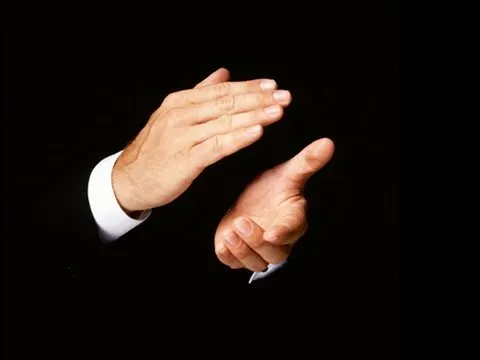
Clapping is a fast, percussive reflex that converts hand kinetic energy into acoustic energy, with major frequency content around 2200–2800 hertz.
Briefing
Clapping is both a biological reflex and a social technology: hands meet to vent excitement, then get trained—sometimes pressured—into a shared ritual that can spread beyond the individual into “one voice” crowds. The physical act is fast and noisy rather than musical: people clap at roughly 2.5–5 claps per second, converting the kinetic energy of moving hands into acoustic energy concentrated around 2200–2800 hertz, with many other frequencies produced too. Because those frequency components don’t line up as clean whole-number multiples, a clap lacks a definite pitch like a piano note or a clarinet tone—so the question becomes less “how can it sound musical?” and more “why does this messy sound work so well for humans?”
At the physiological level, clapping is framed as an impulse tied to overflowing enthusiasm—an immediate, primitive reaction to excitement that doesn’t require language or vocal control. Yet the behavior doesn’t stay purely personal. Over time, clapping becomes “coded” into etiquette, turning into an expected group response that people may feel compelled to perform even when they’d rather not. Historical accounts add weight to that idea: Desmond Morris likens modern clapping to patting a performer from a distance, while other metaphors treat it like congratulating oneself for someone else’s success. But a stronger driver may be the crowd itself. Research in the Journal of the Royal Society suggests an individual’s contribution to applause depends less on personal judgment of performance quality and more on the behavior of the surrounding collective—an anonymous group voice that can pull people along.
Clapping also functions as a social equalizer. Unlike vocalizations, listeners can’t reliably infer whether a clap comes from a man or a woman, nor can they estimate a person’s size from the sound alone. That makes clapping an unusually democratic signal of approval: it’s loud, easy, and doesn’t require special skills or props. It also avoids the disruption of alternatives like stomping or waving large objects, and performers can’t easily counter it with a thumbs-up or wink.
History shows authorities actively shaping the ritual. In 6th century BC Greece, Cleisthenes—credited with democratic reforms—encouraged behaviors like clapping as a civic duty, letting crowds greet leaders together as one synchronized sound. By the early 19th century, professional “claques” were hired to attend performances and clap, cry, or laugh at the right moments so real audiences would follow the cues. Even childhood learning reflects this: babies naturally discover that hands can work together, but parenting guidance often has to teach children to connect clapping with group celebration.
The future angle shifts from physical applause to scalable substitutes. As recorded music and digital media expand, people increasingly consume entertainment alone—an era described as “cocooning” by Faith Popcorn. In that setting, applause doesn’t vanish; it mutates into likes, favorites, shares, and retweets. Those actions can act like “digital applause,” sometimes traceable back to the individual rather than swallowed by a crowd. The result is ambiguous: it could feel like a hollow replacement for real togetherness, or it could be a natural evolution—more applause-worthy moments available than any person can clap for, leading to reactions that are easier to trigger, easier to scale, and potentially more personal. Either way, the core pattern remains: humans keep finding ways to turn excitement into collective signals—even when the crowd moves online.
Cornell Notes
Clapping begins as a bodily reflex tied to excitement, but it becomes a social ritual that spreads through groups. The sound is physically messy and not pitched: claps occur about 2.5–5 times per second and generate energy concentrated around 2200–2800 hertz, with many other frequencies that don’t form a clear musical note. Research in the Journal of the Royal Society links how much someone claps to the crowd’s behavior more than to personal opinion about performance quality. Historically, clapping was actively encouraged—from Cleisthenes’ civic duty in ancient Greece to hired “claques” in the 19th century—showing how etiquette can be imposed. In today’s cocooning era, applause may shift into digital equivalents like likes and retweets, which can preserve a sense of participation while changing how “the crowd” is experienced.
Why can’t a clap produce a clear musical pitch like a piano note?
What evidence suggests applause is driven more by the crowd than by individual judgment?
How does clapping function as an “equalizer” compared with vocalizations?
How did authorities historically turn clapping into expected behavior?
What changes when applause moves online in the cocooning era?
Review Questions
- What physical properties of a clap prevent it from having a definite pitch?
- How does the Journal of the Royal Society finding change the way you think about why people clap during performances?
- In what ways might digital applause (likes/retweets) preserve or alter the social function of clapping?
Key Points
- 1
Clapping is a fast, percussive reflex that converts hand kinetic energy into acoustic energy, with major frequency content around 2200–2800 hertz.
- 2
A clap usually lacks a definite musical pitch because its frequency components don’t align as clean whole-number multiples.
- 3
Applause can be shaped more by crowd behavior than by an individual’s personal evaluation of performance quality.
- 4
Clapping’s sound is relatively anonymous, making it a democratic signal compared with vocalizations that reveal more about the speaker.
- 5
Historical authorities helped institutionalize clapping through civic rules and hired “claques” that modeled when audiences should react.
- 6
In a cocooning media environment, applause increasingly shifts into scalable digital gestures like likes and retweets, which can be both collective and traceable to individuals.