Why Do Wind Turbines Have Three Blades?
Based on minutephysics's video on YouTube. If you like this content, support the original creators by watching, liking and subscribing to their content.
Three blades hit an efficiency peak because torque gains from more blades are offset by rapidly increasing drag at higher spin rates, making intermediate speeds optimal.
Briefing
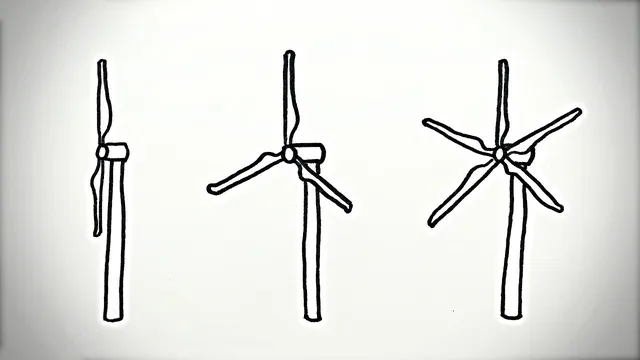
Most modern wind turbines use three blades because that configuration hits a rare balance: strong performance across real operating conditions, better mechanical stability, and a sound/visual profile people are more likely to accept. Physics points to three blades as the efficiency sweet spot. Adding blades can increase the torque a rotor produces, but it also increases drag because each blade must cut through the wind. Drag rises quickly as the rotor spins faster relative to wind speed, so many-bladed designs tend to work best at lower rotational speeds, while fewer-bladed designs can perform better at higher speeds. When efficiency is plotted against the rotor’s spin rate relative to wind, the best overall efficiency occurs at intermediate speeds—corresponding to three blades. A one-blade rotor favors high-speed operation, and a five-blade rotor favors low-speed operation, but the peak of the efficiency curve lands at three.
Efficiency alone doesn’t decide blade count, though. Wind turbines must survive constant bending, twisting, and vibration loads from gusts and changing wind angles. Even-numbered blade rotors can create problematic unbalanced forces when the blades line up with or oppose the tower’s pole—conditions that can generate large twisting moments that push the tower forward/backward or twist it side to side. A two-blade rotor is especially prone to this kind of imbalance, and a single-blade rotor is even worse because it lacks a paired blade to counter unequal wind loading. Odd-numbered rotors—three, five, and so on—avoid that pairing symmetry, distributing wind loads more evenly across the rotor face and reducing bending and twisting forces. That means towers, hubs, and blades can be built with less extreme robustness at the same cost. There’s also a wear-and-tear tradeoff: rotors with more blades generally spin more slowly, so moving parts experience less stress over time.
The third driver is human comfort, which matters because wind farms must fit into communities. Three-blade rotors are widely viewed as more visually pleasing than two-blade equivalents. A two-blade rotor’s silhouette swings between mostly horizontal and mostly vertical orientations, which can look choppy, while a three-blade rotor’s horizontal and vertical footprint changes only slightly over time. Noise adds another constraint. Wind turbines are noisy largely because of turbulence as blades slice through air; slower rotors tend to be quieter. Since three-blade rotors can reach comparable or better efficiency at slower rotational speeds than two-blade designs, they can operate more quietly for a given wind speed—though they are not silent.
Taken together, three blades emerge as a practical compromise: physics favors the efficiency peak, engineering favors reduced load imbalance and lower wear at comparable cost, and community-facing design favors smoother motion and quieter operation. The result is a rotor that performs well, lasts longer, and is easier for people to live with—an unglamorous but decisive combination for why three blades became the default.
Cornell Notes
Three-blade wind turbines dominate because they balance three competing constraints. In physics terms, more blades increase torque but also increase drag, and efficiency peaks at intermediate rotor speeds—where three blades perform best. Engineering adds that odd blade counts distribute wind loads more evenly, reducing bending and twisting forces that can otherwise stress towers and hubs; even-numbered rotors can create unbalanced twisting when blades align with the tower. Slower operation for multi-blade designs also reduces wear on moving parts. Human factors matter too: three blades look more symmetric and tend to run at slower speeds for similar efficiency, which helps keep noise lower than two-blade designs.
Why does adding blades increase both torque and drag, and how does that affect efficiency?
What mechanical problem can even-numbered blade rotors face?
How do odd-numbered blade rotors reduce bending and twisting loads?
How does blade count influence wear and tear over time?
Why do three blades tend to be preferred for visual appearance and noise?
Review Questions
- On an efficiency curve plotted against rotor spin rate relative to wind speed, why does the maximum efficiency correspond to three blades rather than one or five?
- Describe a specific wind-load scenario where a two-blade rotor can create unbalanced twisting forces, and explain why an odd number of blades mitigates that issue.
- How do visual symmetry and noise generation mechanisms influence community acceptance of wind turbines, and why does three-blade geometry help on both fronts?
Key Points
- 1
Three blades hit an efficiency peak because torque gains from more blades are offset by rapidly increasing drag at higher spin rates, making intermediate speeds optimal.
- 2
Even-numbered blade rotors can create unbalanced twisting forces when blades align with or oppose the tower pole, stressing the structure.
- 3
Odd-numbered rotors distribute wind loads more evenly across the rotor face, reducing bending and twisting moments.
- 4
More blades usually mean slower rotation, which reduces wear on moving parts over time.
- 5
Three-blade rotors are generally more visually pleasing than two-blade rotors because their silhouette changes less abruptly over time.
- 6
Wind noise is driven mainly by turbulence from blades cutting through air; slower operation tends to reduce noise, and three-blade designs can run slower for similar efficiency.
- 7
Cost remains a constraint: adding blades beyond three can improve some mechanical and wear characteristics but increases material and build expenses.