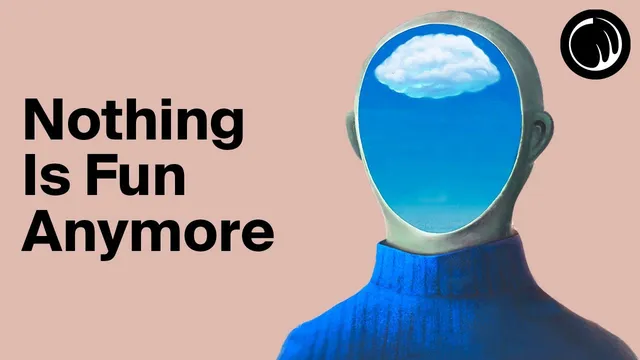
Why Does It Feel Like Nothing Is Fun Anymore?
Based on Pursuit of Wonder's video on YouTube. If you like this content, support the original creators by watching, liking and subscribing to their content.
Many people lose joy because expectations about control and acceptance harden over time, making small disappointments feel like an endless drain.
Briefing
People often stop feeling joy not because life becomes objectively worse, but because expectations harden into a worldview where small disappointments pile up into exhaustion, cynicism, and numbness. Over time, many trade the playfulness of childhood for a “promise land” of achievement and solemnity—an exchange driven by the belief that love and acceptance depend on performance. When that bargain meets unfair treatment, repeated setbacks, and the slow grind of adulthood, the result is a hardened self: less curious, more defensive, and increasingly convinced that nothing will feel light again.
A key thread runs through the argument: bitterness and loss of joy come less from external conditions than from perception—especially the hopes and optimism that were wired in early. The same optimism that once made childhood feel magical can become a trap when it turns into the expectation that life should remain resolvable if one does everything “right.” As days rush by, questions multiply, and demands arrive with little relief, people begin to recognize the very adults they once mocked. The paradox is that the very belief in controllability—life will eventually smooth out—can intensify disappointment when reality refuses to cooperate.
The proposed antidote is not naive positivity but a deliberate loosening of that controlling optimism. Letting go of the fantasy that trivialities and tragedies will subside is framed as a path back toward something like child-like joy. Multiple philosophies are invoked to support this shift: Taoism’s insistence that the world can’t be forced to match desire (as in Lao Tzu’s Tao Te Ching), Stoic and Buddhist themes of accepting what can’t be changed, and philosophical pessimism. Albert Camus’s idea of the “absurd” is used to explain the emotional mismatch: humans crave ultimate meaning and reason, while the universe offers “unreasonable silence.” The absurd arises from the relationship between human longing and the world’s indifference—not from either side alone.
Yet the argument doesn’t land on resignation. Camus is cited for the possibility that the absurd can still hold passion and beauty if it’s met with a different way of seeing. Friedrich Nietzsche is brought in to emphasize learning to find beauty in what is necessary, refusing to wage war on ugliness, and aiming to become a “Yes-sayer.” Even annoyance and the mundane are treated as raw material for meaning rather than proof that life is broken.
At the same time, negative emotions aren’t dismissed as pathology. Anger can be reasonable when boundaries are violated or preventable harm occurs; skepticism can protect people from exploitation; responsibility and goals still matter. The balancing point is to keep seriousness without clinging so tightly that life collapses into futility. The ultimate warning is against becoming the person one never wanted to be—hardened by protection so thoroughly that one loses oneself. The takeaway is practical and psychological: change what’s conscious in one’s thinking, accept the uncontrollable, and keep choosing curiosity and laughter over scoffing.
The closing pitch ties the philosophy to a tool: a guided journal called “All the Ways Things Could Go,” built around prompts meant to surface unconscious patterns and clarify personal values. One example prompt—writing an obituary—is described as a way to view oneself from a future vantage point, forcing attention onto what truly matters once achievements and distractions fall away.
Cornell Notes
Joy often disappears when childhood expectations about control and acceptance harden into a belief that life should become “solvable” through the right achievements. Small frustrations then accumulate into a swarm of trivialities that feel like they can kill faster than major disasters, producing cynicism and numbness. The argument shifts blame from external events to perception: disappointment grows from the clash between what people hope for and what reality allows. Letting go of controlling optimism—while still keeping responsibility and healthy boundaries—can reopen the possibility of seeing beauty in the mundane and even in annoyance. Philosophical frameworks like Taoism, Camus’s “absurd,” and Nietzsche’s “Yes-saying” support the idea that acceptance and a changed lens can restore passion without denying life’s difficulty.
Why does the loss of fun get framed as a perception problem rather than a simple “life got worse” story?
How does early optimism become a source of later bitterness?
What does “letting go of optimism” mean in this argument?
How do Taoism, Camus, and Nietzsche support the proposed shift in mindset?
Why are negative emotions treated as potentially healthy rather than automatically harmful?
What role does the guided journal play in the overall approach?
Review Questions
- What specific belief about control and acceptance is described as turning optimism into disappointment over time?
- How does the concept of the “absurd” explain the emotional gap between human longing and reality?
- What does “loosening the grip” mean here, and how is it different from giving up or becoming indifferent?
Key Points
- 1
Many people lose joy because expectations about control and acceptance harden over time, making small disappointments feel like an endless drain.
- 2
Childhood playfulness is often traded for achievement and solemnity after learning that love and acceptance depend on performance.
- 3
Bitterness and cynicism are linked to perception—especially the mismatch between what people hope life will be and what reality actually delivers.
- 4
Letting go of controlling optimism means releasing the fantasy that life will become fully resolvable if one does everything “right.”
- 5
Philosophical acceptance (Taoism, Stoicism/Buddhism themes, Camus’s “absurd,” Nietzsche’s “Yes-saying”) is used to justify finding beauty and passion even in the mundane.
- 6
Negative emotions can be healthy when they signal preventable harm, boundary violations, or the need for skepticism and responsibility.
- 7
The recommended practice is to make unconscious thought patterns conscious, using tools like guided prompts to clarify values and shift perspective.