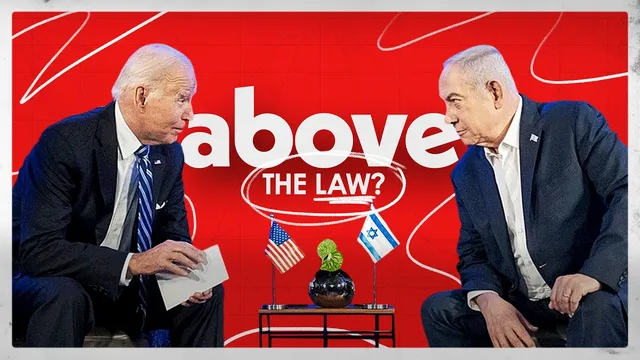
Why Doesn’t International Law Apply to the West?
Based on Second Thought's video on YouTube. If you like this content, support the original creators by watching, liking and subscribing to their content.
The ICC’s warrant efforts against Benjamin Netanyahu and Yoav Gallant are presented as a direct test of whether international law can reach U.S.-backed allies.
Briefing
A new push for International Criminal Court (ICC) arrest warrants against Israeli leaders has reignited a central question: if the United States can shield allies from international legal consequences, what purpose do international law and courts actually serve? In May, the ICC’s lead prosecutor sought arrest warrants for Benjamin Netanyahu and Yoav Gallant over alleged war crimes and crimes against humanity tied to the war in Gaza—claims that include mass civilian harm, attacks on medical personnel and journalists, the use of internationally banned white phosphorus, and repeated strikes on areas described as “safe zones.” The ICC also sought warrants for Hamas leadership, but the U.S. response has been blunt: House Speaker Mike Johnson said the U.S. “refuses” to allow “international bureaucrats” to issue warrants for “false crimes,” while President Joe Biden publicly denied genocide in remarks from the Rose Garden.
The transcript frames this as more than a dispute over one conflict. It argues that Western power routinely treats international law as conditional—invoked when it aligns with geopolitical interests and ignored when it threatens allies. The U.S. and its partners, it says, have repeatedly denied accountability even when violations are widely documented, including U.S. actions in Vietnam (such as the My Lai massacre, Agent Orange/defoliant use, and large-scale bombing and operations with heavy civilian tolls) and later wars in Afghanistan and Iraq, plus drone campaigns in Pakistan, Yemen, and Somalia. The pattern, according to the account, is selective enforcement: the ICC has pursued cases heavily concentrated on African leaders—naming Sudan’s Omar Al Bashir, Kenya’s William Ruto, and Uganda’s Joseph Kony—while cases involving Western leaders or close allies remain absent.
That selectivity is linked to structural constraints. The ICC lacks its own enforcement arm and depends on states to arrest suspects and provide evidence, leaving it vulnerable to non-cooperation. The transcript points to Article 98 of the Rome Statute, which can be used to prevent surrender requests that would conflict with a state’s international obligations, including bilateral immunity arrangements. It also highlights the UN Security Council’s veto power—held by the U.S., UK, France, Russia, and China—as a mechanism that can block referrals or actions that threaten major powers’ interests. Beyond formal vetoes, it adds that economic and diplomatic leverage can pressure other countries and institutions to avoid supporting ICC moves.
The transcript’s bottom line is that the ICC’s legitimacy is undermined when powerful states can refuse cooperation, block referrals, and insulate their personnel—making international law function less like a neutral system of justice and more like a tool for maintaining a Western-dominated order. In that view, the current case will not deliver accountability for U.S.-backed Israeli actions, not because the crimes are unprovable, but because the political architecture surrounding enforcement makes consequences unlikely. The result is a bleak conclusion: as long as the U.S. and allies evade accountability, “true justice” remains unfulfilled.
Cornell Notes
The transcript argues that international law—especially through the ICC—does not apply evenly because enforcement depends on political power. It describes ICC arrest-warrant efforts tied to the Gaza war, then contrasts the U.S. refusal to accept those warrants with the claim that U.S. allies are effectively insulated from consequences. It links this to structural limits: the ICC has no independent police force, relies on state cooperation, and can be blocked through UN Security Council vetoes and legal provisions like Article 98. The account also points to a history of selective ICC focus on African leaders while Western-aligned actors face far fewer cases. The practical takeaway is that international institutions may offer legitimacy, but they struggle to deliver equal justice when major powers choose not to comply.
Why does the transcript treat the ICC’s Gaza-related warrants as a test of whether international law is real?
What structural reasons does the transcript give for why the ICC can’t force compliance?
How does the transcript explain “selective” ICC enforcement?
What examples does the transcript use to argue the U.S. has repeatedly evaded accountability for war crimes?
What does the transcript suggest is the real purpose of international legal institutions under U.S.-led power?
Review Questions
- What enforcement mechanisms does the transcript say the ICC lacks, and how does that affect outcomes?
- How does the transcript connect UN Security Council veto power to the likelihood of prosecutions against major powers’ allies?
- Which historical examples does the transcript use to support the claim that U.S. war crimes go unpunished, and what pattern does it infer from them?
Key Points
- 1
The ICC’s warrant efforts against Benjamin Netanyahu and Yoav Gallant are presented as a direct test of whether international law can reach U.S.-backed allies.
- 2
The transcript argues the U.S. can block or neutralize ICC consequences through refusal to cooperate and political pressure.
- 3
Selective enforcement is attributed to both structural limits (no independent enforcement, reliance on state cooperation) and political veto power at the UN Security Council.
- 4
Article 98 of the Rome Statute is cited as a legal pathway used to secure immunity arrangements that prevent surrender requests.
- 5
The transcript claims the ICC has focused heavily on African leaders while Western-aligned actors face far fewer comparable cases.
- 6
Historical examples—especially U.S. actions in Vietnam and later conflicts—are used to argue that documented war crimes often result in little accountability.
- 7
The overall conclusion is that international institutions struggle to deliver equal justice when major powers choose not to comply.