Why Don’t Railroads Need Expansion Joints?
Based on Veritasium's video on YouTube. If you like this content, support the original creators by watching, liking and subscribing to their content.
Rail gaps were historically used to accommodate seasonal expansion and contraction, preventing buckling and derailment risk.
Briefing
Railroads don’t rely on expansion joints because the track system already has a built-in way to handle thermal expansion: sleepers and ballast convert summer heat into compressive stress rather than letting the rail physically buckle. The key insight is that rail length changes can be managed both thermally (hot rail wants to expand) and mechanically (external forces can shorten or lengthen the rail elastically). When those two effects are balanced, the rail can expand “into” stress while remaining structurally stable—so derailment risk from buckling stays low.
Early railroad construction used long steel rails—about 12 meters—bolted together with fish plates, leaving gaps that produced the familiar “ta-tak” sound. Those gaps weren’t a design flaw; they were a safety valve. Cold weather shrinks the rail and heat makes it grow, and a 40°C temperature swing over a 12-meter length can mean roughly a 6-millimeter increase. Without gaps, engineers feared kilometers of track could expand and buckle, creating a worst-case scenario: derailments. The longer the rail segment, the larger the gap problem; the idea of welding everything into an “infinite rail” sounded like it would create an infinite expansion problem.
That concern is addressed in practice through continuously welded rail and a track foundation that restrains motion. As temperature rises, the rail’s thermal expansion is countered by mechanical compression from the sleepers and ballast, which pin and lock the rail in place. The rail then expands laterally and upward where it’s unconstrained, while compressive stress builds in the constrained direction. Railroads also choose a high neutral temperature so winter shrinkage doesn’t crack the rail under tension—cracking is typically easier to detect than buckling.
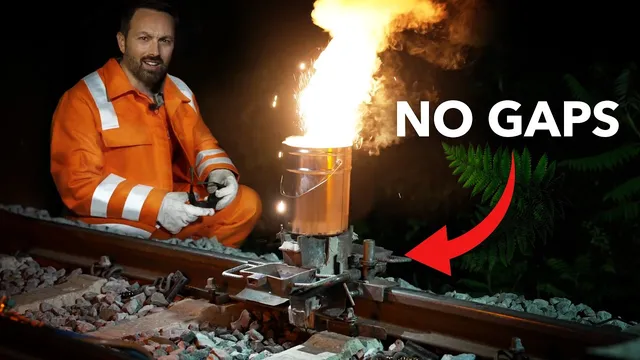
The rest of the material focuses on how welded rail is actually made using thermite, and why the weld must be robust under real-world conditions. In the field, crews cut a gap (about 2.5 cm) into touching rails, align them vertically and horizontally, and even correct for twist within a tight tolerance of about 2 millimeters at the foot. They clamp molds and preheat the rail to drive off moisture and volatiles and to control heat transfer, since molten steel would cool too quickly if both ends weren’t hot enough.
Thermite ignition produces molten steel plus molten aluminum oxide slag. The molten steel fills the mold first; the lighter slag floats and exits separately, reducing the chance of slag contamination. After cooling, crews remove single-use molds, shear off excess steel with a weld shear capable of up to 20 tons, then grind the weld flush—leaving no bumps and no indents.
Quality control then turns microscopic: acid etching reveals distinct zones, including a heat-affected zone that becomes the weakest link in hardness and yield. Weld strength is validated by bending tests on welded rail sections until failure, with cracks often propagating from the bottom upward under load. With roughly 2 million thermite welds performed annually—about half using Goldschmidt’s thermite—rail systems rely on both precise welding and the mechanical-stress strategy that replaces expansion joints with controlled stress management.
Cornell Notes
Railroads avoid expansion joints because continuously welded rail can handle temperature-driven length changes through mechanical restraint. As rails heat and want to expand, sleepers and ballast prevent free movement, turning thermal expansion into compressive stress rather than buckling. Track design also uses a high neutral temperature so winter shrinkage doesn’t crack rails under tension, and cracking is easier to detect than buckling. Thermite welding enables long welded segments, but welds must be aligned precisely, preheated correctly, and ground flush. Metallurgy matters too: the heat-affected zone typically ends up as the weakest region, so welds are tested by bending until failure.
Why did early railroads leave gaps between rails, and what problem were those gaps meant to solve?
What makes expansion joints unnecessary in modern continuously welded rail?
How do crews using thermite welding prepare rails so the weld forms a seamless, strong connection?
Why is preheating critical before igniting thermite?
What happens inside the thermite reaction, and how do slag and steel separate?
Where does weld weakness tend to concentrate, and how is weld strength verified?
Review Questions
- How do sleepers and ballast convert thermal expansion into compressive stress, and why does that prevent buckling?
- What alignment errors (vertical, horizontal, twist) most threaten a thermite weld’s integrity, and how are they detected?
- Why does the heat-affected zone often end up weaker than the fully melted thermite steel?
Key Points
- 1
Rail gaps were historically used to accommodate seasonal expansion and contraction, preventing buckling and derailment risk.
- 2
Continuously welded rail avoids expansion joints by balancing thermal expansion with mechanical restraint from sleepers and ballast.
- 3
Railroads choose a high neutral temperature to reduce the chance of winter cracking under tension, since cracking is easier to detect than buckling.
- 4
Thermite rail welding demands tight alignment (including twist control within about 2 millimeters) and careful vertical/horizontal positioning to account for contraction during cooling.
- 5
Preheating is essential to remove volatiles that cause bubbles and to manage heat transfer so molten steel doesn’t cool too fast.
- 6
Thermite produces molten steel plus aluminum oxide slag; slag floats due to lower density and is routed away to reduce contamination.
- 7
Weld performance depends on metallurgy: the heat-affected zone typically has the lowest hardness and yield, so bending tests confirm strength and failure location.