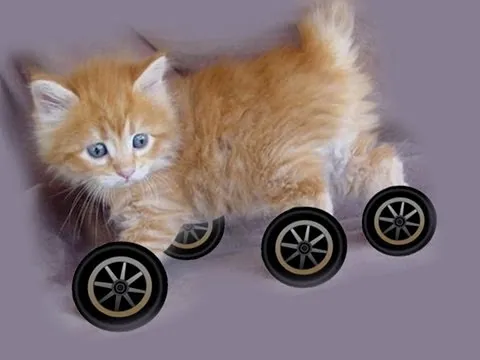
Why Don't Any Animals Have Wheels?
Based on Vsauce's video on YouTube. If you like this content, support the original creators by watching, liking and subscribing to their content.
A wheel is treated as a system: a wheel on an axle that can spin indefinitely while remaining functionally integrated with the body.
Briefing
No animals have wheels because the “wheel” isn’t just a shape—it’s a system that requires biology to grow a detachable, self-sustaining rolling component and a world built to support it. Nature does produce wheel-like motion in a few cases, but those examples don’t match the core engineering idea of a wheel on an axle: a rotating element that can spin indefinitely without rewinding, while remaining functionally integrated with the body that feeds it and benefits from it.
The transcript first distinguishes true wheels from rolling behaviors. Some creatures can roll their bodies or use rolling objects—like a “wheel spider” that turns its body into a tire-like form to escape predators, tumbleweeds that roll and spread seeds, and dung beetles that form poop into balls to move it. These are effective for rolling, but they don’t solve the deeper problem of how a living wheel could be separate from the animal while still receiving nutrients and handling waste. Even if the wheel were made from something the animal already produces—hair or fingernails—the challenge becomes how development could reliably shape that material into a wheel while keeping it separated from the host. There’s also a developmental question: why would evolution favor a wheel-like mutation that doesn’t automatically translate into the same kind of survival and reproductive payoff seen in other traits? A giraffe’s longer neck increases access to food, which supports survival and reproduction; a “slightly round” wheel mutation wouldn’t provide a comparable advantage on its own.
Then comes the second, more environmental bottleneck: wheels require roads. Without smooth, continuous surfaces—roads or rails—wheels lose much of their mechanical advantage, while fins, wings, and legs handle Earth’s rough terrain more effectively. The transcript points out that even humans, after learning about wheels, didn’t immediately get big benefits in muddy or debris-filled conditions. Instead, people relied on “litter” transport—vehicles carried by people or animals, including chair-like sedans for the wealthy and fabric slings used to move wounded soldiers. The modern stretcher is offered as a direct example of non-wheeled mobility that works where wheels struggle.
The final piece ties the road problem to social incentives. Richard Dawkins’ analysis is invoked: roads don’t behave like selfish, defensible structures such as nests, burrows, or dams. A builder can protect a nest or dam for exclusive use, but a road can be used by anyone who finds it. That means the builder pays the costs while “moochers” can benefit without contributing, leaving less evolutionary or cultural pressure to create and maintain roads in the first place. In this framing, humans are the exception because they can enforce collective action through systems like taxes—compelling others to fund services they may not personally use.
Taken together, the wheel’s absence in animals becomes less mysterious: evolution would need both a biological solution for a detachable, axle-based rolling organ and a cooperative environment—smooth infrastructure—that animals themselves don’t have strong incentives to build.
Cornell Notes
Animals don’t have wheels because a wheel is more than a rotating shape: it requires a detachable, self-sustaining axle-and-wheel mechanism and a terrain that makes rolling worthwhile. Rolling behaviors exist—like a spider using a tire-like escape posture, tumbleweeds spreading seeds, and dung beetles rolling dung balls—but these don’t match the “wheel on an axle” concept that can spin indefinitely while staying integrated with the animal’s biology. Even if a wheel could develop, it would likely offer little evolutionary advantage without the smooth surfaces that roads provide. Roads also face a social-incentive problem: they’re hard to defend and easy for non-contributors to use, so maintenance and construction depend on cooperation mechanisms such as taxes, which only humans have broadly invented.
What distinguishes a “wheel” from other rolling strategies found in nature?
Why is it biologically difficult for an animal to have a wheel that’s separate from its body?
Why doesn’t a “wheel mutation” automatically translate into higher fitness the way a giraffe’s neck does?
How do terrain and infrastructure determine whether wheels are useful?
What does Richard Dawkins’ “selfishness” idea add to the road problem?
Why does the transcript claim humans are an exception to the road incentive problem?
Review Questions
- What two major obstacles—biological and environmental—are presented as reasons animals don’t evolve wheels?
- Explain why roads are harder to incentivize than nests, burrows, or dams using the “selfishness” argument.
- Give one example of rolling in nature from the transcript and explain why it still doesn’t count as a wheel on an axle.
Key Points
- 1
A wheel is treated as a system: a wheel on an axle that can spin indefinitely while remaining functionally integrated with the body.
- 2
Rolling behaviors in nature (like wheel-like escape, wind-rolled plants, and dung balls) don’t solve the axle-and-separation requirements of true wheels.
- 3
Evolution would need a biological mechanism to grow a wheel-like component that can still receive nutrients and handle waste while staying separate from the animal.
- 4
A wheel-like mutation may not provide a clear fitness advantage unless it reliably improves survival and reproduction.
- 5
Wheels depend on smooth infrastructure; without roads or rails, legs, wings, and fins often outperform rolling.
- 6
Even when wheels exist, rough terrain reduces their advantage, which helps explain why non-wheeled “litter” transport persisted for humans.
- 7
Road building is discouraged by free-rider incentives because roads are difficult to defend, a problem that humans partially counter with taxes.