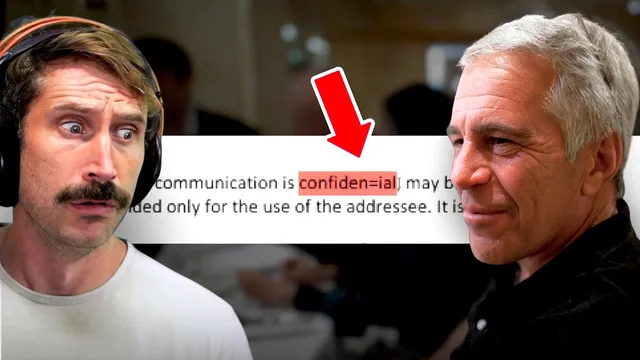
Why Epstein emails have so many ='s
Based on The PrimeTime's video on YouTube. If you like this content, support the original creators by watching, liking and subscribing to their content.
Equal signs in the emails are strongly linked to MIME quoted-printable encoding (RFC 2045), where “=” acts as an escape character.
Briefing
The “mystery” behind the many equal signs in the released Epstein emails comes down to old email encoding rules colliding with line-ending conversions—especially on Windows systems. Those equal signs are tied to MIME “quoted-printable” encoding (RFC 2045), a method designed to keep encoded email lines within strict length limits (76 characters) so they don’t break on older 80-character terminals. When long lines must be wrapped, the encoding uses soft line breaks that include carriage return and line feed markers.
In practice, the transcript traces how those carefully formatted line breaks can get mangled during automated processing. A key culprit is Windows text handling: when files are processed in a way that translates CRLF (carriage return + line feed) into LF (line feed) on input, the original quoted-printable structure can be disrupted. After that translation, the encoded soft breaks may no longer match what downstream decoders expect.
Even when the email is later decoded, the transcript points to a two-pass decoding behavior described in an external article: the decoder first searches for CRLF sequences and removes/joins lines to reconstruct the original text. Then it looks for the quoted-printable “=” escape character followed by hex codes (the mechanism used to represent bytes that can’t be safely transmitted). When the decoder encounters an unexpected pattern—specifically an “=” followed by something that isn’t a valid hex sequence—it falls back by stripping the problematic characters while leaving the “=” behind. That fallback behavior effectively turns what should have been a clean encoding boundary into literal “=” characters embedded in the text.
The result is exactly what readers notice in the Epstein files: letters and words appear to “turn into” sequences like “D E N = I A L” (as shown in the transcript), with equal signs appearing where they shouldn’t be. The transcript also notes that some people interpret those artifacts as hidden signals—an idea that spreads online—but the technical explanation is far more mundane: line-ending conversions and decoder error-handling can leave behind the quoted-printable escape character.
The broader takeaway is that these artifacts aren’t unique to the Epstein documents. Similar issues have shown up across internet protocols and tooling whenever legacy text encodings meet modern systems. The transcript even adds a version-control angle: if a repository has auto CRLF enabled in Git, it can convert CRLF to LF during check-in or check-out, creating the same kind of downstream decoding confusion.
In short, the equal signs are best understood as leftovers from quoted-printable encoding and imperfect decoding after CRLF/LF transformations—most plausibly triggered by Windows-style processing or tooling settings—rather than as evidence of a deliberate hidden message.
Cornell Notes
Many equal signs in the Epstein emails can be traced to MIME “quoted-printable” encoding (RFC 2045). That encoding uses “=” as an escape character and relies on soft line breaks to keep encoded lines within a 76-character limit. Windows-style CRLF↔LF conversions during automated processing can disrupt those soft breaks, so later decoders encounter malformed “=” sequences. A described two-pass decoding approach may then strip the wrong characters while leaving the “=” behind, producing visible “=” artifacts inside words. The same failure mode can also occur with tooling such as Git when auto CRLF is enabled.
What role does RFC 2045’s quoted-printable encoding play in the appearance of “=” characters?
Why do CRLF vs LF conversions matter for decoding quoted-printable?
How does the “two-pass” decoder behavior create visible “=” leftovers?
Why do some readers mistake the artifacts for hidden messages?
How could Git settings contribute to the same problem?
Review Questions
- How do quoted-printable soft line breaks depend on specific line-ending sequences, and what happens when those sequences change?
- What is the significance of “=” followed by hex codes in quoted-printable decoding, and why would an invalid sequence lead to leftover “=” characters?
- Describe a plausible workflow (Windows processing or Git auto CRLF) that could transform CRLF into LF and thereby produce the observed artifacts in decoded text.
Key Points
- 1
Equal signs in the emails are strongly linked to MIME quoted-printable encoding (RFC 2045), where “=” acts as an escape character.
- 2
Quoted-printable wraps long lines to stay within a 76-character limit, using soft line breaks that depend on correct line-ending handling.
- 3
Windows text-mode processing can translate CRLF into LF, disrupting the expected quoted-printable structure.
- 4
A two-pass decoding approach can remove CRLF-based line breaks first, then attempt to interpret “=” plus hex codes; malformed sequences trigger a fallback that leaves “=” behind.
- 5
The visible “=” artifacts inside words are consistent with decoding error-handling rather than intentional hidden messaging.
- 6
Git auto CRLF settings can reproduce the same CRLF/LF transformation problem in version-controlled text workflows.