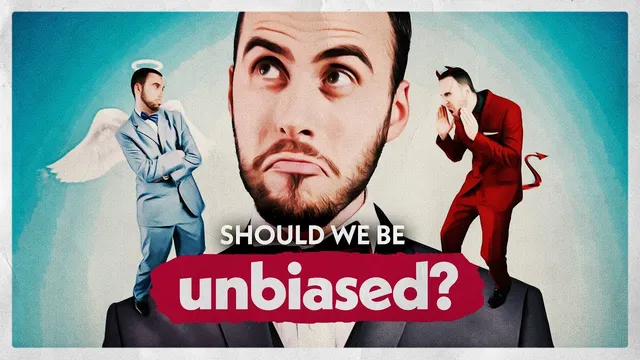
Why "Hearing Both Sides" Is Dangerous
Based on Second Thought's video on YouTube. If you like this content, support the original creators by watching, liking and subscribing to their content.
“Hearing both sides” can function as a fairness trap when it ignores unequal funding, media access, and incentives that shape what the public hears.
Briefing
“Hearing both sides” is dangerous because it treats unequal power and unequal funding as if they were neutral, letting bad-faith or system-aligned narratives win by controlling the terms of public debate. The core claim is that political outcomes aren’t driven mainly by which argument is more rational; they’re shaped by material conditions—especially the economic and media structures of a neoliberal capitalist society. In that environment, “compromise” often becomes a strategy for preserving existing hierarchies rather than resolving injustice.
The argument starts with a familiar liberal slogan: polarization is bad, so the mature move is to reach across the aisle and listen to the other side. That approach rests on a “marketplace of ideas” model where debate naturally elevates truth over falsehood. But recent political trends—rising fascist and nationalist politics, increasing hate crimes and anti-Semitism, and violence against Black and Asian Americans and LGBT people—undermine the idea that better arguments automatically prevail. The reason, the transcript says, isn’t that fascist rhetoric suddenly became more persuasive through clever rewording or that conservatives are inherently irrational. It’s that politics isn’t only about ideas; it’s about the conditions that allow certain ideas to gain traction.
Neoliberalism is presented as the enabling backdrop: massive inequality, the erosion of the welfare state, compromise fatigue, and perpetual war. Those conditions create real grievances that socialists can analyze through systems and institutions. Fascist rhetoric, however, reframes the same worsening conditions by blaming “the wrong kind of people” rather than the structures that produce inequality—thereby protecting existing institutions. The transcript points to racial resentment as a strong predictor of support for Donald Trump in 2016, and it links media incentives to why these narratives spread.
Media ownership and billionaire funding are described as the missing variable liberals often avoid naming. The transcript argues that private control of media institutions ensures pro-capitalist politics gets amplified, while anti-capitalist voices struggle for airtime. It cites Tucker Carlson’s dominance in viewership and the absence of leftists on major television networks as evidence that mainstream platforms reward narratives aligned with what wealthy owners are willing to fund—such as claims about “white people being replaced.”
When Democrats refuse to challenge the conditions under which debate happens, the transcript says they default to a procedural fix: blame “extremes,” trust that the arc of history will bend toward justice, and keep “hearing both sides.” That posture can be exploited by well-funded actors who set the terms of discussion. A concrete example is climate change denial: between 2003 and 2010, climate denial organizations reportedly had over $900 million in income to spread disinformation, enabling a false equivalence on TV—climate denier versus climate scientist—so the public debate could be delayed. The result is not objectivity but time bought for fossil fuel interests, shifting the conversation from whether climate change is real to how slowly society should respond.
The transcript concludes that listening to different perspectives is not the same as treating all positions as equally valid. It invokes the “paradox of intolerance” logic: tolerance requires limiting intolerant ideas when circumstances make unrestricted tolerance self-defeating. Picking a side, updating beliefs with evidence, and rejecting narratives that are clearly wrong are framed as moral and practical necessities. The closing anchor is Martin Luther King Jr.’s critique of the “white moderate” who prefers order over justice, using it to argue that neutrality can function as obstruction to social progress.
Cornell Notes
The transcript argues that “hearing both sides” becomes dangerous when it ignores how power, money, and media ownership shape which ideas get amplified. A liberal “marketplace of ideas” view assumes truth wins through open debate, but rising extremist and hateful politics suggests otherwise. The explanation offered is material: neoliberal inequality and the weakening of social supports create grievances, while fascist rhetoric redirects blame toward scapegoats rather than systems. Private ownership of media and billionaire funding further tilt the debate, allowing well-funded disinformation to set the terms of public discussion. A climate change example illustrates how false equivalence can delay action by buying time, making “neutral” debate morally and politically misleading.
Why does “hearing both sides” get framed as dangerous rather than fair-minded?
What’s the critique of the “marketplace of ideas” model?
How does the transcript connect neoliberalism to the rise of fascist rhetoric?
What role does media ownership and billionaire funding play in shaping political debate?
How does the climate change denial example illustrate the transcript’s core point?
What does the transcript say about tolerance and when limiting ideas is justified?
Review Questions
- What material factors does the transcript claim determine which political ideas gain traction, and why does that undermine “neutral” debate?
- How does the climate change denial case demonstrate the difference between fairness in airtime and fairness in epistemic validity?
- According to the transcript, when does tolerance require limiting certain ideas, and what principle supports that stance?
Key Points
- 1
“Hearing both sides” can function as a fairness trap when it ignores unequal funding, media access, and incentives that shape what the public hears.
- 2
The “marketplace of ideas” assumption—that truth wins through open debate—doesn’t match outcomes when institutions are not neutral.
- 3
Neoliberal inequality and the weakening of social supports create grievances that can be redirected by fascist rhetoric toward scapegoats instead of systems.
- 4
Private media ownership and billionaire funding are presented as structural reasons pro-capitalist narratives get amplified while anti-capitalist voices struggle for airtime.
- 5
Democrats’ reliance on procedural compromise is criticized as insufficient when the conditions of debate are rigged toward one side.
- 6
False equivalence—such as pairing climate denial with climate science—can delay decisions by buying time for powerful interests.
- 7
Picking a side and rejecting clearly wrong narratives is framed as compatible with moral responsibility and evidence-based inquiry.