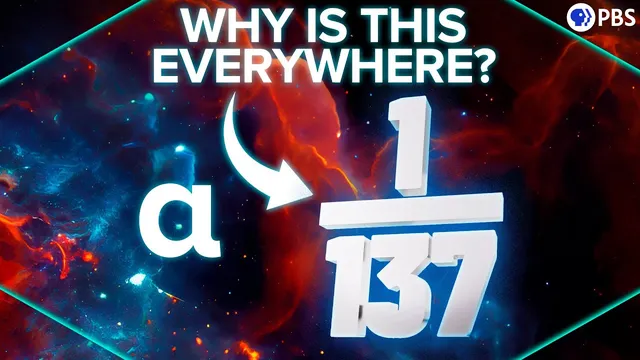
Why Is 1/137 One of the Greatest Unsolved Problems In Physics?
Based on PBS Space Time's video on YouTube. If you like this content, support the original creators by watching, liking and subscribing to their content.
The fine structure constant α ≈ 1/137.035999 is a dimensionless number that sets the effective strength of the electromagnetic force in quantum physics.
Briefing
The fine structure constant—α, approximately 1/137—keeps showing up as the governing “strength” of electromagnetism in quantum physics, yet physicists still can’t explain why it has the particular value it does. It matters because α doesn’t just appear in one tidy formula: it controls the size of atomic structure, the probabilities of electromagnetic interactions in quantum calculations, and the detailed splitting patterns of spectral lines. After more than a century of scrutiny, the number remains both ubiquitous and mysterious, earning obsession from figures like Paul Dirac, Wolfgang Pauli, and Richard Feynman.
The trail begins with spectroscopy. When electrons jump between energy levels in atoms, they emit photons at specific energies, producing sharp spectral lines. Early models—like Bohr’s explanation for hydrogen—matched the main features, but improved measurements revealed two key discrepancies: calculated energies didn’t line up exactly, and each “single” line actually split into two nearly identical lines. Arnold Sommerfeld resolved this by incorporating relativity (from Einstein) and the interaction between electron spin and its own orbital magnetic field. The energy difference between those fine lines turned out to be tied to a particular combination of fundamental constants: the electron’s charge squared, divided by four pi, times the inverse of the vacuum permittivity, Planck’s constant, and the speed of light.
What makes α stand out is that this combination is dimensionless—units cancel completely—leaving a pure number near 1/137.035999. That unitless character is rare in physics, where constants usually carry units that reveal what relationships they encode. α’s dimensionless nature also makes it an unusually “portable” identifier: it would be the same for any civilization regardless of their local units, which is part of why it’s so compelling as a candidate for a deep underlying principle.
Beyond spectroscopy, α appears throughout quantum electrodynamics as the electromagnetic coupling strength. In the language of Feynman diagrams, α^2 sets the base probability for processes like an electron emitting or absorbing a photon, or interacting via virtual photons at each interaction vertex. In plain terms, larger α means electromagnetic disturbances are stronger and interactions more likely; smaller α would weaken electromagnetism.
Even its “constant” status is conditional. α runs with energy: at extremely high energies in the early universe, when forces were unified, it would have been closer to 1, then decreased as energies fell and the forces separated, settling near today’s value around 1/137.035999. Physicists also note that α can’t be zero—without electromagnetism, atoms wouldn’t form—yet the fact that it stops at a life-permitting value fuels speculation about randomness at the Big Bang, or even a multiverse where different regions have different constants.
The central unsolved question remains: why does this specific dimensionless number take this value, and why does it connect so many unrelated-looking parts of nature? Theories range from α reflecting a deeper relationship among fundamental constants, to the possibility that it’s not a physical constant at all but a mathematical one—like π—whose role we haven’t fully understood. For now, α’s combination of ubiquity, unitlessness, and precision keeps it near the top of physics’ most persistent mysteries.
Cornell Notes
The fine structure constant, α ≈ 1/137, is the dimensionless coupling that sets the strength of the electromagnetic force in quantum physics. It first drew attention through spectroscopy: Sommerfeld showed that relativistic effects and spin–orbit interaction explain the fine splitting of spectral lines, with the splitting tied to α. In quantum electrodynamics, α (and especially α^2 at interaction vertices) controls the base probabilities for processes involving photons and electrons. α also “runs” with energy, being larger at higher energies in the early universe and settling near its present value. Despite its central role—from atomic structure to interaction rates—physicists still lack a convincing explanation for why α has exactly this value.
How did spectroscopy lead to the fine structure constant?
Why is α’s dimensionless character such a big deal?
What does α actually control in quantum physics?
Does α stay the same at all energies?
Why do physicists connect α’s value to the possibility of life?
What are the main speculative explanations for why α equals ~1/137?
Review Questions
- What experimental puzzle in atomic spectra forced physicists to refine their calculations, and how did Sommerfeld’s additions resolve it?
- How does α function in quantum electrodynamics, and why does α^2 matter in interaction probabilities?
- What does it mean for α to “run” with energy, and what does that imply about its early-universe value?
Key Points
- 1
The fine structure constant α ≈ 1/137.035999 is a dimensionless number that sets the effective strength of the electromagnetic force in quantum physics.
- 2
Sommerfeld’s explanation of fine spectral line splitting used relativity and spin–orbit interaction, leading directly to α in the energy difference.
- 3
In quantum electrodynamics, α (and particularly α^2 at interaction vertices) determines base probabilities for photon emission/absorption and electron–electron interactions via virtual photons.
- 4
α depends on energy scale: it was larger at higher energies in the early universe and decreases toward its present low-energy value.
- 5
α’s value is tightly linked to atomic structure and stability, with small changes potentially disrupting processes like carbon formation in stars.
- 6
Physicists still lack a fundamental reason for why α takes this specific value, prompting ideas ranging from deeper unifying mechanisms to multiverse-style randomness or even a mathematical origin.