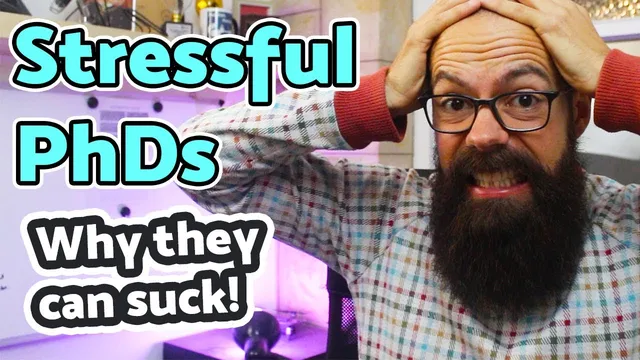
Why is a PhD so stressful? The 5 top and unexplored reasons!
Based on Andy Stapleton's video on YouTube. If you like this content, support the original creators by watching, liking and subscribing to their content.
Expectations can become self-reinforcing: sky-high hopes collapse when experiments stall, and outside assumptions can amplify impostor syndrome.
Briefing
A PhD’s stress often comes less from the work itself and more from the psychological traps that surround it: expectations, comparison, identity, uncertainty, and a mismatch between how brains predict progress and how research actually unfolds. The core pattern is that setbacks don’t just slow experiments—they threaten how students see themselves, how they measure success, and whether they believe the finish line is real.
Expectations come in multiple forms. Students set sky-high hopes for themselves, then watch those hopes collide with the reality of experiments that don’t cooperate. That gap can trigger a downward spiral: doubts about ability start to feel like evidence. External expectations add pressure too. People who haven’t done a PhD often misunderstand it—treating it like “still studying”—while those who have may assume the student is “clever enough” to breeze through. In both cases, the result is fertile ground for impostor syndrome: the fear of being exposed as unqualified, especially when progress isn’t immediate.
Comparison intensifies the stress because academia is structured around metrics and milestones that invite constant ranking. Grants, publications, journal prestige, H-index, impact factors, and career ladder timing all turn research into a scoreboard. Even when someone else’s success doesn’t reduce personal achievement, the comparison still feels like a zero-sum game. The suggested antidote is to narrow the comparison window—benchmarking against one’s own prior performance (for example, progress over the last six months or a year) rather than against peers.
Identity is the third major pressure point. Once a student has earned a place in a PhD—through scholarships, exams, and a long build-up of “being the clever one”—research problems can feel like personal failure. When experiments break, supervisors become difficult, or relationships strain, the internal narrative can escalate into an existential crisis: “Who am I if this isn’t going the way I thought?” The stress grows as those thoughts are treated as reality rather than as protective mind-noise.
Uncertainty is the fourth driver. Research requires solving problems whose outcomes are unknown, and failure is not an exception—it’s part of the process. The unknown becomes especially threatening when it starts dictating self-worth or even whether the PhD will be finished. The practical coping approach is to treat PhD work as a sequence of problems to solve as they appear, like “duck and weave,” while also maintaining self-care.
Finally, a less-discussed reason: brains expect linear progress. Early-stage research often produces little visible payoff, even when effort is high, because the feedback loop is exponential. Foundations laid in the first years may only compound into results near the end—fueling the “second-year slump” when effort doesn’t translate into immediate returns. Understanding that mismatch helps students endure the early plateau without interpreting it as evidence of failure. The overall message is to manage expectations, reduce peer ranking, protect identity from setbacks, face uncertainty step-by-step, and reframe early stagnation as necessary groundwork rather than a sign to quit.
Cornell Notes
PhD stress is driven by five interacting pressures: unrealistic expectations, constant comparison, identity tied to academic success, the fear created by research uncertainty, and a mismatch between how people expect progress (linear) and how research actually pays off (often exponential). Expectations can spiral inward when experiments stall, and outward when family or peers misunderstand what a PhD is or assume the student will “breeze through.” Comparison is reinforced by academic metrics and career timelines, but the suggested fix is to compare against one’s own past performance. Identity-based thinking makes setbacks feel existential, while uncertainty makes outcomes feel personal and finish-line-threatening. Finally, early “no results” periods can reflect foundation-building that compounds later, not incompetence.
How do expectations—both internal and external—turn normal PhD difficulty into a stress spiral?
Why does comparison feel especially punishing in academia, and what alternative comparison strategy is offered?
What makes identity-based stress different from ordinary frustration during a PhD?
How does the “unknown” in research create fear, and what coping method is suggested?
Why does the early PhD often feel like it’s going nowhere, and how does the transcript explain that mismatch?
Review Questions
- Which type of expectation (self-imposed or externally held) is most likely to trigger impostor syndrome, and why?
- What metrics or signals in academia most strongly encourage comparison, and how would you replace that with a self-referenced progress check?
- How does the transcript’s linear-vs-exponential progress model change how you interpret a “second-year slump”?
Key Points
- 1
Expectations can become self-reinforcing: sky-high hopes collapse when experiments stall, and outside assumptions can amplify impostor syndrome.
- 2
Academic comparison is fueled by measurable signals like grants, publications, H-index, and impact factors, turning research into a ranking game.
- 3
Tying identity to academic success makes setbacks feel existential; separating self-worth from outcomes reduces the emotional blow.
- 4
Research uncertainty is unavoidable and can threaten motivation when it’s treated as a verdict on ability or completion.
- 5
Early PhD progress often looks non-linear because foundations compound later; interpreting that correctly helps prevent quitting during plateaus.
- 6
A practical coping strategy is to compare against one’s own past performance (e.g., last six months or a year) rather than peers.
- 7
Handling the unknown means solving problems as they appear while maintaining self-care to avoid burnout.