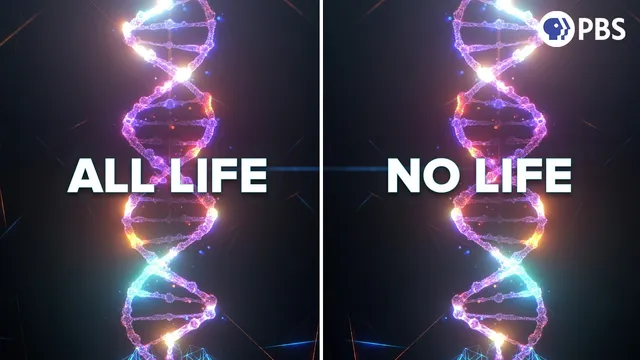
Why Is All DNA Right Handed?
Based on PBS Space Time's video on YouTube. If you like this content, support the original creators by watching, liking and subscribing to their content.
Life’s molecules show strong chirality bias: left-handed amino acids and right-handed sugars produce a right-handed DNA helix and right-handed RNA.
Briefing
Life’s chemistry is strikingly lopsided: DNA and RNA adopt one consistent helical “hand,” and the building blocks of biology show a strong preference for one enantiomer over its mirror image. That uniformity—called homochirality—has no known origin, but it’s hard to ignore that the universe itself also breaks mirror symmetry in subtle ways. A leading idea links the two: the handedness of life may have been nudged into place by the fundamental left-right asymmetry built into weak interactions, then amplified by early Earth chemistry.
Chirality means a shape cannot be perfectly matched to its mirror image by rotation. In biology, this matters because mirror-image molecules (enantiomers) can behave differently in living systems. Life uses left-handed amino acids and right-handed sugars, producing a right-handed DNA helix and right-handed RNA. Experiments and observations back up the pattern: Pasteur found natural tartaric acid comes in only one mirror form while synthetic samples split into both; the Miller–Urey prebiotic chemistry experiments generate racemic mixtures (50–50) rather than the one-handed selection seen in living organisms. So the key question becomes when and how Earth’s chemistry moved from racemic beginnings to a single dominant chirality.
One broad requirement is amplification. Any mechanism that merely gives one enantiomer a tiny advantage won’t be enough unless that advantage triggers positive feedback—through autocatalysis (one chirality helps make more of itself), anticatalysis (the opposite is suppressed), or self-replication (one chirality is preferentially incorporated and the other starves). The transcript lays out a plausible timeline: early “prebiotic” chemistry may have produced small biases, but full homochirality likely required the more complex, catalytic, self-reinforcing environment of the transbiotic stage, when RNA-like polymers could drive selection.
The cosmic angle centers on weak-interaction physics. The weak force violates mirror symmetry, and that violation shows up most clearly in particle decays and their handedness. The proposed pathway uses cosmic rays: high-energy particles from events like supernovae or the Sun strike Earth’s atmosphere, generating particle showers. Among the shower products, muons are rare but highly penetrating and account for roughly 85% of the radiation dose at the surface. If muons carry a handedness preference tied to weak interactions, they could preferentially damage one molecular chirality over the other—creating an evolutionary pressure against, for example, left-handed RNA.
Globus and Blandford model this effect with computational approximations of radiation damage. They find the chirality-dependent damage is too small for simple monomers like amino acids to drive a major shift in the prebiotic era, but much stronger for helical polymers like RNA. In their picture, preferential destruction of left-handed RNA could tip the system toward a right-handed RNA world during the transbiotic phase—provided cosmic-ray muon fluxes were high enough. Present-day fluxes may be insufficient, but the transcript points to likely higher cosmic-ray activity early in Earth’s history, including supernova-driven spikes and a more active young Sun.
The hypothesis makes a testable prediction: if weak-interaction handedness seeds homochirality, then life elsewhere should share the same handedness, and mirror-reflected life should be absent. Closer to home, researchers can search for chiral biases in extraterrestrial amino acids using pristine samples from space. Finally, new experiments at the ISIS Neutron and Muon Source are designed to probe the core mechanism directly by exposing left- and right-handed RNA to spin-polarized muon beams and measuring reaction rates—work that could clarify both the origin of life’s one-handed chemistry and radiation effects relevant to human health.
Cornell Notes
Life’s molecules are not just “chiral,” they’re overwhelmingly one-handed: left-handed amino acids, right-handed sugars, and a right-handed DNA/RNA helix. The origin of this homochirality is unknown, but it likely required amplification—small initial chirality biases must be boosted by positive feedback such as autocatalysis or selective replication. A physics-driven hypothesis links the bias to mirror-symmetry violation in the weak interaction, where particle decays show a handedness preference. Cosmic rays produce muons at Earth’s surface; if muons preferentially damage one molecular chirality, they could create an evolutionary pressure that tips RNA toward one handedness. Globus and Blandford model this effect as weak for amino-acid monomers but stronger for helical RNA polymers, and they argue early Earth’s higher cosmic-ray flux could make the “chirality snowball” plausible.
What does “homochirality” mean, and why is it surprising given prebiotic chemistry experiments?
Why do most proposed chirality-selection mechanisms need positive feedback?
What role does RNA play in the proposed timeline for achieving homochirality?
How do cosmic rays and muons connect weak-interaction handedness to molecular chirality?
What did Globus and Blandford’s modeling suggest about amino acids versus RNA?
What predictions and near-term tests follow from the cosmic-ray muon hypothesis?
Review Questions
- What amplification mechanisms could convert a small initial enantiomer excess into full homochirality, and why is amplification necessary?
- Why does the cosmic-ray muon hypothesis predict a stronger effect for helical RNA polymers than for amino-acid monomers?
- What observations would most directly distinguish a weak-interaction/cosmic-ray origin of chirality from alternatives like polarized light or Earth-based mineral chemistry?
Key Points
- 1
Life’s molecules show strong chirality bias: left-handed amino acids and right-handed sugars produce a right-handed DNA helix and right-handed RNA.
- 2
Homochirality likely required positive feedback, because small chirality advantages must be amplified to eliminate the mirror form.
- 3
Prebiotic chemistry experiments tend to yield racemic mixtures, so the one-handed selection seen in biology needs a later, selection-capable stage.
- 4
A weak-interaction-based hypothesis ties mirror-symmetry violation to muon-driven, chirality-dependent molecular damage.
- 5
Globus and Blandford’s models suggest chirality-dependent damage is too small for amino-acid monomers but much larger for helical RNA polymers.
- 6
Cosmic-ray flux may have been higher early in Earth’s history (supernova spikes and a more active young Sun), making a chirality “snowball” more plausible.
- 7
The hypothesis predicts universal handedness across the universe and motivates tests using pristine extraterrestrial samples and new muon-beam experiments at ISIS.