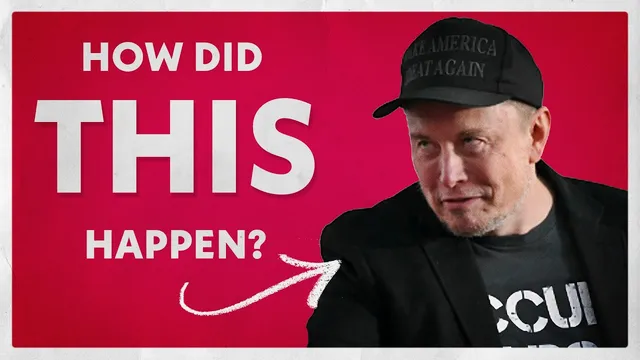
Why Is Elon Musk Like That?
Based on Second Thought's video on YouTube. If you like this content, support the original creators by watching, liking and subscribing to their content.
Cyber libertarianism is portrayed as a long-running ideology that reframes political problems as solvable through technology while treating government oversight as the main threat to “freedom.”
Briefing
Elon Musk’s apparent political shift isn’t treated as a sudden “radicalization moment,” but as the predictable outcome of an older Silicon Valley ideology: cyber libertarianism. That worldview sells technology as a nonpolitical fix for social problems—while pushing an anti-government, pro-corporate definition of “freedom” that ultimately protects concentrated wealth and power. The result, according to this account, is a pipeline from early tech utopianism to today’s right-leaning, conspiracy-friendly internet politics.
The argument traces cyber libertarianism to a marriage of Cold War-era engineering culture and late-1960s counterculture. In this telling, California’s tech ecosystem grew from World War II and Cold War defense investment, then fractured during the Vietnam era as some technologists became uneasy about military uses of their work. Meanwhile, hippie communities—often organized around decentralized communes—found common ground with techno-optimists who believed new computer networks could enable horizontal communication and weaken tyranny. A key bridge was the Whole Earth Catalog, which promoted self-sufficiency and ecology alongside computing-related optimism, helping engineers and countercultural activists form a shared rhetorical project.
By the late 1980s and 1990s, cyber libertarianism moved from counterculture to policy and institutional influence. Ronald Reagan’s rhetoric framed microchips and communications as forces that would topple “totalitarianism,” and Bill Clinton’s administration is described as taking steps that favored privatization of internet infrastructure—shuttering the NSFNET and shifting control toward private companies. The account also points to John Perry Barlow’s “Declaration of the Independence of Cyberspace,” presented as a manifesto backed by elite platforms like the World Economic Forum, reinforcing the idea that governments are inherently freedom’s enemy.
The central critique is that this ideology’s “freedom” is selective. It rejects democratic oversight while leaving corporate power intact, equating free speech with the ability of powerful actors to operate without consequences. The account argues that cyber libertarianism never truly aimed to remove government; instead, it sought to reshape government to serve corporate interests—through subsidies, favorable regulation, and reduced taxation or enforcement. It also ties the ideology to long-running racial and eugenic currents in parts of elite academia and tech culture, citing Stanford’s eugenist history and the way privatized, deregulated networks could enable extremist organizing.
From that foundation, the narrative connects Musk and other tech leaders to a broader political strategy: cementing tech industry influence while shifting blame for social problems onto groups with less power. It contrasts Musk’s public anti-government posture with his willingness to seek government roles and subsidies, and it alleges that platform governance under his control has favored right-wing and far-right voices while restricting left-wing users and some journalism. The takeaway is that the internet’s “decentralization” rhetoric can function as cover for centralized private control—turning a libertarian aesthetic into a mechanism for consolidating power.
The closing portion pivots to sponsorship, promoting Means TV, described as a worker-owned, anti-capitalist streaming alternative, framed as a way to support socialist creators amid suppression on mainstream platforms.
Cornell Notes
Cyber libertarianism is presented as the ideological engine behind Silicon Valley’s shift toward right-wing politics and platform power. The account traces it to a blend of Cold War engineering culture and 1960s counterculture, with the Whole Earth Catalog acting as a bridge between techno-optimists and anti-government hippie rhetoric. Over time, elite political support and policy changes helped translate “digital freedom” into privatized internet infrastructure and reduced democratic oversight. The critique is that this “freedom” protects corporate power rather than expanding real civil liberties, and it can enable extremist organizing by lowering constraints. That framework is used to interpret Elon Musk’s online behavior and platform governance as consistent with long-standing ideology rather than a sudden transformation.
What is cyber libertarianism, and why does it matter for understanding modern tech politics?
How does the narrative connect the Whole Earth Catalog to later Silicon Valley ideology?
Why does the account claim cyber libertarianism became compatible with neoliberal economics?
What role do Reagan, Clinton, and John Perry Barlow play in the story?
How does the account interpret Musk’s platform behavior through this ideological lens?
What is the argument about racism and extremist organizing online?
Review Questions
- How does the account distinguish between anti-government rhetoric and actual government involvement in tech policy?
- What mechanisms does the narrative claim allow “decentralized” networks to still produce centralized private control?
- Why does the account treat the Whole Earth Catalog as more than a publishing artifact—what ideological function does it serve?
Key Points
- 1
Cyber libertarianism is portrayed as a long-running ideology that reframes political problems as solvable through technology while treating government oversight as the main threat to “freedom.”
- 2
The Whole Earth Catalog is presented as an early bridge between Cold War-era techno-optimists and 1960s hippie anti-government rhetoric.
- 3
Elite political support—especially rhetoric from Ronald Reagan and policy shifts under Bill Clinton—is described as helping translate cyber libertarian ideals into privatized internet infrastructure.
- 4
The critique centers on a mismatch: “freedom” is defined in ways that protect corporate power and reduce democratic accountability rather than expanding civil liberties broadly.
- 5
The account links the ideology to enabling extremist organizing by lowering constraints and treating historical harms as irrelevant.
- 6
Elon Musk is used as a case study for how anti-government messaging can coexist with subsidies, government-facing ambitions, and platform governance favoring certain political factions.