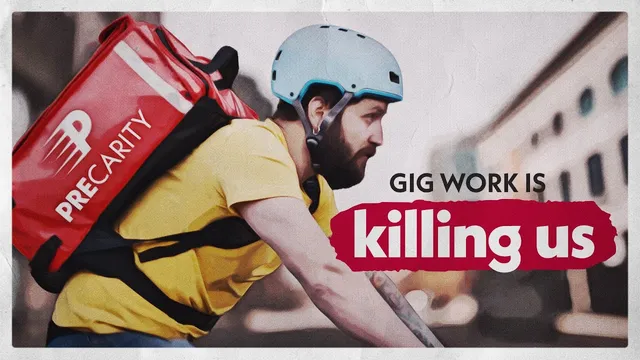
Why Is Everything Turning Into Uber?
Based on Second Thought's video on YouTube. If you like this content, support the original creators by watching, liking and subscribing to their content.
Uber’s profitability is linked to having more desperate drivers available, and inflation can increase that supply.
Briefing
Uber’s “freedom” pitch masks an economic setup that benefits when workers have less money—because desperation drives more people into driving, while the company shifts costs and risks onto drivers. A CNBC clip featuring Uber CEO Dara Khosrowshahi is used as a blunt entry point: inflation makes life more expensive, more drivers sign up out of necessity, and Uber can still tell investors that revenue is rising. The core issue isn’t just that Uber profits during hard times; it’s that the gig economy model is built to turn economic pressure into a steady supply of labor while keeping labor protections out of reach.
The wages story is presented as both hard to pin down and easy to interpret. Earnings vary with demand, supply, tips, surge pricing, app rules, location, and algorithmic decisions, leaving no single “normal” situation. Still, the transcript argues two things are clear: drivers earn far less than advertised, and Uber inflates its numbers. In 2014, Uber claimed New York drivers’ median income was about $90,000 a year—framed as comparable to a college-degree job, with the main requirement being car ownership. Reporters later estimated full-time pay closer to $12 an hour, roughly $25,000 a year, below the poverty line for a family of four. More recent estimates are even lower, with averages around $350 per month and a median of $155, though those figures mix full-time, part-time, and occasional drivers.
The transcript then connects low pay to legal structure. Uber classifies drivers as independent contractors, which means no minimum wage, health insurance, paid time off, sick days, overtime, or other benefits tied to employment. Because time not spent driving is time not earning, drivers are incentivized to work as many of the app’s maximum hours as possible. That pressure becomes especially dangerous when sickness, injury, or emergencies hit—leaving workers with little safety net. Reports of drivers sleeping in cars and working long stints are described as common, and the ability to switch between apps can worsen the problem by helping drivers avoid cutoffs.
A second mechanism is cost shifting. The model is portrayed as “legal optimization”: drivers pay for the car, maintenance, cleaning, insurance, self-employment and income taxes, healthcare, and—most importantly—gas. Gross earnings that look decent in marketing materials are quickly reduced to poverty-level net income. Uber’s “middleman” framing is treated as a cover for control. Even without formal employment, the app uses ride and driver data to adjust prices and ride volume within ranges drivers can’t negotiate. The transcript argues this gives Uber employer-like power, including the ability to reduce earnings abruptly and attribute it to demand or “the algorithm.”
The labor implications extend beyond Uber. In many places, independent contractors can’t form unions, and in the U.S. the National Labor Relations Act protects collective bargaining only for employees. The transcript cites political spending and lobbying as a way to preserve the loophole—such as Uber and Lyft spending $200 million in 2020 to prevent California from classifying drivers as employees, and heavy lobbying efforts in 2016. Even after the UK reclassified Uber drivers as employees, the transcript claims minimum wage protections were effectively reduced because they apply only when a passenger is in the car, which the app enables only 40–50% of the time.
Finally, the argument broadens into an economy-wide shift. Uber is described as a small slice of the workforce, but a symbol of a larger trend toward precarious, unprotected work. The transcript cites examples like Ryanair pilots and efforts to push nurses into independent contractor status, alongside data suggesting most net job growth in the U.S. from 2005–2015 came through “alternative work arrangements.” The conclusion is stark: regulating a few apps won’t fix a system that relies on redefining employment to cut labor costs, and without intense organizing, the future is likely to keep sliding toward exploitation.
Cornell Notes
Uber’s “gig freedom” pitch is presented as a cover for an economic model that shifts risk and costs onto workers while benefiting from economic downturns. Drivers are classified as independent contractors, leaving them without minimum wage, benefits, overtime, or protections tied to employment. The transcript argues Uber also controls earnings through algorithmic pricing and ride availability, while marketing high gross earnings that don’t survive after expenses like gas, insurance, taxes, and maintenance. Political lobbying and legal workarounds are described as key to keeping these rules in place. The broader claim is that Uber is not the whole problem—precarious contracting is spreading across industries, making exploitation a structural feature of the economy.
Why does inflation matter to Uber’s business model, according to the transcript?
How does the transcript connect low driver pay to Uber’s legal classification?
What role does cost shifting play in turning “gross” earnings into poverty-level income?
How does the transcript argue Uber can control drivers without being a traditional employer?
What does the transcript say about union rights and political efforts to preserve contractor status?
How does the transcript broaden the argument beyond Uber itself?
Review Questions
- What specific mechanisms does the transcript use to explain why driver earnings fall below advertised figures (legal status, algorithmic control, and/or cost shifting)?
- How do union and labor-law differences between employees and independent contractors shape the bargaining power of gig workers?
- Why does the transcript argue that Uber is both a symbol and a relatively small part of a broader shift toward precarious work?
Key Points
- 1
Uber’s profitability is linked to having more desperate drivers available, and inflation can increase that supply.
- 2
Uber’s independent-contractor classification removes minimum wage, benefits, overtime, and other employment protections.
- 3
Algorithmic pricing and ride availability give Uber employer-like control over earnings even without formal scheduling power.
- 4
Drivers absorb major operating costs—car expenses, insurance, taxes, healthcare, and gas—turning gross earnings into much lower net income.
- 5
Long hours and precarious income increase risk during illness or injury, with little safety net.
- 6
Lobbying and legal strategy are used to prevent or narrow reclassification as employment, including efforts in California and disputes over minimum wage application.
- 7
The gig economy shift is portrayed as economy-wide, with similar contractor models spreading into other industries beyond ridesharing.