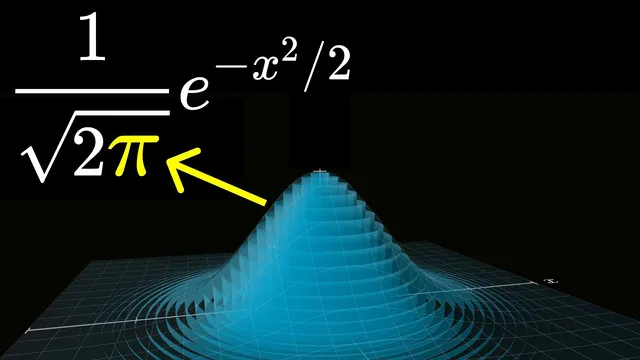
Why π is in the normal distribution (beyond integral tricks)
Based on 3Blue1Brown's video on YouTube. If you like this content, support the original creators by watching, liking and subscribing to their content.
The area under the unnormalized bell curve e^(−x^2) equals √π, and dividing by √π makes the Gaussian integrate to 1.
Briefing
Pi’s appearance in the normal distribution isn’t a coincidence of algebra—it comes from geometry and from the way Gaussian shapes are forced by symmetry and independence. The normal (Gaussian) curve has the form proportional to e^(−x^2), and the constant that makes its total probability equal to 1 is tied to the integral of e^(−x^2). The key quantity is the area under the bell curve, which turns out to be √π; dividing by √π normalizes the distribution.
A classic proof gets √π by temporarily abandoning the “area under a curve” problem and instead computing the “volume under a bell surface” in three dimensions. Using the radially symmetric function e^(−r^2), where r is distance from the origin, the surface has circular symmetry around the z-axis. That symmetry allows the volume to be chopped into thin cylindrical shells: each shell contributes roughly (circumference)×(height)×(thickness). The circumference brings in a factor of 2πr, so π is pulled out naturally. The remaining integral becomes manageable because the integrand is set up so that the calculus antiderivative is available, yielding a total volume of π.
That three-dimensional volume then links back to the original two-dimensional area through a second slicing argument. If the same bell surface is sliced by planes parallel to the x-axis, each slice looks like the original one-dimensional bell curve e^(−x^2), just scaled vertically by a factor depending on the slice’s y-value. Because the function e^(−x^2−y^2) factors as e^(−x^2)·e^(−y^2), the slice areas are all proportional to one constant—exactly the unknown area under e^(−x^2). Integrating those slice areas across all y shows that the total volume equals (that unknown area)². Since the volume is already known to be π, the area under e^(−x^2) must be √π. That’s the direct route from π to the normalization constant in the Gaussian.
But the deeper question—why e^(−x^2) is special in statistics—gets answered by a 19th-century derivation due to John Herschel and later independently by James Clerk Maxwell. Start in two dimensions and demand two properties: (1) radial symmetry, meaning probability depends only on distance from the origin, not direction; and (2) independence of x and y, meaning the joint density factors into an x-part times a y-part. Those constraints force the radial dependence to satisfy a functional equation whose continuous solutions are exponential in r². After normalization, only the negative exponent works, producing the Gaussian shape e^(−const·r²). Maxwell’s three-dimensional statistical mechanics version reaches the same structure for molecular velocities.
Finally, the connection to the central limit theorem is the remaining bridge: in practice, normal distributions emerge from adding many independent variables, and the Gaussian is the unique stable shape consistent with that limiting behavior. The π-in-the-normal story therefore has two legs: geometry explains the √π normalization, while Herschel–Maxwell reasoning explains why the exponential of a squared distance is the natural form that independence and symmetry demand.
Cornell Notes
The Gaussian’s normalization constant is tied to π because the area under e^(−x^2) equals √π. A classic proof computes the volume under the radially symmetric surface e^(−r^2) in 3D, where cylindrical shells introduce a factor of π. Re-slicing the same volume into x-parallel slices shows that this 3D volume equals the square of the unknown 2D area under e^(−x^2), forcing that area to be √π. The transcript then explains why e^(−x^2) is not arbitrary: Herschel (and later Maxwell) derived the Gaussian from two requirements—radial symmetry and independence of coordinates—leading to an exponential in r² with a negative constant after normalization.
Why does computing a 3D “volume under a bell surface” help find the 2D area under e^(−x^2)?
What exact role does circular symmetry play in the appearance of π?
Why can’t e^(−x^2) be integrated using elementary antiderivatives?
How do Herschel’s two assumptions force the Gaussian form?
Why does the constant in the exponent have to be negative?
How does Maxwell connect the same reasoning to real statistical mechanics?
Review Questions
- In the 3D volume proof, how does the factorization e^(−x^2−y^2)=e^(−x^2)·e^(−y^2) enable the second slicing argument to relate the volume to the square of the 1D area?
- What functional equation arises from Herschel’s radial symmetry plus coordinate independence, and why does continuity restrict its solutions to exponentials?
- Why does normalization rule out positive constants in the exponent of the Gaussian form e^(c·r²)?
Key Points
- 1
The area under the unnormalized bell curve e^(−x^2) equals √π, and dividing by √π makes the Gaussian integrate to 1.
- 2
A classic derivation computes the 3D volume under e^(−r^2) using cylindrical shells, where the shell circumference contributes a factor of π.
- 3
Re-slicing the same 3D volume into axis-parallel slices shows the total volume equals the square of the 1D area under e^(−x^2).
- 4
Herschel’s derivation forces the Gaussian shape from two principles: radial symmetry (depends only on distance) and independence of coordinates (joint density factors).
- 5
The resulting functional equation has continuous solutions that are exponentials in r²; normalization requires the exponent constant to be negative.
- 6
Maxwell independently reached the same Gaussian structure in three dimensions while deriving velocity distributions in gases.
- 7
The central limit theorem provides the practical reason normal distributions emerge when many independent variables are added, tying the Gaussian’s form to limiting behavior.