Why is it Harder to Drive Backwards?
Based on minutephysics's video on YouTube. If you like this content, support the original creators by watching, liking and subscribing to their content.
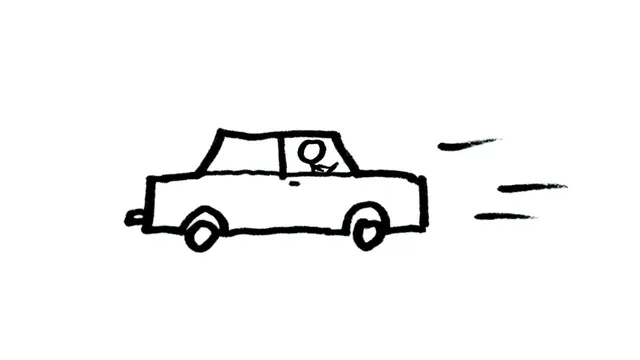
Forward driving is stable because the front wheels both steer and set the direction of travel.
Briefing
Driving backwards feels harder not because the car’s body is reversed, but because steering and motion are controlled by different wheels. A car always follows the same geometric curve for a given steering angle, whether it moves forward or backward—yet the human task of keeping it on course becomes dramatically more demanding. The key difference is mechanical: the front wheels steer, while the car’s direction of travel depends on which wheels are “leading.”
When driving forward, the front wheels both steer and determine where the car goes. Point the front wheels where you want to travel, and the rear wheels naturally follow. That alignment creates a stable feedback loop: small steering inputs reliably produce predictable motion, so the system self-corrects without constant intervention. The transcript likens this to dangling a pencil from your fingers—move your hand and the pencil follows with little conscious control.
Reversing the process breaks that stability. Going backward, the back wheels determine the direction of travel, but the driver still steers with the front wheels. Now the driver must aim the front wheels not at the intended path directly, but at the direction that will cause the back wheels to end up pointing correctly. This introduces an extra “level of separation” between what the driver does (front-wheel steering) and what the car does (rear-wheel orientation and resulting motion). Without continuous corrections, the mismatch compounds: the back wheels drift farther from the desired direction, effectively “running away” from the intended path. The system behaves like an unstable control problem, compared to balancing a pencil on a fingertip—tiny errors grow unless the driver performs rapid, coordinated hand-eye feedback.
The difficulty scales further when a trailer is added. With a trailer, the driver’s steering must indirectly control not only the car’s rear-wheel direction but also the trailer’s orientation, which lags behind and depends on the car’s motion history. Steering backwards already requires translating front-wheel commands into rear-wheel alignment; adding one or more trailers adds additional layers of delay and separation between steering input and where the last segment ends up. Each added trailer increases the number of intermediate “states” that must be kept in sync, making the system more finicky and harder to correct in real time.
That layered instability explains why pushing on one end of a chain or rope rarely makes the other end go where you want, and why balancing a flexible rope or chain upright on a finger is essentially impossible. In short: forward driving is stable because steering and travel direction match; reverse driving is hard because steering and travel direction are controlled by different wheels, and trailers multiply the control delay until the system becomes nearly unmanageable.
Cornell Notes
Forward driving is stable because the same front wheels that the driver steers also set the car’s direction of travel. Backward driving is hard because the driver still steers with the front wheels, but the car’s direction of travel depends on the back wheels. That mismatch creates an unstable feedback loop: if the driver doesn’t continuously correct, the rear wheels drift farther from the intended direction, “running away.” Adding a trailer increases the problem by introducing another delayed, indirect relationship between steering input and where the far end (the trailer) ends up pointing. The result is a control task that demands constant, coordinated hand-eye adjustments.
Why does steering feel easier when driving forward than when driving backward?
What changes physically when you drive backward?
How does the transcript describe the stability difference between forward and backward driving?
Why do trailers make reversing even harder?
How do the chain/rope examples connect to the steering-and-trailer explanation?
Review Questions
- In forward driving, which wheels determine the car’s direction of travel, and why does that matter for stability?
- Explain why steering with the front wheels while traveling backward creates an unstable feedback loop.
- How does adding one trailer change the relationship between steering input and the direction the far end points?
Key Points
- 1
Forward driving is stable because the front wheels both steer and set the direction of travel.
- 2
Backward driving is difficult because the front wheels steer while the back wheels determine the direction of travel.
- 3
Reversing requires aiming the front wheels to indirectly force the back wheels to point correctly.
- 4
Without continuous correction, the rear wheels drift farther from the intended path, making the system unstable.
- 5
Each added trailer increases the delay and separation between steering input and where the trailer ends up pointing.
- 6
Flexible chains and ropes illustrate how indirect, delayed control makes it hard to guide the far end reliably.