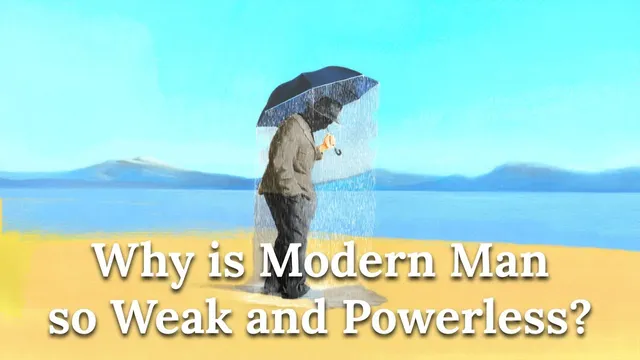
Why is Modern Man so Weak and Powerless? - Carl Jung
Based on Academy of Ideas's video on YouTube. If you like this content, support the original creators by watching, liking and subscribing to their content.
Power is framed as the ability to produce intended effects and shape one’s life, making autonomy a psychological necessity rather than a mere political preference.
Briefing
Modern man’s weakness and powerlessness are framed as the psychological engine behind a slide toward “state slavery”—a system where the state gains total control, strips citizens of autonomy, and maintains that control through surveillance, repression, and extraction of wealth. The central claim is that this power disparity isn’t just political; it’s becoming pathological because ruling elites suffer from “psychological inflation” (an ego swollen beyond reality) while ordinary people experience “psychological deflation” (a contraction of personality that leaves them obedient, docile, and dependent). That two-way imbalance, reinforced by mutual projection, helps entrench a permanent ruling class.
The argument begins with power as a basic human requirement for well-being. Power isn’t reduced to domination; it’s described as the ability to shape one’s life and produce intended effects—an idea tied to Russell’s definition. Drawing on social psychology research attributed to Susan Fiske, the discussion links healthy functioning to motives such as belonging, understanding, self-enhancement, trust, and control/autonomy/competence. Most of these motives, the narrative insists, require personal power. Historical comparisons then sharpen the moral point: Frederick Douglass distinguished the slave from the free person by the level of power to decide one’s destiny, and Orlando Patterson is cited to emphasize that slavery has existed across societies and eras.
From there, the transcript contrasts chattel slavery with “state slavery.” In chattel slavery, the enslaved person is property; in state slavery, the state becomes the master by controlling movement, suppressing free speech, tolerating no dissent, and funding its apparatus through forced labor, direct taxation, or inflationary taxation. The COVID-era period is used as an example of how totalitarian controls can expand and then partially recede while the underlying power divide continues to grow.
Carl Jung’s concept of psychological inflation supplies the mechanism for the ruling class. The inflated ego identifies with roles and titles—CEO, president, military leadership, cabinet posts—treating institutional power as if it were personal essence. Jung’s “God-amightiness” follows: arrogance, belief in exemption from moral codes, loss of touch with reality, and repression of perceived weaknesses. Those repressed traits then get projected onto others—especially the people being ruled—helping elites justify dominance while viewing subjects as inferior.
The transcript argues that the masses experience the mirror image: psychological deflation. When people identify with a socially restricted role—whether in marginalized groups or even “normal” citizens—they lose contact with their own character traits and “will to power.” Deflated individuals then project strengths they can’t access onto leaders, parties, or the nation-state, creating a feedback loop. Projections from below empower the ruling class; projections from above convince elites that citizens are weak and need shepherding. Over time, that dynamic is portrayed as paving the way for total control.
The prescription is practical and psychological. Responsibility rests on citizens: cultivate personal power through learning, skill-building, strengthening the body, setting goals, and emulating powerful role models. Humor and ridicule are offered as a counter-tool—“the Achilles heel of tyrants”—because laughter punctures fear and the aura of invincibility that demagogues rely on. Memes, satire, and comedy skits are presented as ways to expose contradictions and force people to keep thinking rather than panic or defer judgment.
Cornell Notes
The transcript argues that “state slavery” grows out of a psychological feedback loop: ruling elites become psychologically inflated, while citizens become psychologically deflated. Power is treated as a core human need for self-enhancement, autonomy, competence, and healthy relationships, so losing power isn’t just political—it damages the psyche. Psychological inflation makes elites identify with titles and institutional authority as if it were personal essence, leading to arrogance, repression, and projection of flaws onto those they rule. Psychological deflation makes ordinary people identify with narrow social roles or admire powerful institutions, projecting their own denied “will to power” upward and thereby empowering the very rulers who claim citizens need control. Breaking the loop requires citizens to cultivate personal power and use humor to puncture fear-based authority.
How does the transcript define “power,” and why does that definition matter to its claim about slavery?
What is “state slavery,” and how is it contrasted with chattel slavery?
What does “psychological inflation” look like in ruling elites, according to the transcript’s Jung-based framework?
How does projection function in the transcript’s explanation of domination?
What is “psychological deflation,” and how does it create a feedback loop that strengthens the ruling class?
What countermeasures does the transcript recommend to resist state slavery?
Review Questions
- How does the transcript connect human motives like autonomy and self-enhancement to the political concept of power?
- In what ways do psychological inflation and psychological deflation operate as mirror images, and how do they reinforce each other through projection?
- Which practical strategies does the transcript offer for citizens to reduce dependence on the state, and why does humor play a central role?
Key Points
- 1
Power is framed as the ability to produce intended effects and shape one’s life, making autonomy a psychological necessity rather than a mere political preference.
- 2
The transcript distinguishes chattel slavery from state slavery by focusing on who controls life choices: a master versus a totalizing state apparatus.
- 3
Ruling elites are portrayed as psychologically inflated when they identify with titles and roles as if the power were personally inherent, leading to arrogance and “God-amightiness.”
- 4
Repression in inflated elites is linked to projection, which helps justify domination by casting the ruled as inferior or flawed.
- 5
Citizens are portrayed as psychologically deflated when they identify with narrow social roles, losing contact with their own will to power and becoming dependent.
- 6
A feedback loop is described: deflated masses project denied strengths onto leaders and institutions, while inflated elites interpret that dependence as proof citizens need stronger control.
- 7
Resistance is framed as both personal and cultural: cultivate personal power and use humor to puncture fear-based authority and demagogic panic.