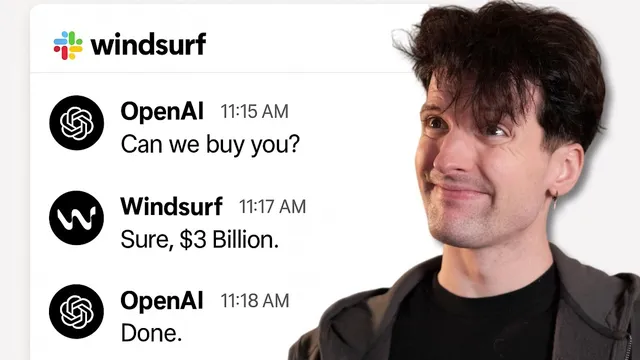
Why is OpenAI buying a VS Code fork???
Based on Theo - t3․gg's video on YouTube. If you like this content, support the original creators by watching, liking and subscribing to their content.
VS Code’s extensibility and open-source status helped AI coding editors scale quickly, but its extension platform limits deeper inline rendering and agentic workflows.
Briefing
OpenAI’s roughly $3 billion acquisition of the VS Code–derived editor Windsurf is less about buying an app and more about buying leverage in the developer market—especially as Anthropic’s models have built strong developer sentiment. The deal isn’t closed yet, but the price has been agreed, and the logic hinges on one point: developers increasingly choose tools based on which AI models feel best in practice, and OpenAI wants to tilt that preference.
The editor ecosystem matters because most “AI coding assistants” now live inside the same extensible foundation: VS Code. Microsoft’s editor became the default for many developers due to its performance and extensibility, plus the fact that it’s open source. That openness, however, comes with a catch. VS Code’s extension platform is powerful for side panels and language-server style features, but it becomes limiting when products try to do deeper inline rendering and agentic workflows—where the editor needs to run multi-step actions across files, not just autocomplete or show richer UI.
That constraint helps explain the rise of AI editors built on VS Code—and the subsequent wave of forks. GitHub Copilot, originally developed through GitHub’s internal experimentation, popularized the idea of “next-token” autocomplete that can carry developers through tedious parts of coding. Cursor then pushed the concept further: it’s a VS Code fork focused on making AI tab completion feel fast and reliable, and it later moved toward more agent-like behavior. Supermaven, another autocomplete-focused tool, ran into VS Code limitations and planned its own editor; Cursor ultimately acquired Supermaven to strengthen its tab-completion capabilities.
Windsurf (formerly associated with Codeium) followed a similar path but with a different emphasis: agentic code editing. Instead of only assisting while typing, Windsurf aims to let users describe changes and have the editor run commands across the codebase—closer to “vibe coding” than incremental autocomplete. The strategy also reflects a broader attempt to cover more of the developer spectrum. Codeium had an enterprise-friendly angle, including strong support for JetBrains, where many Java developers already live. But adoption tends to be slow and uneven in large organizations, and the middle of the market—early adopters—often moves faster.
A key part of the analysis is adoption timing. Early adopters are the “innovators” who try new tools; later segments need different features and smoother UX. The argument is that Windsurf and Codeium leaned too far toward enterprise or “later” needs, while Cursor captured the middle by delivering a workflow developers actually want day-to-day.
So why buy Windsurf now? The acquisition is framed as a developer-sentiment and toolchain integration play. Anthropic is portrayed as the most direct threat because developers often prefer Anthropic models (with many choosing models like 3.5 or 3.7). OpenAI’s goal is to win developers by improving the editor experience and accelerating tool-based workflows—consistent with OpenAI’s broader push toward tool calling in models.
The deal’s financial mechanics also matter: OpenAI’s latest fundraising valued it around $300 billion, so a $3 billion acquisition is about a ~1% trade in ownership terms. That makes the risk feel manageable relative to the potential upside of shifting developer behavior. The analysis ends with a speculative “baller move”: OpenAI could open source Windsurf to reduce friction with developers and potentially pressure Cursor—though it’s uncertain whether that would be enough to dethrone it.
In short, the purchase is presented as a strategic bet that owning (or reshaping) the AI editor layer can help OpenAI outcompete Anthropic in the developer workflow—and prevent a model-and-tool ecosystem from consolidating around a rival.
Cornell Notes
OpenAI’s planned ~$3B acquisition of Windsurf is framed as a developer-market strategy, not just an editor purchase. VS Code’s open-source base enabled AI editor innovation, but its extension limits pushed companies toward forks and acquisitions (e.g., Cursor buying Supermaven) to achieve faster, deeper inline and agentic editing. Windsurf’s differentiator is agentic code editing—describing changes and having the editor run multi-step actions across files—while Codeium/Windsurf also targeted enterprise needs like JetBrains support. The central competitive pressure is Anthropic’s developer sentiment, where many developers prefer Anthropic models for real workflows. OpenAI’s bet is that improving the editor experience can shift developers toward OpenAI models and toolchains, with the ownership dilution risk described as relatively small versus potential adoption gains.
Why did VS Code become the foundation for so many AI coding editors?
What limitation of VS Code pushed tools like Supermaven and Windsurf toward building their own editors?
How does Cursor’s approach differ from Windsurf’s agentic focus?
Why is Anthropic portrayed as the biggest threat to OpenAI in this space?
What does the “adoption curve” framework add to the Windsurf vs. Cursor comparison?
How does the deal’s valuation/dilution factor into the acquisition rationale?
Review Questions
- What specific VS Code extension constraints are cited as barriers to inline and agentic editing, and how did those constraints influence the emergence of forks?
- How does the transcript connect developer sentiment for Anthropic models to OpenAI’s decision to acquire Windsurf?
- Using the innovator-to-early-adopter framework, explain why Cursor might win the “middle” of the market even if Windsurf targets enterprise needs.
Key Points
- 1
VS Code’s extensibility and open-source status helped AI coding editors scale quickly, but its extension platform limits deeper inline rendering and agentic workflows.
- 2
Cursor’s growth is linked to extremely strong, fast AI tab completion, and it expanded capability by acquiring Supermaven.
- 3
Windsurf’s differentiator is agentic code editing—turning natural-language requests into multi-step actions across a codebase.
- 4
The competitive pressure is framed as developer sentiment: Anthropic models reportedly retain strong mindshare among developers for real workflows.
- 5
Adoption timing matters: products that serve the “middle” (early adopters) can outpace tools aimed too far at enterprise or later segments.
- 6
The $3B price is treated as relatively low risk for OpenAI because dilution from the latest $300B valuation makes the ownership trade small compared with potential developer adoption gains.
- 7
OpenAI’s acquisition is also interpreted as a toolchain integration and protection play to prevent Anthropic from consolidating the developer editor ecosystem.