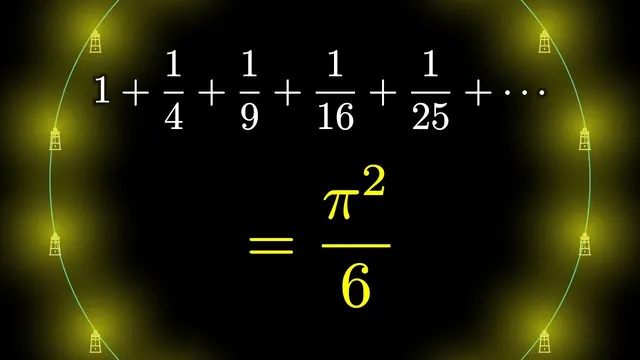
Why is pi here? And why is it squared? A geometric answer to the Basel problem
Based on 3Blue1Brown's video on YouTube. If you like this content, support the original creators by watching, liking and subscribing to their content.
Reinterpret Σ 1/n² as total brightness from an infinite set of lighthouses using the inverse-square law, where brightness scales like 1/n².
Briefing
A classic infinite series—adding the reciprocals of the squares of integers—ends up equal to a multiple of π², and the surprising part is not just the value but why π shows up at all. The “Basel problem” asks what the sum 1 + 1/4 + 1/9 + 1/16 + … approaches. After about 90 years, Leonhard Euler found it equals π²/6. The geometric proof here keeps the same destination but reaches it through circles, angles, and an inverse-square law for light.
The argument begins by translating the series into a physical picture. Imagine an observer at the origin looking at a line of identical lighthouses placed at every positive integer distance. Because light spreads out in three dimensions, brightness falls by the inverse-square law: a lighthouse twice as far away looks four times dimmer, three times as far looks nine times dimmer, and so on. That makes the observer’s total brightness proportional to the sum of 1/n². So the goal becomes showing that the total brightness from an infinite evenly spaced line of lighthouses matches π²/6 times the brightness of the first lighthouse.
Progress comes from a geometric “rearrangement” trick: replacing one lighthouse by two others without changing the observer’s total received brightness. The key relation is an inverse version of the Pythagorean theorem: if a right triangle has legs a and b and hypotenuse h, then 1/a² + 1/b² = 1/h². In the light model, that means a lighthouse at distance h can be traded for two lighthouses at distances a and b along perpendicular directions, with the observer receiving the same total brightness. The proof of this relation is tied to how rays hit a tiny screen: in the limiting case of an infinitesimal screen, the same set of rays corresponds to the same received energy.
With that tool, the construction moves onto a circle. Start with a small circle whose circumference is 2, place a lighthouse opposite the observer, and note that the brightness corresponds to π²/4. Then repeatedly double the circle’s size and replace each lighthouse by two new ones placed where a diameter through the circle’s top meets the larger circle. Right angles created by the diameter ensure the inverse Pythagorean theorem applies at every step, so brightness stays constant. Meanwhile, circle geometry (notably the inscribed angle theorem) forces the new lighthouses to land evenly around the circumference, with fixed spacing. In the limit—circles growing without bound—the setup becomes an infinite line of lighthouses spaced evenly in both directions, yielding the sum of reciprocals of odd squares: Σ_{k odd} 1/k² = π²/4.
Finally, the proof adjusts from “odd-only” to “all integers.” The odd-square sum is π²/8 for positive odds, and comparing even and odd contributions shows that including all integers multiplies the odd-only result by 4/3. That converts π²/8 into π²/6, delivering the Basel answer while making π’s appearance feel geometric rather than mysterious.
Cornell Notes
The Basel problem asks for the limit of 1 + 1/4 + 1/9 + 1/16 + …, which equals π²/6. The proof here reinterprets the series using an inverse-square law for light: brightness from a lighthouse at distance n is proportional to 1/n². A geometric identity—1/a² + 1/b² = 1/h² for a right triangle—lets one replace a single lighthouse by two others without changing the observer’s total brightness. Iterating this replacement around expanding circles turns a line of lighthouses into a limit configuration that yields the odd-square sum π²/4, then a scaling argument converts it to the full Basel sum π²/6.
How does the inverse-square law translate the Basel series into a brightness problem?
What is the inverse Pythagorean theorem, and why does it preserve brightness?
Why do circles and right angles keep showing up in the construction?
How does the inscribed angle theorem force the lighthouses to be evenly spaced?
How does the proof move from the odd-square sum to the full Basel sum?
Review Questions
- In the light-and-screen model, what role does the “tiny screen” (limiting case) play in justifying the inverse Pythagorean theorem?
- During the circle-doubling process, which specific geometric facts guarantee that brightness is preserved at every replacement step?
- Why does comparing even and odd terms lead to a multiplicative factor of 4/3 when converting from the odd-square sum to the full Basel sum?
Key Points
- 1
Reinterpret Σ 1/n² as total brightness from an infinite set of lighthouses using the inverse-square law, where brightness scales like 1/n².
- 2
Use the inverse Pythagorean theorem 1/a² + 1/b² = 1/h² to replace one lighthouse by two at perpendicular geometric positions without changing received brightness.
- 3
Construct an iterative circle-doubling scheme where diameters create right angles, enabling repeated application of the inverse Pythagorean theorem.
- 4
Circle geometry ensures the replaced lighthouses remain evenly spaced via the inscribed angle theorem, so the limit configuration becomes an infinite evenly spaced line.
- 5
The circle limit yields the odd-square sum (π²/4 when including both signs, π²/8 for positive odds).
- 6
Relate even terms to the full series by scaling distances by 2, which introduces a factor of 1/4 and leads to multiplying the odd-only result by 4/3.
- 7
Combining these steps produces the Basel value π²/6.