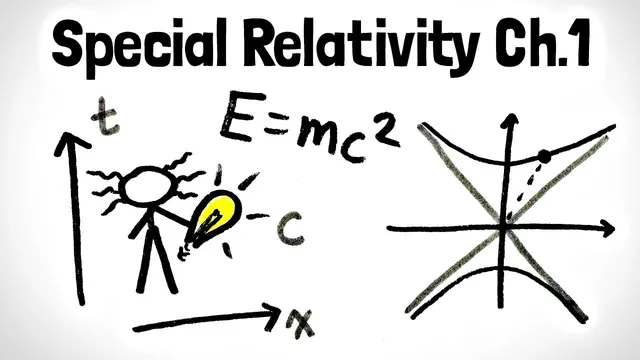
Why is Relativity Hard? | Special Relativity Chapter 1
Based on minutephysics's video on YouTube. If you like this content, support the original creators by watching, liking and subscribing to their content.
Special relativity is often made harder than necessary by an algebra-first presentation that obscures physical meaning behind symbols and square roots.
Briefing
Special relativity is widely known for Einstein’s insights about space, time, and the speed of light—but it’s also widely misunderstood because it’s usually taught through dense algebra full of symbols like Δx and Δx′. The core claim here is that special relativity doesn’t need to be a “square-root maze.” Instead, it can be learned through simpler geometric intuition that makes the theory feel natural rather than mysterious, and that helps explain why the famous paradoxes people hear about aren’t actually contradictions.
The argument starts with a practical problem: special relativity is essential to modern physics, yet it often gets only a brief, squeezed-in treatment in courses that focus on other topics. When it does appear, the presentation tends to emphasize complicated calculations—multiplying and dividing by factors, tracking primed and unprimed quantities, and wrestling with expressions that hide the real physical meaning. That approach can obscure the “mind-blowing insight” underneath the math, leaving learners confused and sometimes turned away from physics altogether.
A second, deeper reason for the confusion is historical. The complicated algebraic style has persisted partly because it resembles how Einstein originally developed the ideas as a professional physicist tackling a difficult intellectual climb. But the transcript argues that modern understanding has revealed a more accessible route: geometric methods that come later and make the same conclusions easier to grasp. The goal of the series is to replace the steep climb with a different path—one that a motivated learner could plausibly follow with the right guidance.
To make that shift concrete, the transcript uses an extended analogy. Learning special relativity is compared to living your whole life thinking the Earth is flat and then being told it’s round. The “round Earth” idea isn’t inherently complicated, but adjusting your intuition—reconciling everyday experiences with the new model—takes effort. Crucially, that effort is different from plugging numbers into formulas. The payoff is also different: once the intuition clicks, predictions like how shadows behave or what happens when you keep walking east become intuitive rather than computational.
That intuition is then given a physical tool: a machined aluminum “space-time globe” designed to build special relativity directly into a hands-on model. The globe is positioned as a way to develop intuition for key phenomena—especially the twins paradox, length contraction, and time dilation—along with the principle that nothing can go faster than light. The series promises that once learners understand the geometric picture, the apparent paradoxes will resolve into common confusions caused by attacking the subject with heavy algebra instead of the underlying structure of space and time.
Cornell Notes
Special relativity often confuses learners because it’s taught through heavy algebra and symbol manipulation, which can hide the physical meaning behind expressions involving quantities like Δx and Δx′. The transcript argues that there’s a simpler path: geometric intuition that makes the theory feel coherent and reduces “paradoxes” to misunderstandings. A major theme is that Einstein’s original approach was hard and historically influential, but later geometric methods provide an easier route. The series aims to build intuition using a hands-on “space-time globe” to connect the theory to concrete effects such as time dilation, length contraction, the twins paradox, and the limit that no signal exceeds the speed of light.
Why does special relativity confuse so many people, even though it’s conceptually accessible?
What change in teaching approach does the transcript advocate?
How does the Earth analogy clarify the kind of mental effort special relativity requires?
What role does the “space-time globe” play in the learning plan?
Which special-relativity results are highlighted as targets for intuition-building?
Review Questions
- What teaching choices (math style, symbol management) are blamed for making special relativity harder than it needs to be?
- Explain the Earth analogy in your own words: what does it say about where the difficulty really lies?
- How does a geometric approach change the way paradoxes like the twins paradox should be interpreted?
Key Points
- 1
Special relativity is often made harder than necessary by an algebra-first presentation that obscures physical meaning behind symbols and square roots.
- 2
The confusion is partly historical: Einstein’s original derivations were difficult, and that complexity has carried forward into modern instruction.
- 3
Geometric intuition is presented as a more accessible route to the same conclusions about space and time.
- 4
Learning relativity requires reworking intuition about everyday experience, not just performing calculations.
- 5
A hands-on “space-time globe” is proposed as a tool to internalize key effects like time dilation and length contraction.
- 6
The series aims to demystify famous “paradoxes” by framing them as misunderstandings rather than contradictions.
- 7
Nothing can exceed the speed of light is treated as a central constraint that should become intuitive through the geometric model.