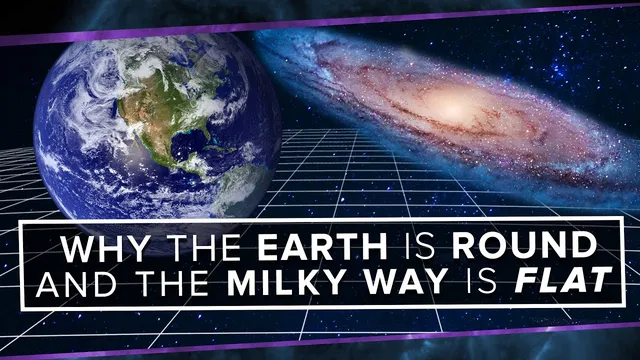
Why is the Earth Round and the Milky Way Flat? | Space Time | PBS Digital Studios
Based on PBS Space Time's video on YouTube. If you like this content, support the original creators by watching, liking and subscribing to their content.
Spherical shapes emerge when pressure dominates gravity and pressure acts with spherical symmetry, letting lateral forces cancel only in a sphere.
Briefing
Earth’s near-spherical shape and the Milky Way’s flat disk aren’t random outcomes—they follow from which physical “counterforce” wins against gravity during formation. When pressure is the main resistance to collapse, it acts equally in all directions, and gravity plus that pressure symmetry naturally favors spheres. When rotation and orbital motion dominate the resistance, matter can’t fall straight inward toward the center without also orbiting, so collapse proceeds into a spinning disk with circular symmetry.
Gravity provides a key baseline because it weakens with distance in the same way in every direction. Under Newton’s law, the gravitational field around an isolated mass has spherical symmetry: at a fixed distance from the center, the strength is the same no matter where you stand. That symmetry matters because equilibrium shapes are the ones where internal forces cancel out. For planets and stars, the stabilizing mechanism is pressure. In a simplified “tower” picture of a planet, weight from above creates a pressure gradient that pushes outward, balancing gravity in the up–down direction. But sideways forces also matter: pressure pushes in all directions, so blocks at the same depth experience equal pressure from neighbors and cancel their lateral pushes. A flattened body breaks that balance because neighboring regions sit at different depths, creating unequal sideways pressure and a net squeeze that drives the material toward a shape where lateral forces cancel—ultimately a sphere.
Rock’s material properties reinforce this tendency. Even if a body is strong against being crushed, it can be weaker against shear, meaning it resists sideways deformation less effectively than compression. For sufficiently large rocky objects—on the order of several kilometers across—self-gravity becomes strong enough to overcome that shear resistance, leading to fracture and reshaping into a sphere. The same logic extends to stars: hydrostatic equilibrium arises because energy from nuclear fusion flows outward from the core, producing pressure that counters gravity. The result is extreme roundness for long-lived objects like the Sun.
Rotation complicates the story but doesn’t overturn it for planets. Spinning creates a centrifugal effect that partially offsets gravity, allowing a slightly larger equatorial radius. For Earth, the rotational contribution at the equator is about 0.03 m/s² compared with 9.8 m/s² from gravity—roughly a 0.3% difference—so the planet remains close to spherical.
Spiral galaxies and solar systems, however, form from collapsing gas clouds that rotate as they contract. As a cloud spins up, conservation of angular momentum forces the gas into orbit around the rotation axis. Gravity still pulls inward and downward, but the inability to lose angular momentum prevents matter from collapsing into a sphere. The cloud collapses mainly along the axis, producing a flattened, rotating disk. That disk structure persists even after clumps form stars in the center and planets further out, leaving the long-lived spiral-galaxy geometry seen in systems like the Milky Way.
The episode ties these shape outcomes to deeper symmetry principles: spheres emerge when pressure’s spherical symmetry dominates gravity, while disks emerge when orbital motion’s circular symmetry dominates. Those same symmetries also connect to conservation laws such as energy and linear and angular momentum.
Cornell Notes
Spheres and disks arise from the balance between gravity and the dominant “resisting” effect during collapse. Gravity’s strength falls off with distance in all directions, giving it spherical symmetry. For planets and stars, pressure provides the counterforce; because pressure pushes outward equally in every direction, lateral forces cancel only when the object is roughly spherical. Rotation changes the details for planets slightly (Earth’s equator bulges by about 0.3%), but it doesn’t create disks. For spiral galaxies and solar systems, rotating gas clouds conserve angular momentum, so matter can’t collapse straight inward; it settles into a spinning disk with circular symmetry, leaving structures like the Milky Way’s flat form.
Why does pressure favor spherical shapes for planets and stars?
How do material strength and size determine whether a rocky body becomes spherical?
What role does Earth’s rotation play in its shape?
Why don’t spiral galaxies collapse into spheres the way planets do?
What symmetry principle links the final shapes to the dominant forces?
Review Questions
- In the “block tower” model, which force balance fails first when a planet is flattened, and why?
- What changes in a rotating gas cloud during collapse that prevents spherical formation and produces a disk?
- How does the magnitude of Earth’s rotational effect compare to gravity, and what does that imply for how spherical Earth remains?
Key Points
- 1
Spherical shapes emerge when pressure dominates gravity and pressure acts with spherical symmetry, letting lateral forces cancel only in a sphere.
- 2
Disk shapes emerge when rotation and orbital motion dominate gravity’s collapse, because angular momentum forces matter into circular orbits around an axis.
- 3
Gravity’s inverse-square behavior gives it spherical symmetry around an isolated mass, so the deciding factor is usually the symmetry of the counteracting effect.
- 4
For rocky bodies, high compressive strength isn’t enough to prevent sphericity; lower shear strength plus sufficient size allows self-gravity to fracture and reshape them into spheres.
- 5
Earth’s spin causes only a small equatorial bulge: the rotational acceleration at the equator is about 0.03 m/s² versus 9.8 m/s² from gravity.
- 6
Stars stay round through hydrostatic equilibrium: outward pressure from fusion balances inward gravity over long timescales.
- 7
Rotating interstellar clouds collapse into disks because matter can’t move inward toward the axis without orbiting, so collapse proceeds mainly along the axis.