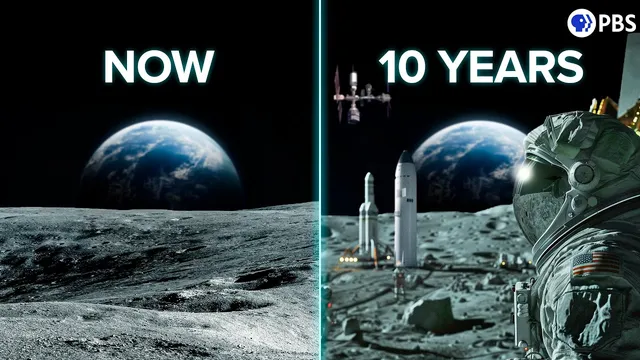
Why Is The World Rushing Back To The Moon?
Based on PBS Space Time's video on YouTube. If you like this content, support the original creators by watching, liking and subscribing to their content.
Lunar water—especially near the south pole—is the central reason the Moon is shifting from a science target to a resource for deep-space missions.
Briefing
The world is rushing back to the Moon because lunar water—especially near the south pole—could turn Earth’s nearest neighbor from a science target into a practical base for deep-space exploration. Recent missions and landings by multiple countries and private companies have reinforced the idea that the Moon is not just a cratered relic of the early solar system, but a resource-rich staging ground where future crews could live, refuel, and launch onward.
The Moon’s importance starts with what it lets humanity measure and learn. Its size relative to Earth makes it a uniquely accessible “laboratory” for understanding the Earth–Moon–Sun system: lunar phases and eclipses reveal the geometry of the system and enable early distance calibration, while the Moon’s gravity helped make Newton’s law of universal gravitation workable in practice. Historically, that knowledge translated into capability—Apollo proved humans could land and operate on another world, and the broader Cold War-era push helped convince planners that inter-world travel was feasible.
But the current surge is driven by a specific discovery: water at the lunar south pole. India’s Chandrayaan-1 mission, using the Moon Impact Probe, detected significant water-related signals in the tenuous atmosphere during a hard landing in Shackleton Crater. The measurements are indirect, interpreted as hydrogen likely tied to ice, water, or hydroxyl-bearing minerals in the soil. At the same time, earlier evidence pointed to ice in permanently shadowed craters, and a growing consensus suggests substantial ice may also exist in sunlit regolith—meaning far more usable water than previously assumed.
That resource matters because water is heavy to launch from Earth and expensive to transport. On the Moon, it could support life and industrial processes without the same launch burden. The transcript frames water as a “game changer” for building infrastructure, recycling supplies, and enabling sustained operations. It also highlights a pathway to rocket fuel: electrolysis can split water into hydrogen and oxygen, which can be recombined for energy or used as propellant. With solar arrays near the poles, the Moon could function as a refueling depot—reducing the amount of fuel missions must carry from Earth and extending reach to destinations like Mars, the asteroid belt, and beyond.
Momentum is building across nations and companies. Intuitive Machines achieved a private soft landing with its Odysseus lander near the lunar south pole region, taking images and collecting data despite tipping on touchdown. India followed with Vikram from Chandrayaan-3, deploying the Pragyan rover in the south pole region. China’s Chang’e program has already landed on the far side (Chang’e-4), returned samples to Earth (Chang’e-5), and is planning further south-pole-focused missions (including Chang’e-6 and experiments under Chang’e-8) aimed at preparing for a crewed lunar base by 2030 and a permanent outpost by the mid-2030s in collaboration with Russia.
The United States is also pivoting back. NASA’s Artemis program uses the Space Launch System and Orion spacecraft, with Artemis 1 and Artemis 2 already mapped to lunar orbit tests and Artemis 3 targeting lunar surface landings. Artemis also includes the Lunar Gateway in lunar orbit, designed to support a surface base and serve as a staging point for other missions. The transcript notes criticism of building in orbit instead of on the surface, but argues Gateway’s role is to support surface operations and broader exploration.
The return to the Moon is increasingly international and infrastructure-focused, with even timekeeping plans such as an internationally agreed Lunar Standard Time. Still, competition is emerging—especially between the U.S. and China—with Russia aligning more with China and Europe leaning toward the U.S. Private companies are expected to play a larger role. The overall forecast: within about a decade, humans may be back on the Moon, and the Moon may soon shift from a destination to a platform for the next phase of space exploration.
Cornell Notes
The Moon is becoming a priority again because evidence points to usable water—most importantly near the lunar south pole. That water could support life and enable in-situ resource use, including making rocket fuel via electrolysis (splitting H2O into hydrogen and oxygen). Multiple landings and missions by private companies and countries are building capability for operating in harsh polar conditions. The transcript connects these resource prospects to major plans: China’s Chang’e program and planned crewed base, and NASA’s Artemis program with Orion, the Space Launch System, and the Lunar Gateway. If lunar refueling becomes practical, missions could carry less fuel from Earth and reach farther destinations like Mars and the asteroid belt.
Why does lunar water—especially at the south pole—change the Moon’s role in space exploration?
What did Chandrayaan-1 contribute to the current focus on the lunar south pole?
How do recent landings demonstrate that polar operations are becoming feasible?
What is the strategic logic behind using the Moon as a refueling depot?
How do Artemis and China’s lunar plans differ in approach, and what do they share?
What tensions could shape the next phase of lunar exploration?
Review Questions
- What evidence supports the claim that the lunar south pole contains significant water, and why are the detections described as indirect?
- How does electrolysis of lunar water translate into a practical advantage for long-range space missions?
- Compare the roles of the Lunar Gateway and a surface base in Artemis, and explain how that relates to the broader goal of sustained lunar operations.
Key Points
- 1
Lunar water—especially near the south pole—is the central reason the Moon is shifting from a science target to a resource for deep-space missions.
- 2
Chandrayaan-1’s Moon Impact Probe detected water-related signals in the Shackleton Crater region, supporting the idea of substantial ice even beyond permanently shadowed areas.
- 3
Private and national landings (Intuitive Machines’ Odysseus; India’s Chandrayaan-3 with Pragyan) show that polar landing and surface operations are increasingly achievable.
- 4
Electrolysis could convert lunar water into hydrogen and oxygen, enabling in-situ rocket fuel production and reducing the amount of propellant launched from Earth.
- 5
A lunar refueling depot would let missions carry only enough fuel to reach the Moon, then top up for destinations like Mars and the asteroid belt.
- 6
China’s Chang’e program and planned crewed base timeline target south-pole capabilities, while NASA’s Artemis combines crewed lunar missions with the Lunar Gateway to support a surface base.
- 7
International coordination is growing, but geopolitical competition—particularly between the U.S. and China—could shape who builds what first and how fast.