WHY IS THERE A MOON? .... and more!
Based on Vsauce's video on YouTube. If you like this content, support the original creators by watching, liking and subscribing to their content.
The Moon’s low density and lack of a large metal core suggest it formed from Earth-like crust and mantle material rather than Earth’s core material.
Briefing
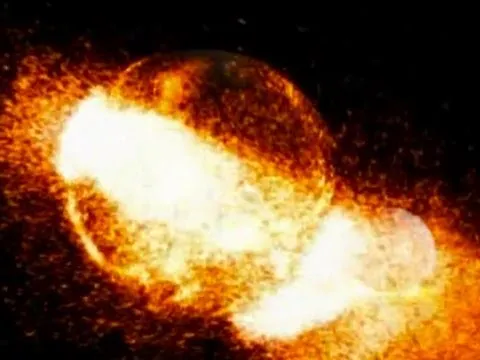
The Moon’s existence makes less sense than its neighbors—because it’s made of Earth-like crust and mantle material but lacks Earth’s dense metal core—so scientists point to a violent origin story: a Mars-sized body called Theia collided with Earth, ejecting rocky material that later coalesced into the Moon. The timing matters too. After the solar system formed from a spinning solar nebula roughly 4.6 billion years ago, Earth and other planets emerged as the surrounding disk of debris condensed. Within that early chaos, the Moon likely formed about 4.52 billion years ago, when Theia struck Earth. The collision is believed to have fused the cores of Theia and Earth while forcefully launching Earth’s crust and mantle into space. That expelled material then orbited Earth and—according to the account here—came together into a Moon in about a week.
That same impact would have left a lasting fingerprint on Earth’s climate and geography. The collision was strong enough to tilt Earth’s rotation axis by about 23.5 degrees, a tilt that still underpins the seasons. With the Moon’s formation tied directly to Earth’s tilt, the Moon stops being a random satellite and becomes a key piece of Earth’s long-term story.
The discussion then pivots from planetary origins to Earth’s surface evolution, emphasizing slow but relentless motion. As Earth cooled, continents formed from crustal pieces floating on molten interior layers. These plates drift over time, and the landmasses periodically gather into supercontinents. Every 300 to 500 million years, continents converge into a single large landmass; Pangaea is the most famous example, though earlier supercontinents may have existed in greater numbers than just one.
Finally, the geography lesson uses the UK as a practical map of definitions—because names that sound interchangeable often refer to different political or physical entities. The British Isles and Ireland are described as a cluster of about 6,000 islands off Europe’s coast. Great Britain is the largest island in that group and contains three countries: England, Wales, and Scotland. Add Northern Ireland and the result is the United Kingdom (UK). Ireland is split into two: Northern Ireland belongs to the UK, while the Republic of Ireland is a separate country. England is also where London sits, tying the geography back to the London location where the lesson begins in Regent’s Park.
Taken together, the core through-line is that big outcomes—seasons, the Moon, and even how people label places—trace back to foundational processes: early solar system collisions, plate tectonics over hundreds of millions of years, and careful distinctions between geographic islands and political borders.
Cornell Notes
The Moon’s low density and lack of an Earth-like metal core point to a different origin than the other inner planets. A leading explanation is that a Mars-sized body, Theia, collided with Earth about 4.52 billion years ago, fusing cores and ejecting Earth’s crust and mantle into space. That debris then orbited Earth and coalesced into the Moon in roughly a week. The same impact tilted Earth’s rotation axis by about 23.5 degrees, helping drive the seasons. The lesson then connects deep time to Earth’s surface by describing drifting continents that periodically form supercontinents like Pangaea, and it clarifies UK geography terms such as Great Britain and the United Kingdom.
Why does the Moon look “different” from the terrestrial planets near the Sun?
What collision-based model explains the Moon’s composition and formation timing?
How does the Moon’s formation connect to Earth’s seasons?
What drives the formation of supercontinents, and how often do they appear?
How do the terms Great Britain, United Kingdom, and Ireland differ?
Where does England fit into the geography lesson’s map?
Review Questions
- What specific evidence about density and internal structure motivates the collision theory for the Moon’s origin?
- According to the explanation given, how does the Theia impact simultaneously produce the Moon and affect Earth’s axial tilt?
- How do the definitions of Great Britain and the United Kingdom change when Northern Ireland is included?
Key Points
- 1
The Moon’s low density and lack of a large metal core suggest it formed from Earth-like crust and mantle material rather than Earth’s core material.
- 2
A collision with a Mars-sized body called Theia is presented as the mechanism ejecting crust and mantle into space to form the Moon.
- 3
The Moon’s formation is placed at about 4.52 billion years ago, with coalescence described as taking roughly a week.
- 4
The same impact is linked to an Earth axial tilt of about 23.5 degrees, which underpins the seasons.
- 5
Continents drift slowly as crustal plates move over Earth’s molten interior, periodically merging into supercontinents.
- 6
Supercontinents are described as forming every 300 to 500 million years, with Pangaea as the most recent example.
- 7
UK geography depends on precise definitions: Great Britain includes England, Wales, and Scotland; adding Northern Ireland yields the United Kingdom; the Republic of Ireland is separate.