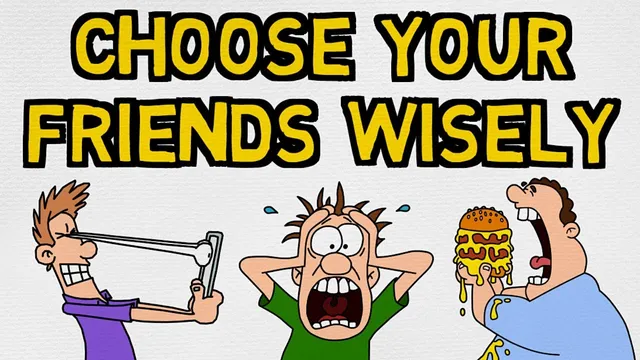
Why It Matters Who Your Friends Are
Based on Better Than Yesterday's video on YouTube. If you like this content, support the original creators by watching, liking and subscribing to their content.
Conformity often comes from the desire to avoid social exclusion, not from genuine agreement with the group’s actions.
Briefing
People rarely follow the “independent thinker” script when social pressure is strong—because humans are wired to fit in. The cliff-jumping thought experiment lands on a blunt reality: if everyone else is doing it, many people will likely follow, not from conviction but from a deep desire not to be the odd one out. A childhood classroom example makes the mechanism concrete: even students who wanted to stay home from skipping class still joined the skip because each assumed everyone else was skipping. That creates a self-reinforcing loop where “normal” is defined by what others appear to be doing, even when the assumption is wrong.
The same psychology helps explain why public health messaging can backfire. Statistics about widespread inactivity and unhealthy eating—like “80% of Americans don’t get enough exercise,” “40% eat junk food daily,” and “almost 100 pounds of sugar per year”—are meant to shock. But when people learn they’re part of the majority, their brains may interpret it as permission: if most others aren’t changing, then changing feels unnecessary. The argument isn’t that the numbers are false; it’s that repeated exposure can shift what feels “normal,” making unhealthy patterns seem acceptable.
Long-running social research from Framingham is used to show how powerful “normal” can be. Tracking more than 12,000 residents over 32 years, researchers found evidence that weight gain and obesity spread through social ties—analogous to how an illness can move through a community. A sister becoming obese raised a woman’s risk by 67%; a brother becoming obese raised a man’s risk by 44%. When a close friend became obese, the risk rose by 57%. The same network effects appeared for other behaviors: increased alcohol use spread through social connections, and smoking habits were more likely to catch on when someone nearby started.
Importantly, the pattern cuts both ways. Quitting smoking increased the odds that friends and family would quit too; stopping drinking reduced the frequency of hangovers among friends; and weight loss spread through the social network as well. The takeaway is not fatalism—“nobody is immune”—but network awareness. Behaviors spread through relationships, not just geography. A stranger smoking nearby doesn’t meaningfully raise someone’s odds of smoking; a close friend starting does.
That leads to the main prescription: choose friends wisely. People around you shape your sense of what counts as normal—whether that’s gym routines, drug use, ambition, or harmful habits. The advice is also practical: don’t necessarily cut off everyone who doesn’t match your standards, but limit exposure and invest more time in people who lift you up. Finally, influence is reciprocal. If someone wants better habits and self-control to spread among their own circle, they must model the behavior—because success and discipline can propagate just as readily as poor choices.
Cornell Notes
Humans tend to conform when they believe others are doing something, even when the “right” answer is to resist. The transcript argues that social norms—what feels normal—can be shaped by the majority, and that even alarming statistics may unintentionally reinforce unhealthy behavior by making it seem typical. Evidence from long-term Framingham data suggests behaviors like obesity, alcohol use, and smoking can spread through social networks, while positive changes like quitting smoking, reducing drinking, and losing weight can also spread. The practical conclusion is to choose friends and environments carefully, limit exposure to negative influences, and model good habits because influence flows both directions.
Why do people sometimes follow a harmful group choice even when they believe they shouldn’t?
How can public health statistics about unhealthy behavior affect individual choices?
What does the Framingham study contribute to the case for social influence?
Does the influence of others depend on physical proximity?
What evidence is offered that good behavior can spread too?
What practical steps does the transcript recommend for managing social influence?
Review Questions
- What mechanisms explain why people may conform to a group behavior even when they personally disagree with it?
- How do the transcript’s examples distinguish between geographic proximity and social network influence?
- What does the Framingham evidence suggest about both negative and positive behavior spreading through relationships?
Key Points
- 1
Conformity often comes from the desire to avoid social exclusion, not from genuine agreement with the group’s actions.
- 2
Repeated exposure to “majority behavior” can shift what feels normal and reduce motivation to change.
- 3
Long-term social-network data from Framingham links obesity and weight gain to friend and family connections, with measurable risk increases.
- 4
Behavior spread depends more on relationship closeness than on physical proximity.
- 5
Unhealthy habits can propagate, but so can positive changes like quitting smoking, reducing alcohol-related harm, and losing weight.
- 6
Choosing friends and managing exposure to negative influences can reshape perceived norms and daily behavior.
- 7
Influence is reciprocal: modeling better habits can help improve the habits and motivation of people around you.