Why It's Impossible to Tune a Piano
Based on minutephysics's video on YouTube. If you like this content, support the original creators by watching, liking and subscribing to their content.
Harmonics arise from fixed-end standing waves, making string frequencies proportional to the harmonic number times the fundamental frequency.
Briefing
A piano can’t be tuned perfectly using the same “harmonic math” that makes violins, guitars, and other string instruments so straightforward—because the piano’s many keys force incompatible frequency ratios to line up across the entire keyboard. Harmonics work by letting a vibrating string resonate only in specific standing-wave patterns: the string’s vibration frequency is proportional to the number of “bumps” (harmonic number) times the fundamental frequency. That creates clean pitch relationships—octaves, fifths, fourths, major thirds, and more—based on simple integer ratios like 2:1 for an octave or 3:2 for a perfect fifth.
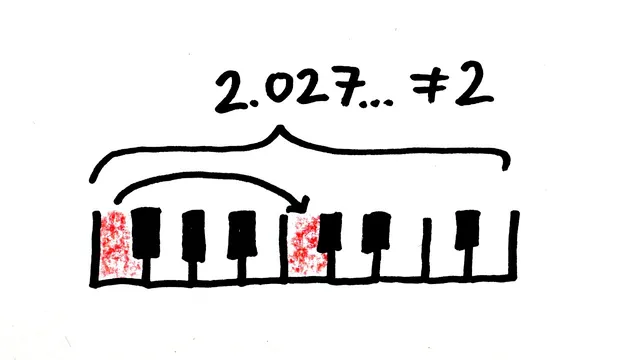
The trouble starts when tuning by matching harmonics across adjacent strings or keys. On instruments with fewer strings, a consistent rule can be applied—for instance, on a violin family instrument, the third harmonic on one string lines up with the second harmonic on the next string up. But a piano (and historically the harpsichord/clavichord) has too many strings: one for each of the 12 semi-tones across multiple octaves. If someone tries to tune by “whole steps” using harmonics—comparing, for example, the ninth harmonic on one key to the eighth harmonic two keys up—the math eventually fails. After repeating the process across six steps, the frequency should land exactly one octave higher (a factor of 2), yet harmonic tuning multiplies by (9/8) each step, giving (9/8)^6 ≈ 2.0273 instead of 2. Other interval choices don’t fix the mismatch: using major thirds yields (5/4)^3 = 1.953125, fourths give about 1.973, and fifths again land near 2.027. Even half-step attempts miss by nearly 10%. In short, there’s no way to choose a single harmonic-based scheme that stays perfectly consistent across all keys.
Because perfect harmonic tuning can’t be made to work globally, modern pianos use equal tempered tuning. Each semitone multiplies frequency by the 12th root of 2, an irrational number that can’t be built from simple harmonic ratios. The payoff is consistency: after 12 semitone steps, the product becomes exactly 2, so octaves are perfect. The cost is that only the octave is truly “perfect.” Other intervals drift slightly: fifths come out a bit flat, fourths sharp, major thirds sharp, minor thirds flat, and so on. Chords built from these intervals can produce a subtle beating effect—described as a “wawawawawa” shimmer—that harmonic tuning would avoid. Still, equal temperament lets musicians play in any key with predictable, repeatable tuning, even if every non-octave interval is slightly off.
Cornell Notes
Harmonics let strings vibrate in fixed standing-wave patterns, producing pitch relationships tied to simple integer ratios (like 2:1 for octaves and 3:2 for perfect fifths). That works well for instruments where a consistent harmonic match can be applied across neighboring strings. A piano’s keyboard, however, requires consistent tuning across many semi-tones, and harmonic-based tuning accumulates errors: repeated harmonic ratios don’t land exactly on an octave (e.g., (9/8)^6 ≈ 2.0273 instead of 2). Since perfect harmonic tuning can’t be made consistent across all keys, pianos use equal temperament, multiplying each semitone by the 12th root of 2. This guarantees perfect octaves but makes other intervals slightly sharp or flat, creating mild beating in some chords.
Why do harmonics produce specific pitch ratios like octaves and fifths?
What goes wrong when trying to tune a piano using harmonic matches across semi-tones?
Why can’t the piano use the same kind of harmonic consistency that works on violins or cellos?
How does equal temperament fix the “octave mismatch” problem?
What trade-off does equal temperament make for intervals other than octaves?
Review Questions
- What mathematical condition must be satisfied for harmonic tuning to produce perfect octaves after repeating a step six times?
- Compare the outcomes of using (9/8)^6 versus the ideal factor of 2 when tuning by whole steps—what does the difference imply?
- Why does equal temperament guarantee perfect octaves even though it uses an irrational semitone ratio?
Key Points
- 1
Harmonics arise from fixed-end standing waves, making string frequencies proportional to the harmonic number times the fundamental frequency.
- 2
Simple integer ratios explain many named intervals (octave, fifth, fourth, major/minor thirds) in harmonic tuning.
- 3
A piano’s many semi-tones prevent any single harmonic-based tuning scheme from staying consistent across the whole keyboard.
- 4
Repeated harmonic ratios accumulate error; for example, (9/8)^6 ≈ 2.0273 rather than the required octave factor of 2.
- 5
Equal temperament tunes each semitone by multiplying frequency by the 12th root of 2, making octaves exact after 12 steps.
- 6
Equal temperament sacrifices perfection for non-octave intervals, producing slight sharp/flat shifts and mild beating in some chords.