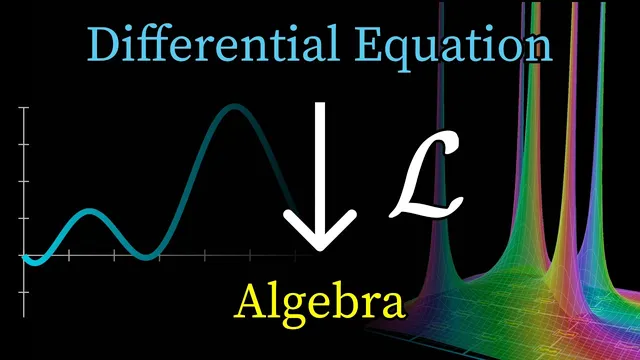
Why Laplace transforms are so useful
Based on 3Blue1Brown's video on YouTube. If you like this content, support the original creators by watching, liking and subscribing to their content.
Laplace transforms convert time derivatives into multiplication by s in the transformed domain, with subtraction terms that encode initial position and velocity.
Briefing
A damped mass–spring system driven by a periodic external force settles into a steady oscillation at the *driving* frequency, while a second, transient motion tied to the system’s natural frequency fades away. The “wibbly startup” comes from two competing sets of terms in the solution: decaying modes from the unforced oscillator and a persistent cosine mode forced by the external wind. Laplace transforms make that split visible and computable by turning differential equations into algebra in the complex s-plane, where the locations of poles directly predict oscillation and decay.
The setup begins with a classic harmonic oscillator: a mass m attached to a spring with stiffness k, optionally damped by a term proportional to velocity with coefficient μ. Without forcing, the system oscillates at its natural frequency determined by the parameters, and damping makes those oscillations decay. Add a third force—an external oscillation modeled as a cosine—and the motion initially looks irregular: the amplitude swells and shrinks before locking into a regular rhythm. Laplace transforms provide a systematic way to analyze exactly why that transient phase lasts and what the eventual steady-state amplitude will be.
The key tool is the Laplace transform’s handling of derivatives. Taking the Laplace transform of f′(t) turns differentiation in time into multiplication by s in the transformed domain, but with a correction term that subtracts the initial value f(0). Applying the rule again shows that higher derivatives become higher powers of s, again with built-in initial-condition terms. This is the mechanism that converts the original differential equation into a rational expression: a polynomial in s multiplying the transformed unknown X(s), plus extra terms encoding initial position and velocity.
With the simplifying assumption that the mass starts from rest (x(0)=0 and x′(0)=0), the transformed equation yields a denominator that factors into two groups of poles. One group comes from the oscillator’s characteristic polynomial (the “mirror image” of the unforced dynamics). Those poles typically have negative real parts (so their contributions decay) and nonzero imaginary parts (so they oscillate). The other group comes from the Laplace transform of the forcing term cos(ωt), producing poles at s = iω and s = −iω. Those poles lie on the imaginary axis, meaning they generate a persistent oscillation with frequency ω and no decay.
In the s-plane picture, the transient “startup” corresponds to the decaying pole contributions still being significant early on; as time passes, those left-half-plane poles fade, leaving only the imaginary-axis poles. That’s why the system eventually follows a clean cosine synced to the external force, even when the driving frequency is unrelated to the spring’s natural resonant frequency.
To get an explicit time-domain formula, the rational expression in X(s) is decomposed into partial fractions. Each pole location becomes an exponential term in time, and pairs of complex-conjugate imaginary poles combine into a cosine for the steady state. The remaining algebra determines the amplitude, which depends on how close the driving frequency is to the resonant frequency—an insight with practical stakes for engineering structures like bridges.
Finally, the derivative-to-multiplication rule is justified in three ways: by checking it on exponentials (where differentiation is simple), by deriving it from the Laplace transform definition using integration by parts, and by connecting it to the deeper structure of inverse Laplace transforms—hinting at contour integrals and a unified theory that will be developed next.
Cornell Notes
Laplace transforms turn differential equations into algebra by mapping time derivatives to multiplication by s, with correction terms that automatically incorporate initial conditions. For a damped mass–spring system driven by a cosine force, the transformed solution X(s) has poles coming from two sources: the oscillator’s natural dynamics and the forcing frequency. Poles with negative real parts produce oscillations that decay, explaining the irregular startup phase. Poles at s = ±iω produce a non-decaying cosine at the driving frequency, explaining the eventual steady rhythm. Partial fraction decomposition then converts the pole structure back into an explicit time-domain solution, including the steady-state amplitude and its dependence on frequency mismatch.
Why does the mass–spring motion look irregular at first, then become a clean cosine?
How does the Laplace transform convert differentiation into algebra, and where do initial conditions enter?
What do poles in X(s) tell you about oscillation and stability?
Why does a cosine forcing term produce poles at s = ±iω?
How does partial fraction decomposition produce the time-domain solution?
What frequency relationship matters for the steady-state amplitude?
Review Questions
- In the Laplace-domain solution for a driven damped oscillator, which pole locations correspond to transient decay versus persistent oscillation, and how can you tell from their positions in the s-plane?
- How do the terms involving f(0) and f′(0) arise when transforming second derivatives, and why are they essential for matching the initial physical state?
- If the external force were not cos(ωt) but another periodic function, what would you expect to change in the pole structure of X(s), and how would that affect the long-term motion?
Key Points
- 1
Laplace transforms convert time derivatives into multiplication by s in the transformed domain, with subtraction terms that encode initial position and velocity.
- 2
For a damped mass–spring system driven by cos(ωt), the transformed solution has poles from both the natural oscillator dynamics and the forcing term.
- 3
Poles with negative real parts generate oscillations that decay, explaining the irregular startup before steady behavior emerges.
- 4
Poles at s = ±iω generate a persistent cosine at the driving frequency, explaining why the long-term motion locks to the external rhythm.
- 5
The “wibbly startup” is the period when decaying natural-mode contributions are still significant compared with the non-decaying forced-mode contribution.
- 6
Partial fraction decomposition maps pole locations back into exponentials in time, and complex-conjugate imaginary poles combine into cosines.
- 7
The steady-state amplitude depends strongly on the frequency mismatch between the driving frequency and the system’s resonant frequency, with direct engineering implications.