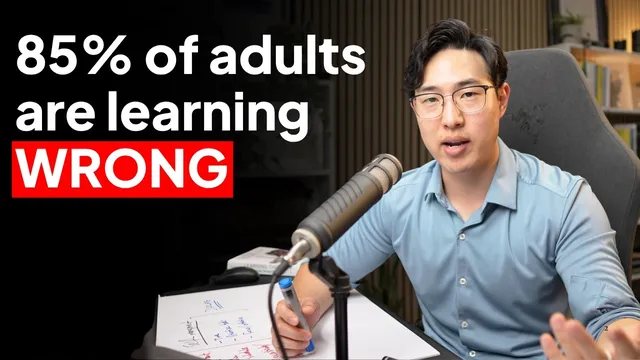
Why Learning Is So Hard As An Adult
Based on Justin Sung's video on YouTube. If you like this content, support the original creators by watching, liking and subscribing to their content.
Adult learning pressure is driven by faster knowledge growth and shorter useful lifespans, forcing continuous retraining while working.
Briefing
Adult learning feels like a losing battle because the knowledge required to stay employable is expanding faster than most people can study—yet the real bottleneck is often not time, but slow, outdated learning processes. Human knowledge has been doubling repeatedly since 1900 (with some estimates suggesting a much faster pace today), while the “useful” lifespan of what’s learned shrinks. Professionals therefore face a cycle of continuous retraining: by the time someone finishes a degree, parts of that knowledge may already be outdated, and maintaining a career can require learning “an entire degree’s worth” every few years while working.
That mismatch creates a familiar squeeze. People feel guilty for not spending evenings and weekends with family, friends, or rest, and still end up behind. Even high-achieving professionals describe extreme schedules—such as a trauma surgeon waking at 4:30 a.m. to study before long shifts that run until late night—because the pressure to keep up has shifted from “advance your career through learning” to “learning is required just to maintain it.” But the harder part isn’t only the workload; it’s that many adults rely on study habits built for school exams, not for modern professional demands.
School-based learning is shaped by exams: the goal is to pass, not to develop adaptable expertise. Historically, standardized exams emerged from 1800s British civil service selection, emphasizing recall and filtering rather than feedback and growth. That legacy still shows up in common exam strategies—cramming, repeating more rounds, and compensating for inefficiency by adding hours. Those tactics can work when the target is a test and the feedback loop is simpler, but they break down when professionals must learn large volumes, apply knowledge creatively, and solve problems under real-world constraints.
A key reframing offered is “reverse causation” behind the phrase “I don’t have time.” Time is relatively fixed; what’s changeable is learning effectiveness. When someone says they lack time, the underlying issue is that the learning process they’re using produces too little knowledge per unit time. If the knowledge threshold for a job, promotion, or career change is essentially set, then slow learning forces people to compensate by sacrificing sleep, relationships, and hobbies. Faster learning frees time while still reaching the required standard.
Why doesn’t everyone simply optimize? Because adult learning habits become autopilot through years of experience. Those habits were reinforced by past results—often exam performance—but the environment has changed. Updating methods can feel psychologically uncomfortable, cognitively difficult, and risky when stakes are higher than in school. People also may not believe efficient learning is possible if they’ve never experienced it.
The transcript also challenges another assumption: effective learning requires long, uninterrupted study blocks. Busy adults—especially those with kids—often get only 20–30 minute windows. Techniques such as microchunking and cognitive “bookmarking” can make short intervals productive, illustrated by an athlete who studied in small gaps (including commute time and brief bathroom breaks) while training intensely.
Finally, the argument ties learning efficiency to an AI-era competitive edge through a “book-to-brain barrier.” Access to information is becoming nearly instantaneous, so the advantage won’t come from faster retrieval (minutes vs. seconds), but from extracting, integrating, and turning information into real expertise. The practical takeaway is to challenge entrenched assumptions, redesign learning habits, and avoid sacrificing everything just to create more study time.
Cornell Notes
Adult learning feels harder because required knowledge is expanding and becoming obsolete faster, while many people rely on study habits built for exam-based schooling. The core reframing is “reverse causation”: “I don’t have time” usually means the current learning process is too slow, not that time itself can’t be increased. Since learning habits become autopilot and were reinforced by past results, changing them can be uncomfortable and risky—especially when career stakes are high. Efficient learning can still happen in short windows using approaches like microchunking and cognitive bookmarking, and the long-term payoff is crossing the “book-to-brain barrier” in an AI age where information access is nearly instant.
Why does adult learning feel like it’s constantly falling behind even for high performers?
How does the “reverse causation” idea change what “I don’t have time” really means?
What’s wrong with many exam-oriented study habits for professional life?
Why don’t adults just switch to more efficient learning methods?
How can effective learning work without long uninterrupted study blocks?
What is the “book-to-brain barrier,” and why does it matter in an AI age?
Review Questions
- What does “reverse causation” imply about the relationship between time and learning effectiveness?
- Which exam-oriented habits (e.g., cramming, repetition) are least aligned with professional learning goals, and why?
- How do microchunking and cognitive bookmarking help when adults only have 20–30 minute windows?
Key Points
- 1
Adult learning pressure is driven by faster knowledge growth and shorter useful lifespans, forcing continuous retraining while working.
- 2
“I don’t have time” is often a symptom of slow learning processes rather than a true lack of available time.
- 3
Exam-trained strategies like cramming and compensating with more hours can fail when professional goals require application and problem-solving.
- 4
Learning habits become autopilot through past success, making change uncomfortable and risky when career stakes are high.
- 5
Efficient learning can be done in short windows using methods such as microchunking and cognitive bookmarking instead of relying on 3–5 hour blocks.
- 6
In an AI era, competitive advantage shifts from information access speed to the ability to convert information into real expertise (“book-to-brain barrier”).