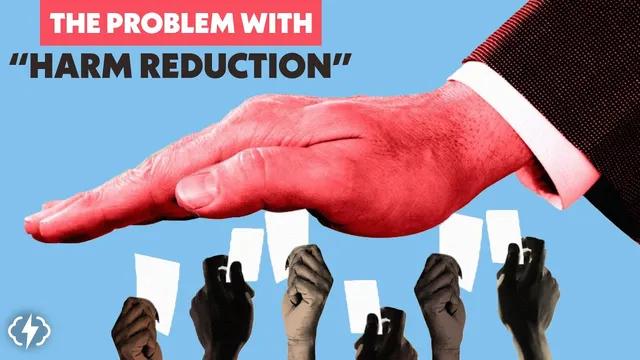
Why Liberalism Won't Solve Anything
Based on Second Thought's video on YouTube. If you like this content, support the original creators by watching, liking and subscribing to their content.
The transcript argues that lesser-evil politics often prevents some immediate worst outcomes while still failing to produce real progress.
Briefing
Liberal “lesser evil” politics is portrayed as a system-level distraction: even when it can prevent some immediate worst-case outcomes, it narrows political life to election day while leaving the underlying power structure intact. The core claim is that harm-reduction framing—especially when it becomes a moral mandate to vote for the “blue” option—does not deliver real progress; it often just manages damage while the political center keeps shifting right under corporate influence.
The argument is built around a blunt metaphor: pulling a knife out partway is not progress if the blade remains lodged. That framing is used to assess the Biden presidency as a case study in “good-ish” reforms paired with continued or expanded coercive and pro-corporate policies. On the positive side, Biden is credited with reversing some Trump-era actions and advancing a limited set of left-leaning measures: canceling the Keystone pipeline, reversing methane-emissions policies, overturning the Muslim ban, freeing resources for disaster response after the 2017 hurricane in Puerto Rico, passing a child tax credit, extending a pause on student loan repayment, and resuming a pause on federal executions.
But the bulk of the assessment lists what’s described as the “rest” of the record—policies that, in the speaker’s view, keep the wound open. These include continued border detainment and reinforcement with Mexico, more deportations under Title 42 than under Trump, ongoing drone strikes that still kill civilians despite no formal U.S. war, increased police budgets and expanded access to military equipment, and escalating tensions with major rivals and adversaries. The account also highlights continued military and foreign-policy commitments: sanctions affecting Afghanistan, support for Israel’s actions toward Palestinians, arms supplied to Saudi Arabia amid Yemen’s humanitarian crisis, and a higher military budget. Domestically, it points to surveillance expansion, pressure on Julian Assange’s prosecution, and efforts to seize reporters’ records. It further argues that pandemic management favored insurers and manufacturers through reimbursement structures and intellectual-property waivers, reducing testing access and slowing resolution—thereby increasing the chance of variants.
The same pattern is extended beyond federal politics. Even in “blue” states and cities, the argument says, democratic branding doesn’t prevent militarized policing, regressive tax burdens, and widening inequality—citing examples like New York City’s police state dynamics and Washington’s tax structure and housing/education disparities. The conclusion is that defending a party that repeatedly under-delivers doesn’t win anything lasting, because the political system is designed to preserve a status quo where plutocratic interests dominate.
From there, the prescription shifts from electoral strategy to time allocation and institution-building. The emphasis is on spending most political energy outside ballot-box cycles—mutual aid, organizing, education about political theories, and direct efforts to improve lives—while treating elections as limited tools that often stop short of representing collective interests. The argument also claims the U.S. electoral system itself is structurally anti-democratic: first-past-the-post rules, territorial representation, and barriers to voting mean power repeatedly concentrates among the wealthy and well-connected. The final message is a call to resist “lesser evil” obsession as a purposeful distraction, and to redirect effort toward solidarity networks and collective leverage—especially in workplaces and unions—rather than perpetual harm-management through elections.
Cornell Notes
The transcript argues that “lesser evil” liberalism functions mainly as damage control, not genuine progress. Using a knife metaphor, it claims that partial harm reduction still leaves the core threat in place, especially when voters focus almost exclusively on presidential elections. A detailed comparison of Biden’s record is used to show a pattern: some progressive reversals and social policies coexist with continued coercive, surveillance, militarized, and pro-corporate decisions. The argument extends this to state and local politics, claiming “blue” governance often reproduces similar harms. It concludes that meaningful change requires shifting energy away from election cycles and toward organizing, mutual aid, education, and collective power-building.
Why does the transcript treat “lesser evil” voting as more than just a pragmatic choice?
What specific examples are used to describe Biden’s “good-ish” actions versus “bad” continuities?
How does the transcript argue that local elections don’t solve the problem?
What does the transcript recommend doing instead of prioritizing elections?
What structural reasons does the transcript give for why U.S. democracy is limited?
How does the transcript address the “spoiler effect” argument for third parties?
Review Questions
- What does the knife metaphor imply about harm reduction as a strategy, and how is it applied to the Biden record?
- Which categories of policy are used to argue that “blue” governance reproduces similar harms at federal, state, and local levels?
- What kinds of political activity does the transcript prioritize over election-focused campaigning, and why?
Key Points
- 1
The transcript argues that lesser-evil politics often prevents some immediate worst outcomes while still failing to produce real progress.
- 2
A knife metaphor is used to claim that partial removal of harm is not healing if the underlying threat remains.
- 3
Biden’s record is presented as a mix of limited progressive actions and continued coercive, militarized, surveillance, and pro-corporate policies.
- 4
The argument extends beyond presidents, claiming that “blue” states and cities reproduce similar harms through policing, taxation, housing, and education inequality.
- 5
The transcript recommends shifting most political energy away from election cycles toward mutual aid, organizing, education, and direct institution-building.
- 6
It claims the U.S. electoral system and voting access rules structurally limit democratic responsiveness and concentrate power among the wealthy.
- 7
Collective leverage—especially through unions and workplace organizing—is presented as more effective than repeated ballot-box harm management.