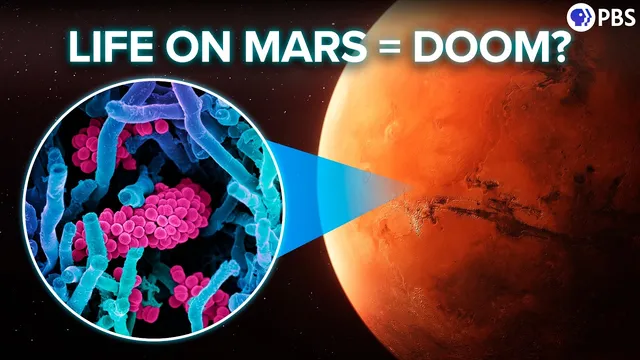
Why Life on Mars Will DOOM Humanity
Based on PBS Space Time's video on YouTube. If you like this content, support the original creators by watching, liking and subscribing to their content.
Perseverance found millimeter-scale “poppy seed” rings and “leopard spot” patterns at Mars’ Jezero crater Bright Angel outcrop, with mineralogy consistent with iron phosphate rings and iron sulphide interiors (likely vivianite around greigite).
Briefing
Ancient-life clues on Mars—especially the “Bright Angel” patterns spotted by NASA’s Perseverance rover—could reshape how often life arises in the universe, and that shift has a darker implication: it may strengthen the case that humanity faces a “great filter” later in the timeline. The rover landed in Jezero Crater on February 18, 2021, a site chosen for its preserved watery history. In the Neretva Vallis region, Perseverance targeted an unusually light outcrop and found millimeter-scale rings and spots nicknamed “poppy seeds” and “leopard spots.” The chemistry looks strikingly Earthlike: the rings appear tied to iron phosphate, with pale interiors linked to iron sulphide, most likely vivianite surrounding greigite, alongside a strong association with organic molecules.
On Earth, similar mineral structures can emerge from microbial redox metabolism—organics get oxidized while minerals get reduced—so the Bright Angel results fit a plausible biological pathway. Perseverance used Raman spectroscopy, reflectance analysis, and X-ray fluorescence, then transmitted the data for months of analysis back on Earth. The team also argues that the usual non-biological alternatives are less obvious here: the setting was warm and wet river-delta material, and the observations don’t readily point to the extreme heat, high acidity, or geothermal sulphur sources that could otherwise drive the same chemistry.
Still, the case isn’t closed. Past “biosignature” headlines—like NASA’s tentative JWST detection of dimethyl sulphide in a red-dwarf system and the 2020 phosphine claim from Venus—have either failed to hold up under follow-up or have credible abiotic mechanisms. Even a Mars meteorite report of microbe-like cylindrical structures faced pushback from scientists who could reproduce similar shapes without life. That pattern matters because false positives are expected: at advanced stages of science, truly revolutionary findings are rare, so even slightly less-rare false positives can dominate.
The Bright Angel find feels different mainly because an obvious abiotic explanation hasn’t yet taken hold. If the patterns are eventually confirmed as biological, the implications cascade. Earth is the only known life-bearing world, and life appeared quickly there—tempting people to conclude life is easy. But selection effects and “anthropic” reasoning complicate that inference: we only observe a universe where observers exist. The argument gets sharper with Mars. If primitive life arose on Mars as well, then abiogenesis may not be a once-in-a-galaxy fluke, and it would undercut models where life formation is extremely sensitive to rare planetary conditions.
That doesn’t guarantee a universe full of advanced civilizations. If primitive life is common but technological life is not, then the bottleneck shifts to later steps—what philosophers of science often call the “great filter.” With early filters reduced, the remaining hard transitions (from simple cells to complex life, or from digital to spacefaring survival) become more likely candidates. The transcript also notes an escape hatch—panspermia—where life could have spread between planets via impact ejecta, raising the question of whether Earth and Mars share a common origin.
For now, the most concrete next step is sample return. Perseverance packaged the Bright Angel materials for a future mission designed to bring them back to Earth for definitive testing. That retrieval effort was reportedly cancelled in a prior White House budget, leaving the timeline uncertain. If the samples do return, the world may soon learn whether Mars is a neighbor with extinct life—or another reminder that chemistry can mimic biology.
Cornell Notes
Perseverance’s Bright Angel observations in Mars’ Jezero crater show millimeter-scale rings and spots whose mineralogy (iron phosphate with iron sulphide interiors, likely vivianite around greigite) and associated organic molecules resemble Earth microbial redox structures. The chemistry fits a biological pathway—oxidizing organics while reducing iron minerals—but the evidence still isn’t definitive, and past “biosignature” claims (JWST dimethyl sulphide, Venus phosphine) have often collapsed under abiotic explanations or lack of confirmation. If Bright Angel is confirmed as ancient life, it would strongly suggest life’s origin is not extraordinarily rare and would undercut arguments that abiogenesis is extremely sensitive to rare planetary conditions. That shift would push the “great filter” problem later in evolution, making existential risk less about getting life started and more about what prevents most life from becoming star-hopping civilizations.
What exactly did Perseverance find at Bright Angel, and why did it resemble Earth biology?
What measurements and analysis steps turned the rover’s observations into a specific chemical story?
Why do researchers still hesitate to call the Bright Angel patterns “life” right now?
How would confirmed ancient life on Mars change estimates of how common life is in the universe?
Why does more evidence for primitive life increase concern about humanity’s future?
What role could panspermia play in interpreting Mars and Earth life?
Review Questions
- What specific mineralogical and organic associations at Bright Angel support a microbial redox interpretation, and what would be needed to confirm biology?
- How do selection bias and anthropic reasoning affect conclusions drawn from Earth’s rapid emergence of life?
- Explain the “great filter” logic: why would confirming life on Mars shift the likely bottleneck away from abiogenesis?
Key Points
- 1
Perseverance found millimeter-scale “poppy seed” rings and “leopard spot” patterns at Mars’ Jezero crater Bright Angel outcrop, with mineralogy consistent with iron phosphate rings and iron sulphide interiors (likely vivianite around greigite).
- 2
The patterns show a strong association with organic molecules, fitting an Earth-style redox metabolism pathway where organics oxidize and iron minerals reduce as colonies grow.
- 3
The Bright Angel interpretation remains non-definitive because past biosignature claims (JWST dimethyl sulphide, Venus phosphine, and a Mars meteorite microbe-like structure) have often yielded abiotic explanations or lacked confirmation.
- 4
If ancient life on Mars is confirmed, it would strongly weaken models where abiogenesis is extremely rare or highly sensitive to rare planetary conditions.
- 5
More evidence for primitive life would intensify the “great filter” argument by pushing the hardest steps toward later evolution or civilization survival rather than the origin of life itself.
- 6
Sample return is central to resolving the question: Perseverance packaged the Bright Angel materials for a future Earth-return mission, though that retrieval effort has been reported as uncertain after budget decisions.