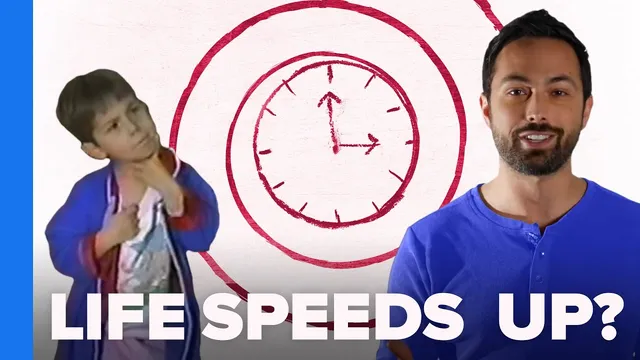
Why Life Seems to Speed Up as We Age
Based on Veritasium's video on YouTube. If you like this content, support the original creators by watching, liking and subscribing to their content.
The “fraction of life” math doesn’t match perception because integrating the implied curve suggests implausibly early completion of half a lifetime by about age 6.
Briefing
People across ages often report that time speeds up as they get older, and the best explanation isn’t that each year shrinks as a fraction of a lifetime. A more convincing account ties perceived time to how the brain processes information: when internal “clock” signals slow, attention shifts, and novelty fades, moments can feel compressed even if external time stays constant.
One line of reasoning starts with a simple fraction-of-life idea: at 20, a year is 1/20 of a person’s age, while at 67 it’s 1/67. That logic predicts a steady acceleration in how much of life a year represents. But the math doesn’t match lived experience. If the fraction-of-life curve is integrated, it implies that half of a lifetime would already be “used up” by about age 6—an outcome that doesn’t fit how people actually remember and feel time.
Instead, experiments suggest that aging changes the brain’s timing machinery. In a minute-timing test, older participants tend to overestimate how long a minute lasts, while younger participants often land closer to the mark. The mechanism offered is biological: as people age, neuron firing rates and conduction velocity decline. If the brain’s internal timing process runs more slowly, then the same external interval can feel shorter—making time seem to speed up.
Perception of time also isn’t a single, neatly localized sense. Chronoception lacks dedicated receptor cells and doesn’t appear confined to one brain region. Evidence from animal studies reinforces that timing can be fundamental and relatively early in evolution: rats can still learn to time roughly 40 seconds accurately even after removal of the neocortex. That doesn’t mean time is perceived faithfully, though. Attention and mental state can distort duration.
When people are deeply focused—sports, video games, artistic creation, or meditation—time can slip by unnoticed, producing a mental state often described as “flow.” In that mode, the brain invests less in tracking elapsed time, so moments feel shorter than they are.
Novelty and repetition add another layer. In an image-duration task, participants typically judge a novel image (like a dog) as lasting longer even when all images are displayed for the same objective time. Subjective duration tracks the brain’s energy use: the more processing effort a stimulus demands, the longer it feels. Brain energy consumption peaks around age five, when much of life is new, which helps explain why childhood can feel slower.
Finally, memory changes the story. Vacations can feel fast while they’re happening, yet remembered as long, because the brain later estimates duration by how many memories were formed. That creates a paradox: the same novelty that makes time feel quick in the moment can make it feel lengthy in retrospect.
Attempts to slow time down—fear, extreme experiences, or boredom—can work perceptually, but they may not be pleasant. The practical takeaway is that “time speeding up” is less about calendars and more about brain timing, attention, novelty, and what gets encoded into memory. The result is a life that can feel either stretched or compressed depending on what the brain is doing with each moment.
Cornell Notes
Perceived time can feel like it accelerates with age, but the explanation based purely on “a year is a smaller fraction of life” doesn’t fit key implications of the math. Experiments instead point to changes in the brain’s internal timing: older people often overestimate a minute, consistent with slower neuron firing and conduction velocity. Chronoception also isn’t a single sense; it’s shaped by attention, mental states like flow, and how much energy the brain spends processing novelty. Subjective duration correlates with neural energy use, which peaks in early childhood when experiences are highly novel. Memory further complicates perception: vacations can feel fast in the moment yet long when recalled because duration is partly judged by how many memories were formed.
Why does the “fraction of life” argument fail to match lived experience?
What timing experiment suggests aging affects an internal clock?
How do attention and “flow” change how long moments feel?
Why do novel stimuli seem to last longer even when they’re shown for the same time?
How does boredom or fear alter perceived duration?
What is the “paradox” between how time feels during an event and how it feels in memory?
Review Questions
- How do changes in neuron firing rate and conduction velocity connect to the way older people estimate a minute?
- What evidence supports the idea that subjective duration tracks brain energy use rather than objective time?
- Why might a vacation feel short while it’s happening but long when recalled?
Key Points
- 1
The “fraction of life” math doesn’t match perception because integrating the implied curve suggests implausibly early completion of half a lifetime by about age 6.
- 2
Aging appears to alter internal timing: older participants often overestimate a minute in timing tasks, consistent with slower neuron firing and conduction velocity.
- 3
Chronoception isn’t localized to one sense or brain region; it behaves like a fundamental but flexible brain function.
- 4
Attention changes duration: deep engagement and “flow” reduce awareness of time passing, making experiences feel shorter.
- 5
Novelty stretches perceived duration because subjective time correlates with how much neural energy the brain spends processing new stimuli.
- 6
Memory reshapes duration judgments: events with many novel experiences can feel fast in the moment but long when recalled due to increased memory formation.
- 7
Perceived time can be slowed by fear or boredom, but those strategies may not be desirable for quality of life.