Why Magnetic Monopoles SHOULD Exist
Based on PBS Space Time's video on YouTube. If you like this content, support the original creators by watching, liking and subscribing to their content.
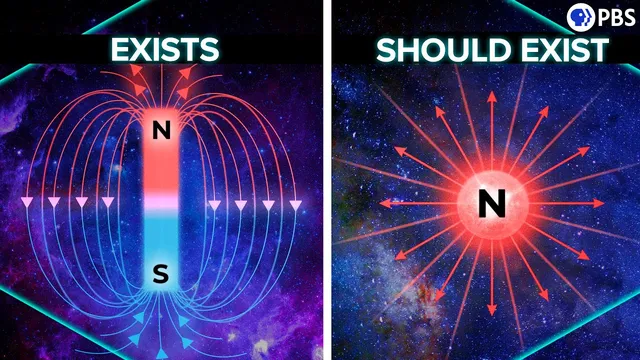
Gauss’s law for magnetism enforces zero divergence of the magnetic field, preventing magnetic field lines from terminating on isolated magnetic charges in classical electromagnetism.
Briefing
Magnetic monopoles—isolated north or south magnetic charges—remain unobserved, but the case for them is unusually strong because multiple layers of physics either permit them or even require them. Classical electromagnetism says they should not exist: Gauss’s law for magnetism has zero divergence, meaning magnetic field lines can loop or extend to infinity but never begin or end. By contrast, Gauss’s law for electric fields links nonzero divergence directly to electric charge density, which is why electric field lines can start or stop on isolated charges. That asymmetry is the starting point for the “monopoles shouldn’t exist” expectation.
Yet the symmetry between electricity and magnetism in Maxwell’s equations is only broken by the assumption that magnetic charge is zero. If magnetic charge were allowed, the force law would mirror electrostatics, and the mathematics would become more symmetric. Murray Gell-Mann’s “Everything not forbidden is compulsory” captures the logic: if the equations allow it, nature might implement it. Classical theory alone doesn’t forbid monopoles; it effectively hard-codes their absence through the choice to set magnetic charge to zero.
Quantum mechanics complicates the picture. Early quantum-field formulations of electromagnetism enforce that the magnetic field has zero divergence, seemingly blocking magnetic charge. But Paul Dirac found a loophole by focusing on the quantum detectability of a construction that mimics a monopole. By using a solenoid, one can create a configuration that looks like two separated magnetic charges, connected by an unobservable artifact called the “Dirac string.” In quantum mechanics, the string’s magnetic field would shift the phase of a charged particle’s wavefunction, potentially making the string detectable. Dirac’s key condition is that the phase difference becomes an integer number of wave cycles for certain electric charges, making the string fundamentally undetectable. That requirement forces electric charge to be quantized—an outcome consistent with what’s observed.
The strongest push comes decades later from grand unified theories (GUTs). In the early 1970s, unifying forces through larger symmetry groups and their symmetry breaking patterns leads to topological defects in the Higgs field. In simple GUTs, the Higgs field has more internal degrees of freedom than in the electroweak theory, allowing “hedgehog” configurations—knots that can’t be removed by smooth deformation. Those topological discontinuities behave like massive particles carrying magnetic charge: magnetic monopoles. The catch is cosmology. GUTs predict monopoles should form copiously in the early universe and be extremely heavy—so heavy that they could dominate the universe’s evolution and cause rapid recollapse. Cosmic inflation offers a rescue by stretching space after monopole production, diluting them to a tiny number within the observable universe.
Searches have followed. A 1982 claim by Blas Cabrera Navarro using a superconducting coil at Stanford reported a candidate monopole with the Dirac-predicted charge, but it was never repeated. Collider experiments at the Large Hadron Collider have also failed to find monopoles, unsurprising given that the energies are far below what GUTs suggest is needed. Cosmic-ray and Earth-field searches likewise haven’t produced convincing evidence. The result is a paradox: monopoles are mathematically plausible, quantum-consistent via charge quantization, and even topologically inevitable in GUTs—yet experiments keep coming up empty.
Cornell Notes
Magnetic monopoles are isolated magnetic charges that would make magnetic field lines start or end, analogous to how electric field lines terminate on electric charge. Classical electromagnetism forbids them through Gauss’s law for magnetism, which enforces zero divergence of the magnetic field. Dirac showed that monopoles can still be consistent with quantum mechanics if the unphysical “Dirac string” connecting them is undetectable; that undetectability requires electric charge to be quantized. Grand unified theories go further: symmetry breaking in the Higgs field can produce topological “hedgehog” defects that behave like massive magnetic monopoles, but inflation could dilute their abundance. Despite decades of searches, no confirmed monopole has been detected.
Why does classical electromagnetism predict no magnetic monopoles?
How does Dirac’s argument make monopoles compatible with quantum mechanics?
What does Dirac’s condition imply about electric charge?
Why do grand unified theories predict magnetic monopoles?
How does cosmic inflation address the “monopole problem”?
What experimental results have tried to find monopoles, and why are they difficult?
Review Questions
- What specific mathematical condition in Maxwell’s equations eliminates isolated magnetic charges in classical electromagnetism?
- How does the undetectability of the Dirac string lead to quantization of electric charge?
- What role do topological defects in the Higgs field play in grand unified theories’ prediction of monopoles?
Key Points
- 1
Gauss’s law for magnetism enforces zero divergence of the magnetic field, preventing magnetic field lines from terminating on isolated magnetic charges in classical electromagnetism.
- 2
Allowing magnetic charge would restore a stronger symmetry between electric and magnetic force laws, but classical theory effectively hard-codes magnetic charge to zero.
- 3
Dirac’s “Dirac string” construction can mimic monopoles in quantum theory if the string’s phase effects become unobservable, which requires electric charge quantization.
- 4
Grand unified theories predict monopoles as topological hedgehog defects in the Higgs field, worked out in 1974 by Gerard ’t Hooft and Alexander Polyakov.
- 5
Inflation can dilute an initially huge monopole population predicted by GUTs, reducing the expected number to something compatible with today’s universe.
- 6
Searches—including a 1982 superconducting-coil claim by Blas Cabrera Navarro and multiple collider and cosmic searches—have not produced confirmed monopoles, partly because required production energies may be far beyond current experiments.