Why Masks Work BETTER Than You'd Think
Based on minutephysics's video on YouTube. If you like this content, support the original creators by watching, liking and subscribing to their content.
Masks reduce transmission in two directions—when infectious air is exhaled and when potentially infectious air is inhaled—so two masked people create layered protection.
Briefing
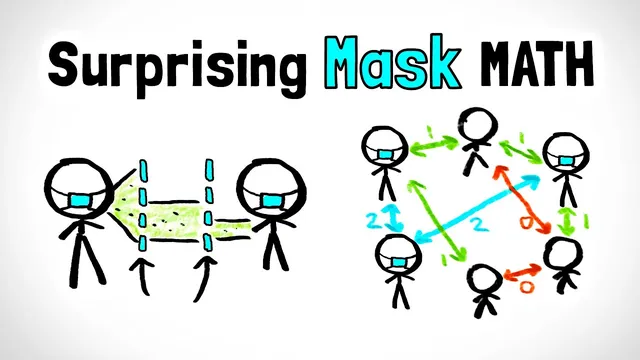
Mask-wearing delivers more protection than many people’s intuition predicts because masks work in both directions—reducing risk when a person breathes in and when they breathe out. In the simplest math model, a “50% effective” mask doesn’t translate into a 50% drop in transmission when everyone wears it. Instead, transmission falls by about 75%, because two masks end up between any pair of people: one on the contagious person and one on the susceptible person.
The counterintuitive result comes from treating infection as a two-way process. If inhalation and exhalation are equally improved by the same fraction, then each mask halves transmission risk in that direction. When both people in an interaction wear masks, the risk gets halved twice—once for the breath leaving the contagious person and once for the breath entering the susceptible person—yielding a 75% reduction rather than 50%. That “double duty” effect breaks the common mental model that masks only protect the wearer.
The analysis gets even more striking once partial adoption is included. With only 50% mask usage across a population (and assuming random mixing), interactions split into four equally likely categories: neither person masked (no reduction), only the contagious person masked (50% reduction), only the susceptible person masked (50% reduction), and both masked (75% reduction). Even though only half the population wears masks, three-quarters of interactions involve at least one mask, and a quarter involve two masks—so overall transmission drops far more than a simple “50% of 50%” calculation would suggest.
The same multiplicative logic applies more generally: for a wide range of mask effectiveness and usage rates, the combined impact on transmission is consistently better than multiplying those two numbers together would predict. The model’s practical implication is that epidemics can be extinguished if enough transmission is suppressed to push the average number of secondary infections below one.
For COVID-19 specifically, epidemiology estimates that each contagious person infects about 2.5 others on average. The math indicates that reducing transmission by just over 60% would bring the effective number of secondary infections below one, allowing spread to halt. One cost-effective scenario offered is that if 60% of people wore 60% effective masks, transmission would drop by roughly 60%—enough to “beat COVID” in this simplified framework.
The transcript also flags real-world caveats. “X% effective” is treated abstractly as a direct proportional reduction in transmission, even though actual masks vary based on filtration, fit, valves, and whether they’re used or decontaminated correctly. The model assumes equal effectiveness for inhalation and exhalation, random mixing, and that contagious and non-contagious people wear masks at the same rate. It notes that clustering—where mask wearers interact mostly with other mask wearers—can reduce overall impact, requiring higher adoption to achieve the same transmission drop. An interactive companion essay is referenced for scenarios that relax these assumptions, including different inhalation vs. exhalation effectiveness and non-random mixing. Funding support is credited to the Heising-Simons Foundation, including work related to N95 decontamination and broader COVID response efforts.
Cornell Notes
Masks can reduce COVID-19 transmission more than expected because they work both ways: they lower risk when contaminated air is exhaled and when potentially infectious air is inhaled. In a simplified model where a mask is “50% effective” in each direction, two masked people create two layers of risk reduction, producing about a 75% drop in transmission—not 50%. With partial adoption, random mixing means many interactions still involve at least one mask, and a meaningful fraction involve two masks, so overall transmission falls more than “usage × effectiveness” would predict. The framework suggests that if enough people wear sufficiently effective masks to cut transmission by just over 60%, the average number of secondary infections can drop below one and halt spread.
Why does a “50% effective” mask lead to a ~75% transmission drop when everyone wears one?
How do partial mask-wearing rates change the average transmission reduction?
What “magic math” is being highlighted beyond the specific 50% example?
What transmission reduction is needed to halt COVID-19 spread in the model?
Why might real-world outcomes differ from the simplified math?
What does the transcript suggest about a concrete policy-like scenario?
Review Questions
- In the bidirectional model, what mathematical step turns a single-mask effectiveness into a larger population-level transmission reduction?
- Under random mixing with 50% mask adoption, list the four interaction categories and state which category produces the largest reduction.
- Which simplifying assumptions (inhalation vs. exhalation symmetry, random mixing, equal mask-wearing among contagious and non-contagious people) could reduce the real-world effectiveness compared with the model’s predictions?
Key Points
- 1
Masks reduce transmission in two directions—when infectious air is exhaled and when potentially infectious air is inhaled—so two masked people create layered protection.
- 2
A mask described as “X% effective” in each direction can produce a larger-than-X reduction in transmission when both people wear masks (e.g., 50% each direction yields ~75% reduction).
- 3
With partial adoption, random mixing means many interactions involve at least one mask and some involve two masks, so overall transmission drops more than “usage × effectiveness.”
- 4
To halt an epidemic, the goal is to reduce the average number of secondary infections below one; the transcript links this to a transmission reduction of just over 60% for COVID-19’s estimated baseline.
- 5
The model’s conclusions depend on assumptions that may not hold perfectly in practice, including equal inhalation/exhalation effectiveness and random mixing.
- 6
Clustering of mask wearers can reduce population impact, potentially requiring higher mask adoption to achieve the same transmission reduction.
- 7
Real masks vary widely in effectiveness due to filtration, fit, valves, and correct use or decontamination, so “X% effective” is an abstraction for transmission reduction.