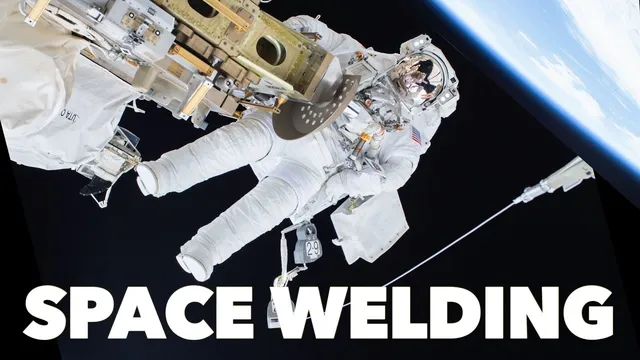
Why Metals Spontaneously Fuse Together In Space
Based on Veritasium's video on YouTube. If you like this content, support the original creators by watching, liking and subscribing to their content.
Cold welding lets metal surfaces fuse without heating when clean metal-to-metal contact occurs in a vacuum.
Briefing
In space, two pieces of metal can fuse together without heating—an effect known as cold welding—and it has real consequences for spacecraft hardware, from stuck hatches to jammed antennas. The core idea is that metal surfaces aren’t just “coated” layers; they’re built from a lattice of positively charged ions surrounded by mobile electrons. When two clean metal surfaces touch in a vacuum, electrons can flow across the contact, effectively letting atoms “forget” they started in separate parts.
That mechanism became infamous after a problem during the first American spacewalk on Gemini IV on June 3, 1965. Astronaut Ed White exited the spacecraft using a gold-plated, oxygen-fed tether system, then returned—only to face a new failure: the hatch would not close for about an hour. Communication also went out of range over Africa, adding pressure as flight controllers worked through the issue. NASA engineers at the time blamed the sticking on cold welding, a plausible-sounding explanation because space removes the oxygen that normally forms a protective oxide layer on metal.
On Earth, metal surfaces quickly react with atmospheric oxygen, creating an oxide film that blocks direct metal-to-metal bonding. In space, that film can wear away, especially when parts rub or experience impacts, exposing bare metal that can bond under pressure. The Gemini IV hatch incident fit that narrative: once oxide is gone, even modest force can allow bonding to occur.
But later understanding complicated the story. Experiments in vacuum chambers and in orbit show that cold welding does happen when metal surfaces are truly clean and pressed together in the absence of atmosphere. The catch is that spacecraft metals are rarely perfectly clean. Oxides, dirt, grease, and other contaminants mean true “bare metal contact” is harder to achieve than early models suggested. In that view, the Gemini IV hatch was likely just a sticky door rather than a full-on cold-welded failure.
Cold welding still matters, though, because it can show up in specific designs and wear conditions. A clear example came in 1991 with the Galileo spacecraft: when its high-gain antenna was supposed to unfurl like an umbrella, three of its 18 ribs refused to open. Investigators attributed the sticking in part to cold welding at the pins, forcing a fallback strategy using the low-gain antenna to communicate from Jupiter.
To reduce risk, a 2009 European Space Agency report recommended three practical mitigations: avoid sliding metal-on-metal contacts by using plastics or ceramics where possible; when metal-on-metal is unavoidable, use two different metals or alloys to reduce the chance of bonding; and apply durable coatings that resist wear so bare metal doesn’t repeatedly meet bare metal.
Cold welding isn’t only a hazard. In nanotechnology, the same “no heat needed” bonding can be a feature. Researchers have fused single-crystal gold nanowires in seconds under conditions similar to space vacuum, producing welds that preserve the nanowires’ crystalline structure and mechanical/electrical properties—turning a space-age nuisance into a manufacturing tool.
Cornell Notes
Cold welding is the ability of two metal surfaces to fuse together without heating when they contact in a vacuum. The effect comes from metals’ internal structure: mobile electrons can move across a contact, so atoms don’t “know” they belong to different pieces. Early fears that cold welding would constantly wreck spacecraft hardware proved overstated because real spacecraft parts aren’t perfectly clean; oxides and contaminants often prevent true bare-metal contact. Still, cold welding can cause failures in specific mechanisms, such as Galileo’s high-gain antenna ribs that would not open. Engineers reduce the risk with design choices like avoiding metal-on-metal sliding, using dissimilar metals, and applying wear-resistant coatings—and the same physics can be useful for heat-free nanowire fabrication.
What physical mechanism allows metals to bond in space without melting?
Why did the Gemini IV hatch problem get linked to cold welding, and why that explanation later weakened?
What real spacecraft failure illustrates cold welding risk despite the “clean-surface” caveat?
What mitigation strategies did the European Space Agency recommend to reduce cold welding risk?
How can cold welding be beneficial instead of harmful?
Review Questions
- What role does the oxide layer play in preventing or enabling cold welding, and how does the space environment change that?
- Why might cold welding be less common in spacecraft than early theories predicted, even though it is physically possible?
- How do design choices like using dissimilar metals or applying wear-resistant coatings reduce the likelihood of metal-to-metal bonding?
Key Points
- 1
Cold welding lets metal surfaces fuse without heating when clean metal-to-metal contact occurs in a vacuum.
- 2
On Earth, oxide layers formed by atmospheric oxygen usually block direct bonding; in space, those layers can wear away.
- 3
Cold welding is real but often less frequent in spacecraft because parts are rarely perfectly clean.
- 4
Gemini IV’s stuck hatch was initially blamed on cold welding, but later reasoning suggests it was more likely mechanical sticking.
- 5
Galileo’s high-gain antenna deployment failure in 1991 shows cold welding can still jam spacecraft mechanisms.
- 6
The European Space Agency’s 2009 recommendations include avoiding metal-on-metal sliding, using dissimilar metals, and using durable wear-resistant coatings.
- 7
Cold welding can also be used intentionally in nanotechnology to join nanowires quickly without heat damage.