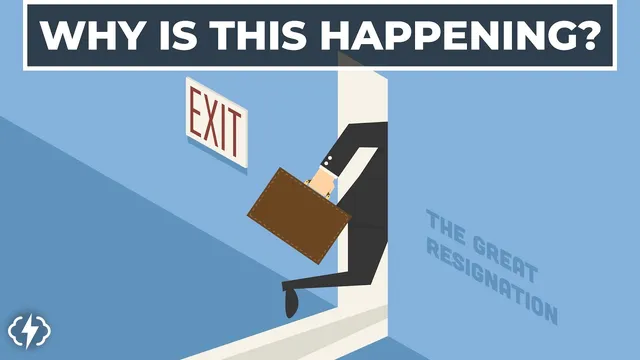
Why Millions Of Americans Are Quitting Their Jobs
Based on Second Thought's video on YouTube. If you like this content, support the original creators by watching, liking and subscribing to their content.
Resignations are portrayed as a long-running response to deteriorating job quality—especially stagnant wages and shrinking benefits—rather than a one-off reaction to COVID-19.
Briefing
Millions of Americans are quitting their jobs at record levels, and the surge is tied not just to pandemic-era stress but to a long-running deterioration of work under capitalism—low pay, shrinking benefits, and a loss of control that leaves people alienated, anxious, and increasingly unwilling to keep risking their lives for employers. The resignation wave accelerated during COVID-19, when workers were treated as “essential” while still being exposed to deadly conditions, then continued after official messaging shifted as corporations pushed for normalcy.
Resignations have been rising for decades, with one exception during the Great Recession, and the transcript links that trend to structural changes in the labor market: wages that lag behind inflation, fewer paid days off and sick leave, weak or nonexistent parental leave, the disappearance of pensions, and the expectation that employees remain reachable outside working hours. Managers texting on days off and demands to cover for sick coworkers are presented as everyday examples of how work has expanded into personal time. Even the promise of upward mobility is described as largely blocked for many workers, making job changes less like career steps and more like attempts to escape worsening conditions.
A central explanation goes beyond economics to psychology and social relations. Work is portrayed as alienating in three ways: workers lose autonomy (“becoming a cog”), lose connection to other people through competition (“what if they take your job”), and lose ownership of what they produce. The transcript contrasts earlier craft arrangements—where a carpenter or bootmaker controlled the process and owned the finished goods—with factory systems that fragment labor into hyper-specialized tasks. In that setup, workers sell labor for wages while the product belongs to capitalists, who then profit from sales. That mismatch, it argues, helps explain why many jobs feel degrading and why misery at work intensifies when the stakes rise, such as during a pandemic.
The resignation numbers cited are meant to show scale and momentum: in November 2021, 4.5 million Americans quit; in August 2021, 4.3 million quit; and an average of 3.95 million workers quit each month across 2021. A poll is referenced claiming over half of Americans are looking for a new job or want to leave their current one. Media coverage is described as framing the trend like a “virus” and treating workers as a problem to be “inoculated” against, rather than as people responding rationally to exploitation.
Business responses are criticized for not addressing root causes. Instead of competing with better pay and conditions, the transcript claims employers resist meaningful change and even suggests a willingness to lower labor costs by expanding child labor—citing reduced-pay roles for 14- and 15-year-olds at McDonald’s and speculation about teenage drivers in trucking.
Individual fixes—talking to a manager, starting a side hustle, or simply finding another job—are rejected as insufficient because they don’t change bargaining power and often lead to more burnout or continued exposure to low wages and unsafe conditions. The transcript’s proposed remedy is unionization. It points to a rise in union certification elections filed in 2021 and highlights Starbucks as a driver of new organizing, including store unionization in Buffalo, New York and additional filings across multiple states. The call to action focuses on supporting groups such as the IWW (Industrial Workers of the World), distributing organizing materials, and using social media or local networks to build class consciousness—arguing that collective bargaining is the lever that can shift wages and treatment in workers’ favor.
Cornell Notes
The resignation wave is framed as a predictable response to worsening work conditions and deeper alienation under capitalism, not as a sudden cultural fad. The transcript links rising quits to stagnant wages, shrinking benefits, disappearing pensions, and constant availability demands, with COVID-19 acting as an accelerant. It argues that work alienates people from themselves (loss of autonomy), from others (competition and fear), and from the products of their labor (workers don’t own what they make). Because individual strategies like talking to a manager or switching jobs don’t change bargaining power, the proposed path forward is unionization. Starbucks organizing is used as a concrete example of momentum and potential leverage.
What conditions are presented as driving Americans to quit, and how far back does the trend go?
How does the transcript explain alienation at work in three parts?
Why does COVID-19 matter to the resignation story beyond general stress?
What resignation statistics are cited to show the scale of the trend?
Why are individual solutions—manager talks, side hustles, job-hopping—treated as inadequate?
What role does unionization play in the proposed solution, and what examples are given?
Review Questions
- Which three forms of alienation does the transcript claim are produced by capitalist work, and how does each connect to quitting?
- What specific labor-market changes (wages, benefits, scheduling, job security) are cited as worsening conditions over time?
- Why does the transcript treat unionization as more effective than individual strategies like switching jobs or negotiating with a manager?
Key Points
- 1
Resignations are portrayed as a long-running response to deteriorating job quality—especially stagnant wages and shrinking benefits—rather than a one-off reaction to COVID-19.
- 2
COVID-19 is described as an accelerant because workers were required to work in dangerous conditions while being treated as disposable once corporate priorities shifted.
- 3
Work is framed as alienating: it strips autonomy, pits people against each other, and denies workers ownership of what they produce.
- 4
The transcript cites large quit numbers in 2021 (including 4.5 million in November and 4.3 million in August) to argue the trend is sustained and widespread.
- 5
Individual fixes like talking to managers, starting side hustles, or switching jobs are criticized for not changing bargaining power and for often leading back to the same problems.
- 6
Unionization is presented as the practical solution because collective bargaining can raise wages and improve treatment.
- 7
Starbucks organizing is used as a concrete example of growing momentum, including filings across multiple states after a Buffalo, New York union win.