Why More Is Less & Less Is More
Based on Better Than Yesterday's video on YouTube. If you like this content, support the original creators by watching, liking and subscribing to their content.
The paradox of choice links rising options to falling satisfaction, largely through expectation inflation.
Briefing
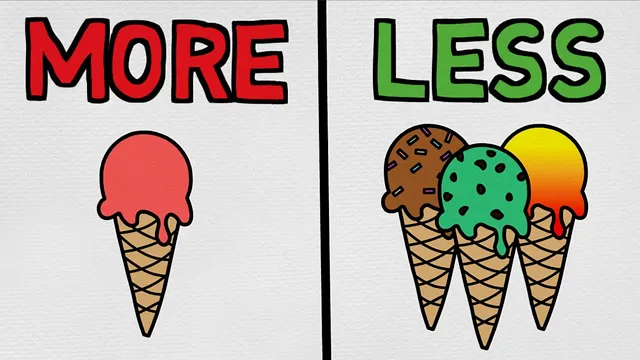
More choice can make people less happy—sometimes as much as having no choice at all. The core insight is the “paradox of choice”: as options multiply, satisfaction often falls because expectations rise and decisions become harder to commit to. A simple ice-cream story illustrates the pattern. Mike picks strawberry at a shop with only three flavors and feels satisfied because the limited menu sets a modest expectation; the taste lands at least “good enough.” A week later, he faces a shop with far more options. He still chooses strawberry, but the experience disappoints because the abundance of choices implies that something “perfect” should be available, and “only okay” feels like a failure.
That mismatch between what people expect and what they actually get drives dissatisfaction. With many options, people assume the best outcome is within reach, so they judge their selection more harshly—even when the chosen item is essentially the same as before. The transcript connects this to higher-stakes decisions where “perfect” is rarely guaranteed. Dating is used as a modern example: swiping through apps can make it feel like the entire world is available at once, encouraging unrealistic standards (“why settle for anything less than perfect?”). The result is less satisfaction, and in some cases a refusal to choose at all.
When too many possibilities compete, people can stall in “analysis paralysis.” The more variables involved—whether it’s comparing partners, homes, books, exercise plans, or investments—the more likely someone is to freeze, delay, or avoid committing. The transcript argues that this avoidance often becomes the worst outcome: not buying a home, not reading any books, not exercising, and not investing because the search for the “best” never ends.
A key complication is that “the best” usually doesn’t exist. Real choices involve trade-offs: choosing one car can mean sacrificing storage or leg room for other benefits; choosing another can mean giving up aesthetics for practicality. The practical takeaway is to clarify priorities—decide which qualities matter most—so extra options can be filtered rather than endlessly compared. The transcript also notes that the paradox doesn’t hit everyone equally. People with strong preferences or domain experience can ignore irrelevant options because they already know what they want.
Finally, the transcript points to design solutions that reduce cognitive load. Restaurants, for instance, may offer two menus: a large menu for diners who want variety and a smaller set of daily dishes for those who just want an easy decision. Awareness of the paradox of choice, plus deliberate prioritization, is presented as a way to reduce both disappointment and paralysis when options expand.
Cornell Notes
The paradox of choice says that increasing options can reduce happiness rather than increase it. Limited choice can lower expectations, so a satisfactory outcome feels better; abundant choice raises expectations and makes “only okay” feel like a poor decision. Too many options can also trigger analysis paralysis, where people delay or avoid choosing because comparing everything is overwhelming. The transcript argues that “best” is usually a myth because choices require trade-offs, so people should set clear priorities to filter options. People with strong preferences or expertise may be less affected because they can disregard irrelevant alternatives.
Why does “more choice” sometimes lead to less happiness even when the selected option is the same?
How does the paradox of choice connect to analysis paralysis?
Why is the idea of a single “best” option often unrealistic?
What practical strategy helps people avoid paralysis when faced with many choices?
When does extra choice become less harmful?
How do restaurants use choice architecture to reduce decision stress?
Review Questions
- Think of a decision you recently made with many options. Did your expectations rise because of the abundance, and did that affect satisfaction?
- Describe a situation where trade-offs made “the best” impossible. What priority would have helped you choose sooner?
- What cues in your own behavior suggest analysis paralysis is starting (e.g., delaying, over-comparing, searching for perfection)?
Key Points
- 1
The paradox of choice links rising options to falling satisfaction, largely through expectation inflation.
- 2
Limited choice can improve perceived outcomes because people expect less and judge more leniently.
- 3
Too many options can trigger analysis paralysis, where people delay or avoid decisions due to overwhelming comparisons.
- 4
“Best” is usually unattainable because most choices involve trade-offs across multiple attributes.
- 5
Clarifying priorities helps filter options and reduces both dissatisfaction and decision overload.
- 6
People with strong preferences or expertise can handle more choice by ignoring irrelevant alternatives.
- 7
Choice architecture—like offering a smaller menu alongside a larger one—can reduce cognitive load and make decisions easier.