Why "Neither Left Nor Right" Just Means Right Wing | Bonapartism
Based on Second Thought's video on YouTube. If you like this content, support the original creators by watching, liking and subscribing to their content.
Bonapartism is characterized as authoritarian, centralized rule legitimized through plebiscites and framed as standing above left-right conflict.
Briefing
Bonapartism is a political playbook for draining democracy of real power while installing a “popular” strongman who claims to stand above left and right—then governs in ways that protect right-wing interests. The core claim is that “neither left nor right” rhetoric isn’t moderation; it’s a strategy to muddy ideological lines so a centralized executive can act with minimal accountability, unify the public around a single leader, and ultimately advance reactionary policies.
The term “bonapartism” is defined as authoritarian, centralized rule legitimized through plebiscites—public referendums of approval—where a leader (often framed as a revived king-like figure) asks voters to grant sweeping authority because the nation supposedly agrees the leader is exceptional. Bonapartists present themselves as unifiers who transcend class conflict and even left-right divisions, typically using scapegoats and an “outside enemy” narrative to bind the public into a single national front. The result is characteristically xenophobic and reactionary: the rhetoric of unity and national renewal masks a turn toward monarchy-like rule.
A key mechanism is propaganda that leverages democratic symbols and institutions while hollowing out democratic gains. Napoleon Bonaparte and his nephew, Napoleon III, are used as the historical template. Both are portrayed as counter-revolutionary figures who exploited the revolutionary era’s legitimacy and imagery—celebrating the republic’s symbols and invoking the “defense of the republic”—while reversing outcomes such as universal suffrage, the abolition of slavery, and labor nationalization. Napoleon I is described as rising through a coup, then moving from First Consul to First Consul for Life and finally emperor with mass support; Napoleon III is described as seizing power through a coup d’état after serving as president. In both cases, centralized dictatorship replaces parliamentary power, press control tightens, women’s rights are stripped, slavery is reinstated, and foreign and domestic repression follows.
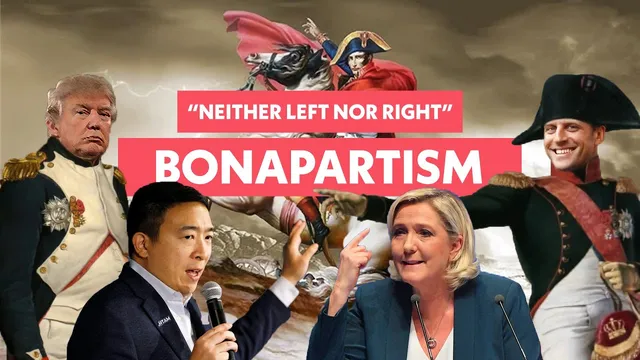
The same pattern is argued to appear in modern “neither left nor right” politics. French examples include Emmanuel Macron and Marine Le Pen, both framed as using Napoleon as a cultural and political reference point while employing the “neither left nor right” slogan to justify their own agendas. Macron is characterized as pursuing right-wing liberalism—tax cuts for the wealthy, aggressive protest suppression, and expanded executive power—while Le Pen is framed as far-right and xenophobic. Despite differences in style, both are said to delegate decisive authority upward to markets: Macron through “third way” neoliberalism associated with deregulation, privatization, and austerity; Le Pen through reliance on domestic capitalists to manage labor conditions.
The argument extends beyond France to the U.S. by comparing the bonapartist model to leaders who treat democracy as something that ends at elections. Andrew Yang is presented as an example of a “unifying” figure who claims to transcend polarization while advancing market-centered “human-centered capitalism,” including a universal monthly check framed as permission for capitalists to do what they want. Donald Trump is also linked to the same underlying logic—kingly imagery and appeals to an imagined national identity—though with more personal and monarchic symbolism.
The takeaway is a warning: revolutionary language, national pageantry, or “above left and right” branding doesn’t guarantee democratic commitment. If the practical effect is to concentrate decision-making in the hands of a leader and protect capitalist power, that’s bonapartism—not democracy.
Cornell Notes
Bonapartism is described as authoritarian, centralized rule that gains legitimacy through plebiscites and the claim that a leader stands above left-right conflict. The strategy works by using democratic symbols and institutions to justify concentrating power—then governing in reactionary ways that protect elite interests. Napoleon Bonaparte and Napoleon III are used as historical models: both invoked the republic while dismantling democratic gains and expanding executive control. The same pattern is then applied to modern “neither left nor right” politics, where leaders present themselves as unifiers while delegating real authority to markets and capital. The central warning is that democracy isn’t just voting for a favorite figure; it requires collective control over decisions.
What is bonapartism, and how does it claim legitimacy while concentrating power?
Why do “neither left nor right” slogans matter in the bonapartist framework?
How do Napoleon Bonaparte and Napoleon III illustrate the propaganda-democracy paradox?
What modern examples are used to connect bonapartism to “market power above democracy”?
How does the transcript distinguish bonapartism from simple “populism vs populism” comparisons?
Review Questions
- In the transcript’s definition, what role do plebiscites play in bonapartism, and why do they matter for accountability?
- What does the transcript claim happens when leaders use revolutionary or democratic symbols while reversing democratic gains?
- How does the transcript connect “neither left nor right” messaging to market power and the concentration of decision-making?
Key Points
- 1
Bonapartism is characterized as authoritarian, centralized rule legitimized through plebiscites and framed as standing above left-right conflict.
- 2
“Neither left nor right” rhetoric functions as political camouflage, helping leaders justify reactionary policies while claiming unity.
- 3
Napoleon Bonaparte and Napoleon III are presented as historical models: mass-backed executive power paired with reversals of revolutionary democratic gains.
- 4
Bonapartist politics is described as thinning out democratic participation until only leader approval remains, with parliaments and collective decision-making weakened.
- 5
Modern “unifier” politics (including Emmanuel Macron and Marine Le Pen) is linked to delegating real authority upward to markets and capital.
- 6
The transcript argues democracy is more than elections; it requires collective control over decisions rather than granting power to protect elite interests.
- 7
Andrew Yang and Donald Trump are used as examples of leaders whose unifying or monarchic imagery aligns with the same underlying anti-democratic logic.