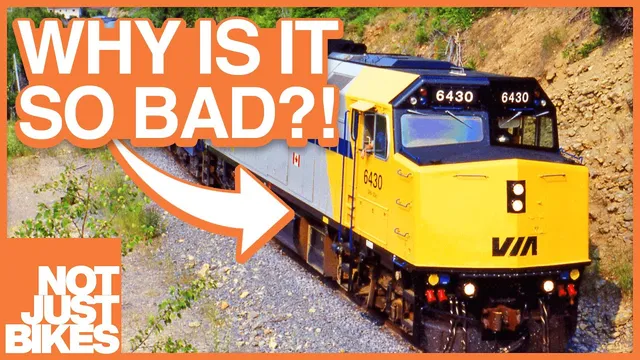
Why Passenger Trains Suck in Canada - VIA Rail
Based on Not Just Bikes's video on YouTube. If you like this content, support the original creators by watching, liking and subscribing to their content.
VIA Rail’s passenger service is constrained because it does not own the tracks it uses, forcing passenger trains to yield to freight traffic and making delays highly sensitive to schedule changes.
Briefing
Passenger rail in Canada is slow, unreliable, and often pointless for getting around once travelers arrive—especially along the Quebec City–Windsor corridor where more than half the country’s population lives. The core problem isn’t just aging equipment; it’s a system built around passenger trains that must yield to freight traffic, run infrequently, and land in cities where public transit is weak or missing. The result is a travel experience that can feel like “airplane pain” with “driving time,” even on routes that are major by Canadian standards.
The journey starts with friction: travelers are told to arrive at least 30 minutes early for ticket checks and bag weighing, then board in a process that prioritizes business-class passengers. Inside, conditions are not miserable—refurbished stainless-steel cars can offer comfortable seating, free Wi‑Fi, and meal service—but the timetable and equipment age still shape the experience. Diesel locomotives dominate because Canada’s last electric passenger service ended in the 1960s, and while trains may be rated for theoretical speeds around 160 km/h, they rarely approach that figure.
Why the service struggles traces back to policy choices after World War II. Investment shifted heavily toward automobile infrastructure, while private passenger rail operators couldn’t compete with highway networks that were heavily subsidized. Canadian Pacific, the largest private rail operator, wanted out of passenger service, and the government ultimately nationalized what remained into VIA Rail. A crucial structural detail follows: VIA Rail does not own the tracks. Passenger trains must negotiate with freight rail companies for access, so even small schedule changes can cascade into delays lasting hours.
Frequency is another major constraint. On the Toronto–London route—described as a fairly significant corridor segment—there are only seven trains per day, including a “milk run” that takes about three and a half hours. High-speed rail proposals come and go, but many experts argue that what matters more is running trains at least every 30 minutes so people can plan trips without relying on a handful of departures.
Even if trains ran more often or faster, the “last mile” problem remains. In most Canadian cities, arriving by train doesn’t connect well to local transit; downtowns are portrayed as hollowed out by decades of car-centric planning, leaving travelers with surface parking lots and half-empty buildings. If a car is needed anyway, the train’s advantage shrinks—so the typical VIA Rail rider becomes framed as a rail enthusiast or a student.
Solutions exist but are uneven. VIA Rail plans to renew its fleet with newer Siemens locomotives and passenger cars, and it has ambitions to buy and build track in the corridor. But improving last-mile connectivity requires a long-term rethink of how Canadian cities were suburbanized, a process expected to take years. For now, the train remains most viable in places with functional transit connections—especially Montreal and Toronto—while other routes are likely to stay painful for the foreseeable future.
Cornell Notes
Canada’s passenger rail experience along the Quebec City–Windsor corridor is shaped by three linked weaknesses: infrequent service, slow operation caused by freight-priority track access, and weak local transit at many destinations. VIA Rail runs on tracks it does not own, so passenger schedules are vulnerable to freight rail changes, producing delays that can last hours. Even on major routes like Toronto–London, service frequency is low (seven trains per day), making planning difficult. The fleet is aging and diesel-powered, though renewal with Siemens locomotives and passenger cars is underway. The hardest fix is last-mile connectivity, which depends on long-term changes to suburban, car-oriented city design.
Why do delays on Canadian passenger trains often balloon into hours?
What does low service frequency do to the usefulness of trains like Toronto–London?
How do city design and local transit affect the value of arriving by train?
What role does rolling stock and electrification history play in the Canadian experience?
What improvements are underway, and what remains the toughest challenge?
Review Questions
- How does VIA Rail’s lack of track ownership change the way passenger schedules interact with freight operations?
- Why might increasing speed alone fail to make rail a practical option if trains still run infrequently and stations lack strong local transit connections?
- What kinds of long-term urban planning changes would be required to make train arrivals more useful without needing a car?
Key Points
- 1
VIA Rail’s passenger service is constrained because it does not own the tracks it uses, forcing passenger trains to yield to freight traffic and making delays highly sensitive to schedule changes.
- 2
Along the Quebec City–Windsor corridor, low train frequency (e.g., seven trains per day on Toronto–London) makes trip planning difficult even when routes are relatively major.
- 3
Diesel-powered trains and aging infrastructure contribute to slow, inconsistent travel times, despite refurbished interiors offering amenities like free Wi‑Fi and meal service.
- 4
High-speed rail proposals may be less urgent than increasing frequency—many experts argue for departures at least every 30 minutes to make rail practical.
- 5
Weak local transit at many destinations turns train travel into a partial solution, since travelers often still need cars for the final leg to their destinations.
- 6
Fleet renewal is underway, with plans to replace older equipment using Siemens locomotives and passenger cars over the next two years.
- 7
The hardest long-term fix is last-mile connectivity, requiring major changes to car-oriented suburban city design and transit networks.