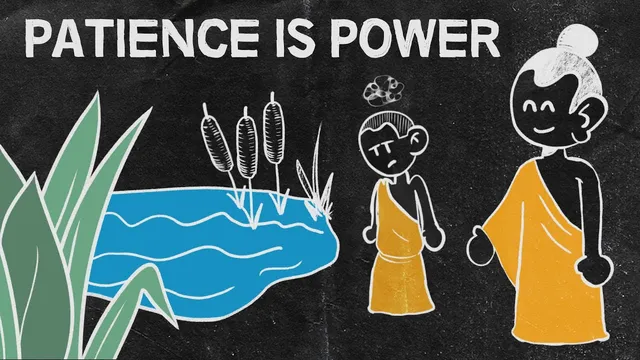
Why Patience is Power | Priceless Benefits of Being Patient
Based on Einzelgänger's video on YouTube. If you like this content, support the original creators by watching, liking and subscribing to their content.
Patience is treated as power because it prevents anger when circumstances can’t be controlled and shifts focus to changing attitude instead.
Briefing
Patience is framed as a practical form of power: when circumstances can’t be controlled, waiting with composure prevents anger, improves judgment, and strengthens relationships. The core lesson comes from a Buddha story in which an impatient disciple repeatedly brings muddy lake water—until the mud settles on its own. The disciple can’t force the water to clear, and trying to speed it up would likely worsen things. The takeaway is less about “enduring” and more about changing attitude when external conditions are fixed, echoing Viktor Frankl’s idea that when change is impossible, the challenge shifts to changing oneself.
Impatience is portrayed as both painful and pointless. It grows out of dissatisfaction with the present and a refusal to accept life’s pace—an expectation that the universe should bend to immediate wishes. That mismatch between desire and reality can trigger outbursts, with “road rage” offered as a familiar example of how frustration turns into harmful behavior. Patience, by contrast, is defined as the capacity to tolerate delay, trouble, or suffering without getting angry or upset (citing Oxford Languages). The video then links patience to five concrete benefits that show up in everyday decisions and long-term goals.
First is the “natural flow,” drawing on Taoist ideas associated with wu wei (effort action or non-doing). Forcing outcomes often backfires because nature has its own timing and optimal course. Patience helps people align expectations with that timing, and creativity becomes the example: creative impulses tend to arrive spontaneously, while forcing them can deepen “writer’s block.” The advice is to stop trying to control the moment and instead wait for inspiration to return.
Second comes wiser, more rational decision-making. Patience is described as self-control that lets emotions dissolve before action, reducing the likelihood of regrettable choices—such as ending a friendship during a heated quarrel. Folk wisdom like “sleep on it” or “count to ten” is presented as a simple way to create that emotional pause.
Third is equanimity. Stoic thinking is used to argue that letting external events dictate inner mood hands away personal power. The train-delay scenario illustrates the difference: impatient commuters fidget and curse, while patient ones acknowledge the delay and suffer less.
Fourth is perseverance and success. Long-term progress requires tolerating delayed results; focusing only on quick outcomes leads people to quit when results don’t appear fast enough. Elbert Hubbard’s quote about throwing up one’s hands too early is paired with a bamboo-growing story where seeds take five years to begin—years of care with no visible payoff.
Fifth is tolerance for others. People can’t control other people’s will, so impatience becomes intolerance and conflict. Stoic emperor Marcus Aurelius is invoked to emphasize that encountering difficult people is unavoidable, but attitude is changeable. Patience improves listening, empathy, and forgiveness, and the video closes by tying patience to strength and equanimity—summarized as “patience is power.”
Cornell Notes
Patience is presented as a practical kind of power: when external conditions can’t be changed, waiting with composure prevents anger and improves how people think and act. A Buddha story about muddy lake water illustrates the point—only time clears the water, and forcing it would likely worsen things. The transcript then connects patience to five benefits: following the natural flow (especially for creativity), making wiser decisions by letting emotions settle, maintaining equanimity when events like train delays happen, sustaining perseverance for long-term goals, and tolerating others despite differences and frustrations. The overall message is that patience reduces suffering, supports better choices, and strengthens relationships.
Why does the muddy-water story matter to the transcript’s definition of patience?
How does patience improve decision-making in the transcript’s framework?
What does “equanimity” mean here, and how is it illustrated?
Why does perseverance depend on patience according to the transcript?
How does patience change interactions with difficult people?
Review Questions
- Which parts of the Buddha lake story are used to argue that forcing outcomes can backfire, and what should be changed instead?
- How does the transcript distinguish patience from overthinking or doubt when making decisions?
- Pick one of the five benefits (natural flow, equanimity, perseverance, or tolerance). What mechanism links patience to the benefit?
Key Points
- 1
Patience is treated as power because it prevents anger when circumstances can’t be controlled and shifts focus to changing attitude instead.
- 2
Impatience is described as dissatisfaction with the present and a demand for immediate results, which can trigger harmful reactions like road rage.
- 3
Patience supports clearer decision-making by allowing emotions to settle before action, reducing the chance of regrettable choices.
- 4
Equanimity is framed as refusing to let external events dictate inner mood, illustrated through train-delay behavior.
- 5
Perseverance depends on tolerating delayed outcomes; quitting often happens when people fixate on results rather than the process.
- 6
Tolerance for others grows from accepting that other people’s behavior is not controllable, enabling empathy and forgiveness instead of reactive conflict.