Why People Aren’t Having Kids & How To Fix It
Based on Sabine Hossenfelder's video on YouTube. If you like this content, support the original creators by watching, liking and subscribing to their content.
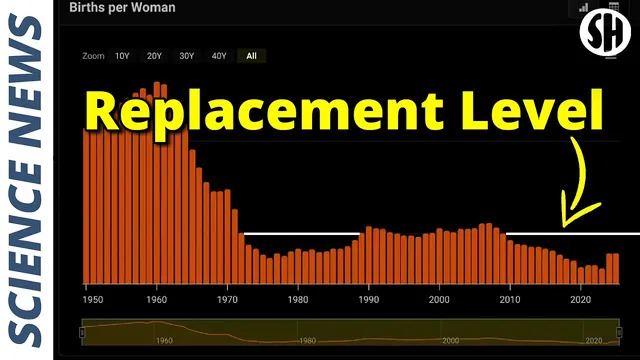
US fertility fell to an all-time low in 2023 and was 1.79 in 2024, still below replacement level.
Briefing
Fertility rates in much of the industrialized world have fallen to levels that governments can’t easily reverse—cash incentives can nudge birth rates upward, but the gains tend to be small and temporary. In the US, the average number of children per woman hit an all-time low in 2023 (1.79 in 2024, still below the replacement level of about 2.1). A Pew Research Center report adds urgency: among US adults under 50 who are childless, 47% say they’re unlikely to have kids, and among those, 57% say the reason is simply that they “just don’t want to.”
That mix—low desire to have children plus persistent declines across industrialized countries—has fueled political debate and a pronatalist push. Explanations range from cultural shifts (later childbearing, more work for women, lifestyle preferences) to technology and social media, with TikTok often blamed. Economic obstacles are one of the most supported theories, partly because many countries show a “fertility gap”: couples report wanting more children than they actually have. Yet even places with strong parental support—Northern Europe with maternity leave and state-subsidized childcare—still show low fertility, suggesting no single lever can solve the problem.
Governments have tried a variety of pronatalist policies, from direct payments to tax breaks and expanded services. Italy and Greece offer bonuses per baby; Hungary increases payments with each additional child, reaching up to 30,000 euro for families with at least three. Taiwan provides tax cuts and even “free pets,” while Denmark has urged citizens to have more children. A recent review of past research finds the most consistently effective initiatives are cash benefits—birth payments or tax exemptions—alongside paid leave and childcare coverage. The catch is magnitude: measurable effects exist, but they’re small.
The clearest example comes from Australia’s large birth bonus. A 3,000-dollar payment was later raised to 5,000, temporarily lifting the fertility rate from about 1.76 to 2.02. Once the bonus ended in 2013, fertility fell again. France combined a smaller baby bonus (around 1,000 euro) with additional support for the first year and childcare coverage up to age 2, and that package appears to have helped. Hungary’s bonus also raised fertility, but again only modestly.
The broader takeaway is that money can matter, but it doesn’t override deeper uncertainty. The proposed driver is insecurity about the future: young people may be reluctant to have children when they don’t trust conditions will improve. The practical implication is straightforward—if societies want higher birth rates, they need to reduce the anxieties that make parenthood feel risky. Otherwise, the policy toolbox may keep producing short-lived bumps rather than lasting change.
Cornell Notes
Fertility rates across industrialized countries remain below replacement level, and in the US the rate is 1.79 (2024) after an all-time low in 2023. A major barrier isn’t only affordability: Pew Research Center data show many childless adults under 50 say they simply don’t want children, with economic “fertility gaps” also appearing in multiple countries. Pronatalist policies have ranged from cash bonuses and tax exemptions to paid leave and childcare coverage. Research reviews find cash benefits and family-support services are the most consistently effective, but their effects are typically small and often fade when payments end. Australia’s large bonus temporarily raised fertility, but the rate dropped after the program ended, illustrating the limits of financial incentives alone.
What do recent US survey data suggest about why people aren’t having children?
Why do economists and policymakers keep returning to the “fertility gap” idea?
Which policy types show the most consistent evidence of raising birth rates?
How did Australia’s birth bonus illustrate both the potential and the limits of cash incentives?
What does the persistence of low fertility in well-supported countries imply?
Review Questions
- What evidence suggests that lack of desire, not just economic barriers, plays a role in low fertility?
- Compare Australia’s policy outcome with the general findings from research reviews—what does that tell you about long-term effectiveness?
- Why might strong childcare and maternity leave still fail to bring fertility to replacement level?
Key Points
- 1
US fertility fell to an all-time low in 2023 and was 1.79 in 2024, still below replacement level.
- 2
Pew Research Center data show many childless adults under 50 say they don’t want children, not just that they can’t afford them.
- 3
Economic obstacles remain a leading theory, supported by “fertility gaps” where desired family size exceeds actual outcomes.
- 4
A research review finds cash benefits, paid leave, and childcare coverage are the most consistently effective policy tools, but effects are small.
- 5
Australia’s large birth bonus temporarily raised fertility (about 1.76 to 2.02) but fertility dropped after the program ended.
- 6
Policies that rely mainly on payments may struggle to produce lasting change if uncertainty about the future remains high.