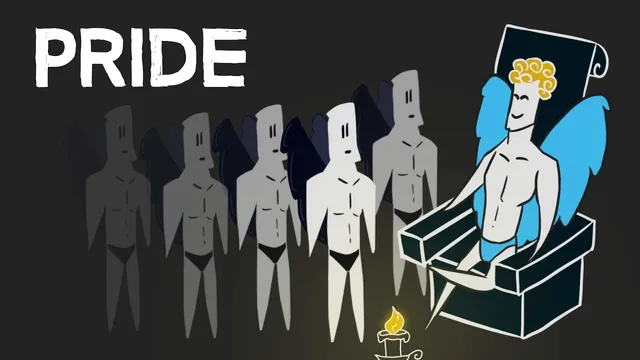
Why Pride Is the Worst | The Seven Deadly Sins | PRIDE
Based on Einzelgänger's video on YouTube. If you like this content, support the original creators by watching, liking and subscribing to their content.
Pride is portrayed as a gateway mindset: once someone believes they are superior, it becomes easier to rationalize other sins.
Briefing
Pride is framed as a root cause of moral collapse—starting with Lucifer’s fall—and then traced through both Christian theology and modern psychology to show how “feeling better than others” can quietly fuel greed, envy, cruelty, and social division. The central claim is that pride doesn’t just sit alongside other sins; it acts like a gateway, making people more susceptible to nearly every other form of wrongdoing.
Christian tradition anchors this warning in the story of Lucifer, depicted as the most magnificent angel who becomes convinced he is elevated above the other angels and even above God. Seeking to be like God, Lucifer builds a throne above the stars and recruits a third of the angelic beings to seize Heaven. After losing the war, he is cast down to Hell, and his former beauty is transformed into ugliness—an origin myth for Satan. Pride, in this telling, is not merely vanity but an inflated sense of self-importance, entitlement, and power.
That theological logic is reinforced by the “capital sins” framework associated with Thomas Aquinas, where pride is treated as the worst sin because it generates the others. Pride is described as the mental posture of superiority—an assumption that one’s position, identity, or accomplishments place one above other people. From there, the transcript links pride to specific downstream sins: greed grows from entitlement to have more; lust treats others as objects because one believes one deserves them; envy arises from resentment when others have what one thinks should be one’s; gluttony becomes a belief that one deserves more even when others go without; wrath is tied to arrogance and the conviction that one is always right; and sloth follows from the idea that one is too good to work.
The discussion then pivots to a non-Christian lens, arguing that pride can be driven by poor self-worth and shame. An article in Psychology Today by John Amodei is cited to describe pride as a compensation strategy: people feel so badly about themselves that they try to conceal it by finding others’ flaws, criticizing them, and using superiority as a shield. The transcript connects this coping pattern to narcissism, where an extreme need for superiority props up a fragile self-image.
Pride is also portrayed as subtle and socially contagious. Reality TV, gossip, and “cancel culture” are presented as arenas where people may enjoy humiliation of others while disguising it as moral correction. Mythology supplies a cautionary parallel through Narcissus: self-obsession becomes self-destructive, pulling attention away from food, relationships, and the outside world.
National pride is treated as a special case—sometimes a source of solidarity, especially in sports, but also a mechanism for hostility toward outgroups. The transcript points to ultranationalism, religious prejudice, and even internal religious hierarchies as examples of pride dividing communities.
Finally, the transcript complicates the picture by distinguishing between “authentic” pride and “hubristic” pride, citing Tracy and Robbins’ 2007 study. Authentic pride aligns with achievement and confidence; hubristic pride aligns with dominance, social validation, extrinsic goals, and aggression. The closing tension is whether pride is inherently corrupt or whether it becomes dangerous only when it turns into arrogance and entitlement—an argument that pride can be replaced by dignity and stable self-worth that does not depend on external wins.
Cornell Notes
Pride is presented as a foundational sin that leads to other moral failures, beginning with the Lucifer narrative in Christian tradition. Aquinas and earlier lists of “capital sins” place pride at the top because it creates the mindset of superiority—“being better than others”—which then feeds greed, lust, envy, gluttony, wrath, and sloth. Modern psychology is used to explain why pride can be compensatory: poor self-worth and shame can drive people to feel superior, criticize others, and maintain a fragile self-image (including narcissism). Myth and social examples (Narcissus, gossip, cancel culture, national and religious hostility) illustrate how pride can isolate people and divide groups. At the same time, research distinguishes authentic pride from hubristic pride, suggesting pride may be healthier when tied to achievement without dominance.
Why does Christian tradition treat pride as the “mother” or “gateway” sin rather than just another flaw?
How do biblical examples (Lucifer, Adam and Eve, Pharaoh) connect pride to disobedience and punishment?
What non-Christian explanation is offered for why pride often appears in everyday behavior?
How does the Narcissus myth illustrate pride’s psychological and social consequences?
Why is national pride treated as both potentially bonding and potentially dangerous?
What does the authentic-versus-hubristic pride distinction add to the debate about whether pride is always bad?
Review Questions
- How does the transcript connect pride to each of the other “capital sins” (greed, lust, envy, gluttony, wrath, sloth)?
- What psychological mechanism does Amodei describe that can make pride a defense against shame?
- According to Tracy and Robbins, what separates authentic pride from hubristic pride, and why does that matter for judging pride as “all bad”?
Key Points
- 1
Pride is portrayed as a gateway mindset: once someone believes they are superior, it becomes easier to rationalize other sins.
- 2
Christian theology places pride at the top of the “capital sins” because it generates the rest by encouraging entitlement and superiority.
- 3
Biblical narratives (Lucifer’s rebellion, Eve’s temptation, Pharaoh’s refusal) treat pride as disobedience rooted in the belief that one does not need God.
- 4
Modern psychology frames pride as compensation for shame and poor self-worth, often leading people to criticize others to protect their self-image.
- 5
Pride can be subtle—showing up in gossip, humiliation-as-entertainment, and social punishment framed as moral correction.
- 6
Myth and social examples (Narcissus, national and religious hostility) illustrate how pride can isolate individuals and divide groups.
- 7
Research distinguishes authentic pride from hubristic pride, implying pride is not automatically harmful when it stays achievement-linked and non-dominating.