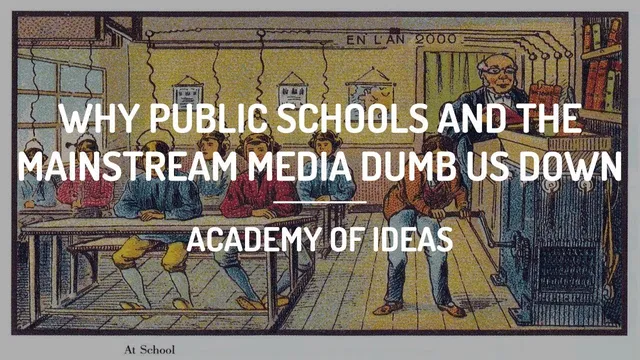
Why Public Schools and the Mainstream Media Dumb Us Down
Based on Academy of Ideas's video on YouTube. If you like this content, support the original creators by watching, liking and subscribing to their content.
The transcript claims compulsory public schooling prioritizes compliance over curiosity, leaving graduates less equipped to challenge corrupted authority.
Briefing
The central claim is that Western public schools and mainstream media have helped produce passive, compliant citizens—making societies more vulnerable to corrupted authority and tyranny. The argument ties together two institutions that shape what people learn, what they question, and what they accept as “normal,” warning that unquestioning obedience is a recipe for losing liberty.
The case against compulsory public schooling begins with the mismatch between the ideal and the reality. Public education is presented as free, compulsory, and universally beneficial, but the critique says the system is designed less to cultivate independent thinking than to train students into a factory-like routine. The transcript points to the Prussian model introduced in the early 1700s as an early template for state-run schooling, emphasizing standardization and compliance over curiosity. John Taylor Gatto—described as a former teacher turned critic—frames this as an intentional outcome rather than an accidental failure. Noam Chomsky is also invoked through his work *Understanding Power*, reinforcing the idea that the system’s structure historically served power rather than personal development.
Albert Einstein is used as a concrete counterexample to the “school makes minds” narrative. After finishing his final examinations, Einstein’s interest in the field he later transformed, the transcript says, was “all but dead,” implying that compulsory schooling can extinguish the very motivation it claims to foster. Bruce Levine’s *Resisting Illegitimate Authority* is then cited to argue that graduates often leave without the “thirst for knowledge” and curiosity that a free society needs.
That raises a second question: if schools don’t reliably produce critical citizens, can mainstream media fill the gap? The transcript argues that media skepticism is not new and cites intellectual critics of mass media. Friedrich Nietzsche is described as unimpressed by mainstream outlets, while Richard Weaver—writing in the era of newspapers—warns that modern societies have traded one worldview for another that can be manipulated. The critique leans heavily on Chomsky’s *Media Control*, suggesting that media institutions are shaped by elitist ideology and that their role is to manage the public as passive spectators rather than active participants.
Walter Lippmann’s phrase “bewildered herd” is used to capture the alleged function of media: placing masses “in their proper place.” The transcript then frames a key political uncertainty—whether this management serves the public good or mainly protects elite structures.
From there, the argument pivots to a prescription: societies need “anti-authoritarians,” defined not as people who reject all authority, but as those who refuse blind consensus and remain willing to question, scrutinize, and resist harmful power. The transcript cites Henry David Thoreau and CP Snow to argue that tyranny grows when malevolent authority meets passive citizens, and that anti-authoritarians are the alarm system that wakes people from illusion. Voltaire is invoked as a final caution that liberty depends on resisting the drift toward unquestioned control.
Cornell Notes
The transcript argues that compulsory public schooling and mainstream media help create passive citizens who are less able to resist corrupted authority. It claims state-run education follows a factory-style model (traced to Prussia) that prioritizes compliance over curiosity, citing John Taylor Gatto, Noam Chomsky, and examples such as Albert Einstein’s reported loss of interest after exams. It then argues that mainstream media reinforces passivity through elitist ideology, using Noam Chomsky’s *Media Control* and Walter Lippmann’s “bewildered herd” to describe media as managing the public as spectators. The conclusion calls for “anti-authoritarians”—skeptical of authority and willing to resist when power becomes harmful—because tyranny requires both malevolent authority and passive citizens.
Why does the transcript say compulsory public schooling can undermine liberty?
What role does mainstream media play in the transcript’s theory of social control?
How does the transcript connect media manipulation to elite ideology?
What does “anti-authoritarian” mean in the transcript, and what doesn’t it mean?
Why does the transcript argue anti-authoritarians are necessary rather than dangerous?
Review Questions
- What evidence and examples does the transcript use to argue that compulsory schooling reduces curiosity and critical thinking?
- How do Chomsky’s and Lippmann’s ideas about the “bewildered herd” support the transcript’s view of mainstream media’s social function?
- In the transcript’s definition, how does an anti-authoritarian differ from someone who rejects all authority?
Key Points
- 1
The transcript claims compulsory public schooling prioritizes compliance over curiosity, leaving graduates less equipped to challenge corrupted authority.
- 2
It traces state-run education’s logic to a factory-style model associated with Prussia in the early 1700s.
- 3
Albert Einstein is used as a case study to suggest compulsory schooling can extinguish motivation for the work that later defines genius.
- 4
Mainstream media is portrayed as reinforcing passivity through elitist ideology, with Chomsky’s *Media Control* and Lippmann’s “bewildered herd” used to describe public management.
- 5
The transcript frames a central uncertainty: whether media and institutions serve public flourishing or mainly protect elite structures.
- 6
“Anti-authoritarian” is defined as skeptical and willing to resist harmful authority—not as rejecting all authority.
- 7
The transcript argues that tyranny requires both malevolent authority and passive citizens, so anti-authoritarians are positioned as essential safeguards for liberty.