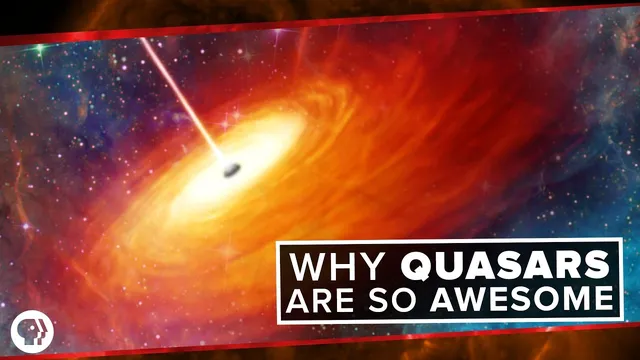
Why Quasars are so Awesome | Space Time
Based on PBS Space Time's video on YouTube. If you like this content, support the original creators by watching, liking and subscribing to their content.
Quasars are powered by accretion onto supermassive black holes, where infalling gas forms an accretion disk that converts motion into heat and light.
Briefing
Quasars are the universe’s most luminous signposts of supermassive black holes feeding—brief, intense bursts that can reshape entire galaxies and help set the conditions for cosmic evolution. When gas falls into a black hole millions to billions of times the Sun’s mass, it forms a scorching accretion disk. That disk converts the infalling gas’s motion into heat and light so powerful it can be seen across billions of light-years, while some of the same energy drives winds and, in certain cases, collimated jets that blast through surrounding space.
The modern picture of quasars crystallized from early radio astronomy. In the early days, radio telescopes detected “blobs” of radio emission with poor resolution, leaving their locations uncertain. In 1962, astronomers used a lunar occultation—when the Moon passed in front of a bright radio source—to pinpoint the emission’s origin. The source, cataloged as 3C273, was then identified optically as a tiny bluish point. Its spectrum didn’t match any known star, and its light was strongly redshifted, implying it lay about two billion light-years away. The puzzle was scale: such brightness from such a small region demanded an engine far more extreme than anything stellar.
By the 1980s, the explanation converged on accreting supermassive black holes at galactic centers. Every “decent sized” galaxy is believed to host one, and galaxy mergers can funnel gas inward. As gas spirals in, it heats up in the accretion disk; some material is swallowed and the black hole grows, while much of the energy escapes as radiation. That radiation can also push gas outward, suppressing further star formation by heating the galactic environment. The quasar phenomenon also depends strongly on orientation. If the accretion disk is viewed face-on, the bright disk dominates. If viewed edge-on, a thick, dusty ring can obscure the disk, leaving only indirect signatures—such as gas lit up around the center. When powerful jets exist and are aimed toward Earth, relativistic beaming can amplify the jet’s light dramatically, producing blazar-like behavior. Without a jet, or with a different viewing angle, the same underlying engine can look like a different class of active galaxy.
Quasars matter because their peak era coincided with the universe’s most violent youth. Early galaxies underwent intense star formation, followed by waves of supernovae that stirred and enriched their surroundings. Quasar activity rose in parallel as gas that fueled starbursts also fed central black holes. Each quasar episode likely lasts around 10 million years—short on cosmic timescales, but long enough to heat gas across a galaxy and shut down starbursts. As the universe aged to roughly a quarter of its current age, both star formation and quasar activity began to fade, giving galaxies a calmer environment in which life could plausibly emerge. Today, active galactic nuclei still occur, but typically at lower power; 3C273 remains a luminous late relic from that earlier “quasar epoch.” Future galaxy mergers—like a Milky Way–Andromeda collision—could trigger new quasar phases by delivering fresh fuel to merged black holes.
Cornell Notes
Quasars are extraordinarily bright, short-lived episodes powered by supermassive black holes accreting gas at galactic centers. Gas spirals into an accretion disk, where motion becomes heat and light; some energy escapes as radiation that can drive winds, while some systems launch jets. What astronomers observe depends on orientation: face-on views highlight the disk, edge-on views can obscure it with dusty gas, and jets pointed toward Earth can appear dramatically brighter due to relativistic beaming (blazars). Quasar activity peaked in the early universe alongside intense star formation, and quasar heating likely suppressed starbursts, shaping how galaxies evolved. Even today, active galactic nuclei persist, but full quasar power is rarer; 3C273 is a notable luminous example.
How did astronomers go from blurry radio “blobs” to identifying a specific quasar candidate like 3C273?
Why did 3C273’s redshift create such a brightness-scale problem?
What physical mechanism links supermassive black holes to quasar luminosity?
How do orientation and jets change what astronomers see?
Why are quasars important for galaxy evolution and the possibility of life?
Review Questions
- What observational evidence tied 3C273 to a distant, compact energy source rather than a normal star?
- Describe the chain of events from gas inflow to accretion disk heating to quasar radiation and feedback.
- How can the same underlying active galactic nucleus appear as a quasar, radio galaxy, or blazar depending on geometry?
Key Points
- 1
Quasars are powered by accretion onto supermassive black holes, where infalling gas forms an accretion disk that converts motion into heat and light.
- 2
Lunar occultations helped pinpoint early radio sources, enabling the optical identification of 3C273 and the discovery of its unusual, redshifted spectrum.
- 3
The extreme brightness of quasars from tiny regions implies an energy engine far beyond stellar processes, consistent with black-hole accretion.
- 4
Quasar feedback includes radiation-driven winds that can heat galactic gas and suppress star formation by preventing gas from collapsing.
- 5
Orientation matters: dusty obscuration can hide the disk edge-on, while jets and relativistic beaming can make jet-aligned systems appear dramatically brighter.
- 6
Quasar activity peaked in the early universe alongside starbursts, likely shaping how galaxies evolved during the universe’s most turbulent epoch.
- 7
Even today, active galactic nuclei persist, but full quasar power is rarer; 3C273 is a notable luminous relic from the earlier quasar era.