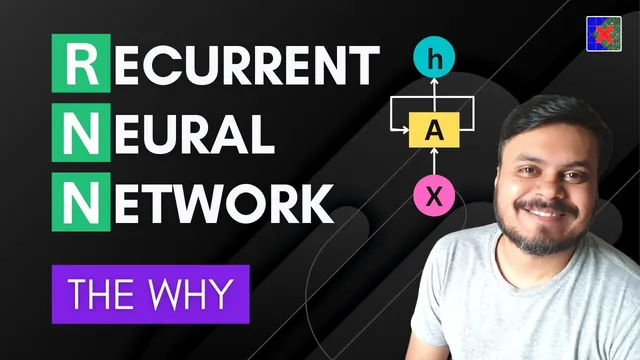
Why RNNs are needed | RNNs Vs ANNs | RNN Part 1
Based on CampusX's video on YouTube. If you like this content, support the original creators by watching, liking and subscribing to their content.
RNNs are built to model sequential data where order determines meaning, such as sentences, time series, audio, and DNA sequences.
Briefing
Recurrent Neural Networks (RNNs) are built for one job: handling sequential data where meaning depends on order—like words in a sentence, timestamps in a time series, or bases in a DNA sequence. Unlike feedforward models such as Artificial Neural Networks (ANNs) or Convolutional Neural Networks (CNNs), RNNs are designed to process sequences in a way that preserves context across steps, which is why they became central to NLP and other sequence-heavy tasks.
The core motivation starts with what “sequential data” really means. In text, reading happens word-by-word, and the final meaning depends on what came first and what came next. In time series, today’s value depends on prior values. Even in audio, a waveform unfolds over time, and in biology, DNA is inherently ordered. The transcript contrasts this with tabular data (where order often doesn’t matter) and images/video (where spatial patterns matter more), setting up why a sequence-specific architecture is needed.
A key problem with using a basic ANN on text is that it typically expects a fixed-size input. If a sentence is represented using one-hot vectors for each word, then the input size becomes tied to the number of words in the sentence. The transcript walks through a toy example: with a vocabulary size of 12, a sentence of 3 words produces a different input shape than a sentence of 5 words. Standard dense layers can’t naturally accept variable-length inputs, so padding is used—adding zeros to shorter sentences and truncating or padding to match a maximum length.
But padding creates new issues. It forces unnecessary computation for the many padded zeros, inflates the number of parameters (especially when the vocabulary is large), and still doesn’t solve the deeper limitation: sending all words at once to a feedforward network loses the “order-aware” mechanism. When words are processed without a memory of earlier steps, the model can’t reliably capture the sequence semantics—what happened before and what follows—so accuracy suffers.
RNNs address this by introducing a recurrent structure that carries information forward across time steps. Instead of treating a sentence as a single fixed block, the model processes it step-by-step, maintaining context so that earlier tokens can influence later predictions. The transcript emphasizes that this “memory of sequence” is the capability missing from the simpler approach.
From there, the transcript highlights why RNNs matter in practice, listing applications where order and context are essential: sentiment analysis of movie reviews (including extracting sentiment words and producing a score), sentence completion/autocomplete in tools like Gmail and on phone keypads, image caption generation (turning visual content into descriptive text), and machine translation (auto-detecting language and converting between languages). It also mentions question-answering systems that can answer queries based on a provided paragraph or web content, and briefly notes other uses like time-series forecasting and speech classification.
Finally, the roadmap points to what comes next: learning the simplest RNN architecture, implementing it in code, studying backpropagation through time (BPTT), diagnosing RNN training problems like vanishing and exploding gradients, and then moving to improved variants such as LSTM and GRU, plus additional RNN types and deeper concepts.
Cornell Notes
RNNs are designed for sequential data where order changes meaning—sentences, time series, audio, and DNA sequences. A plain ANN struggles because it expects fixed-size inputs; representing text as one-hot vectors makes input dimensions depend on sentence length, forcing padding and creating heavy unnecessary computation. Even with padding, a feedforward approach processes the sequence as a single block and lacks a built-in mechanism to remember earlier tokens, so it can’t reliably capture order-dependent semantics. RNNs fix this by processing inputs step-by-step while carrying forward context, enabling predictions that depend on what came before. This sequence-aware capability underpins common applications like sentiment analysis, sentence completion, image captioning, machine translation, and question answering.
Why does sequential data require a different neural network design than tabular data?
What fixed-input limitation appears when using a basic ANN on sentences?
Why is padding a “workaround” rather than a complete solution?
How do RNNs address the order/“memory” problem?
Give examples of tasks where sequence order is essential and RNNs are a natural fit.
What training challenges are expected with RNNs, and what improvements are planned next?
Review Questions
- How does padding change the computational cost and parameter count when using one-hot word representations with a fixed-length ANN?
- What specific capability does an RNN add that a feedforward model lacks for sequence semantics?
- Why do vanishing/exploding gradients matter for learning long-range dependencies in RNNs?
Key Points
- 1
RNNs are built to model sequential data where order determines meaning, such as sentences, time series, audio, and DNA sequences.
- 2
ANNs typically require fixed-size inputs, so variable-length text forces padding or truncation.
- 3
Padding reduces the input-size mismatch but increases unnecessary computation and can inflate parameters, especially with large vocabularies.
- 4
Even with padding, feedforward processing of the whole sequence at once can lose order-aware semantics (what came before vs. after).
- 5
RNNs process sequences step-by-step while carrying forward context, enabling order-dependent predictions.
- 6
RNN-driven sequence modeling supports tasks like sentiment analysis, sentence completion, machine translation, image captioning, and question answering.
- 7
The learning path ahead includes implementing a simple RNN, then addressing training issues like vanishing/exploding gradients using LSTM and GRU.