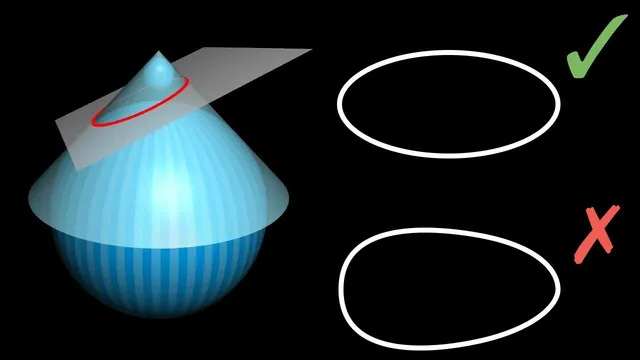
Why slicing a cone gives an ellipse (beautiful proof)
Based on 3Blue1Brown's video on YouTube. If you like this content, support the original creators by watching, liking and subscribing to their content.
Cone slicing produces an ellipse because every point on the intersection curve satisfies the constant sum of distances to two interior foci.
Briefing
Slicing a cone at the right angle produces an ellipse—and the surprising part is that this “conic section” curve matches exactly the ellipse drawn by the classic two-thumbtack string construction. The core finding is an equivalence proof: for every point on the cone’s intersection curve, there exist two interior “focus” points such that the sum of its distances to those foci stays constant. That constant-sum property is precisely what defines an ellipse in the thumbtack model, so the two constructions generate the same family of shapes.
The argument starts by recalling three geometric definitions of an ellipse. One stretches a circle by scaling one coordinate; another traces points whose distances to two fixed foci add to a constant (the thumbtack-and-string method); the third slices a cone with a plane at an angle shallower than the cone’s side, producing the intersection curve. Since these procedures look unrelated—3D slicing versus 2D stretching versus a distance-sum constraint—the natural question is why they land on identical curves, including the same eccentricity behavior.
To prove the cone-slicing version matches the thumbtack definition, the proof targets a single equivalence: every ellipse from a cone slice also satisfies the constant focal sum rule. The key move is a creative geometric construction using two spheres, one above the slicing plane and one below it. Each sphere is chosen to be tangent to the cone along a circle of points and tangent to the slicing plane at exactly one point. Those two tangency points inside the ellipse become the candidate foci.
Pick any point q on the cone–plane intersection curve. From q, draw a line to the tangency point on the upper sphere (the “top focus”) and also draw the line from q that lies along the cone toward the lower tangency circle. The proof then uses a standard tangency fact: if multiple lines from a common external point touch the same sphere, tangency forces those line segments to have equal length. In the setup, the line from q to the top focus is tangent to the upper sphere, and the line from q along the cone to the tangency circle is also tangent to that same sphere—so those lengths match. The same reasoning applies to the lower sphere and the second focus.
As a result, the distance from q to the first focus plus the distance from q to the second focus equals the straight-line distance between the two tangency circles on the spheres, measured along the cone through q. Crucially, that straight-line distance is fixed by the geometry of the cone slice and the chosen spheres, not by where q sits on the ellipse. Therefore, the sum of distances from q to the two foci is constant for every point q on the intersection curve—exactly the thumbtack definition.
The proof is commonly credited to Dandelin (1822), often referenced through “Dandelin spheres,” and it also generalizes: slicing a cylinder at an angle yields an ellipse, and projecting a circle onto a tilted plane explains why “stretched circle” and “distance-sum” definitions coincide. Beyond the geometry, the transcript emphasizes why the construction feels like real mathematical progress: it’s not brute computation but an equivalence built from a single inspired insertion—two carefully chosen spheres—followed by systematic use of tangency properties.
Cornell Notes
Cone slicing at an angle produces an ellipse because the intersection curve satisfies the same constant-distance-to-two-foci rule as the thumbtack construction. The proof introduces two special spheres—tangent to the cone along circles and tangent to the slicing plane at single points. Those tangency points serve as the ellipse’s foci. For any point q on the intersection curve, tangency geometry forces the lengths from q to each focus to match corresponding tangent segments along the cone. That makes the sum of distances from q to the two foci constant, independent of q, so the cone-slice ellipse and the thumbtack ellipse are the same family of curves.
Why does the proof focus on showing a constant sum of distances to two points (foci)?
What are the Dandelin spheres, and how are they chosen?
How does tangency to a sphere turn into an equality of lengths?
Where does the “constant” come from in the focal-sum argument?
Why does the proof also imply other ellipse definitions agree (like stretching a circle)?
Review Questions
- In the Dandelin-sphere proof, what specific tangency conditions guarantee that the two tangency points on the slicing plane can serve as foci?
- For a point q on the cone–plane intersection, which two tangent segments are shown equal, and to which sphere do they both remain tangent?
- How does the proof convert a geometric condition about tangency into the constant-sum property dist(q, F1)+dist(q, F2)=constant?
Key Points
- 1
Cone slicing produces an ellipse because every point on the intersection curve satisfies the constant sum of distances to two interior foci.
- 2
Two Dandelin spheres—each tangent to the cone along a circle and tangent to the slicing plane at one point—identify the ellipse’s foci.
- 3
Tangency geometry implies that from a point q, all tangent segments to the same sphere have equal length.
- 4
For any point q on the intersection curve, the focal distance sum equals a fixed distance determined by the cone slice, not by q’s position.
- 5
The equivalence links three ellipse definitions: conic sections, the thumbtack string construction, and (via related arguments) stretching/projection views.
- 6
The proof’s creative step is inserting the right spheres; the rest follows from systematic use of tangency properties.