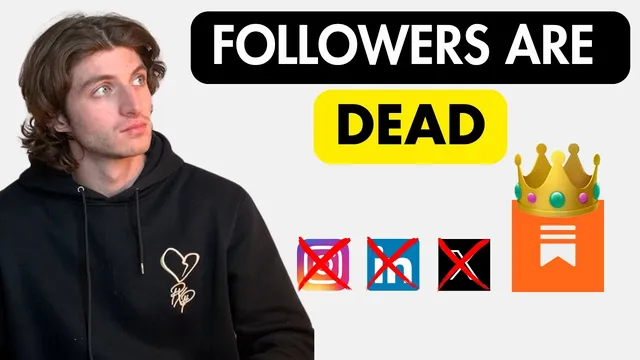
Why Smart Creators Are Ditching Social Media for Substack
Based on Noah Vincent's video on YouTube. If you like this content, support the original creators by watching, liking and subscribing to their content.
Social platforms mediate visibility through algorithms that optimize for retention, so “followers” don’t guarantee reach.
Briefing
Creators no longer control their audience on social platforms; algorithm-driven feeds and retention incentives mean “followers” behave like rented attention. That shift matters because it turns years of audience-building into something fragile—one update can erase reach overnight—while most creators keep chasing engagement metrics inside systems that optimize for platform growth, not creator success.
The transcript frames this as a structural problem: platforms mediate what people see, so there’s no direct connection between a creator and the people who “follow” them. Twitter and Instagram are described as having moved from a simple follow-and-view model to algorithmic selection, where posts are surfaced based on what keeps users on the app. The result is familiar to many creators—large follower counts paired with low engagement—because the algorithm is training users to value the platform experience rather than the creator’s work. Even major accounts can see reach collapse after a single change, reinforcing the idea that social media has shifted from audience discovery to using creators as content fuel to keep users scrolling.
To explain why some creators are escaping this trap, the transcript lays out a predictable platform lifecycle. New platforms begin in an innovation/launch phase where they need creators and grant broad organic reach. They then move into early adopters, where algorithm preference still helps but the audience pool is limited. Next comes the early majority “sweet spot,” when the platform has a large user base without being oversaturated, making growth comparatively easier. Later phases bring heavier competition, reduced organic reach, and pay-to-play visibility. Eventually, saturated conditions force creators to “play the algorithm game perfectly,” with TikTok (2019), Instagram (2020), and LinkedIn (2021) cited as examples of platforms that reached their golden age and then shifted toward algorithm dependence.
Substack is positioned as being in that early majority stage right now—described as having over 50 million unique monthly visitors and more than 30 million monthly active subscribers, including over 5 million paid subscribers. The transcript also claims Substack is still actively promoting new creators, pointing to high-profile migrations such as Dano and Justin Welsh moving entire audiences to Substack. Practical outcomes are used to argue the case: in five days on Substack, 33 email subscribers were generated directly from the platform, and a note received 176 likes within four days while continuing to grow. By contrast, Twitter growth is portrayed as slower and more volatile, with content effectively dying quickly unless the algorithm resurfaces it.
The strategic pitch is that Substack changes the ownership equation. Subscribers provide real email addresses that can be exported, giving creators control over distribution and relationship-building. Built-in recommendation and cross-promotion mechanics are described as working in creators’ favor, and Substack readers are characterized as more likely to read long-form content rather than scroll passively.
The transcript doesn’t ignore tradeoffs. Switching can mean managing dual email lists and reworking website opt-ins, plus losing some advanced marketing automation capabilities compared with dedicated email platforms. It also warns that discovery still depends on Substack’s recommendation systems, so platform dependency doesn’t vanish—only the balance shifts toward owned distribution.
Finally, the transcript argues that long-term success isn’t about gaming algorithms; it’s about producing content people genuinely want to read. For newer creators stuck on “what to write,” it promotes an AI-assisted “second brain” workflow using Cortex and the Zettelkasten-style zettocast method to capture permanent notes, connect ideas, and generate content from accumulated context. The closing prediction is that Substack’s advantage won’t last forever: saturation will eventually arrive, so creators should use the current window to build ownership and dependency before the lifecycle turns.
Cornell Notes
The transcript claims social media “followers” aren’t truly owned because algorithms decide who sees a creator’s work, optimizing for user retention rather than creator growth. It argues that platforms follow a lifecycle—launch, early adopters, early majority, late majority, and saturation—and that creators who enter during the early majority stage gain a structural advantage. Substack is presented as sitting in that early majority window, with large traffic and subscriber numbers plus continued promotion of new writers. The core strategic benefit is owned distribution: Substack subscribers provide exportable email addresses, enabling relationship-building beyond algorithm reach. The tradeoff is operational complexity (dual email lists, funnel changes) and continued dependence on Substack for discovery, but the transcript frames this as a better risk profile than algorithm-only growth.
Why does the transcript say “followers are dead,” and what does that mean in practice?
How does the platform lifecycle model explain why some creators grow faster than others?
What specific reasons are given for choosing Substack over algorithm-driven social platforms?
What tradeoffs come with moving to Substack, according to the transcript?
What day-to-day content system is recommended for Substack success?
How does the transcript propose solving the “what should I write about?” problem for new creators?
Review Questions
- What mechanisms make social media “followers” less reliable than email subscribers, according to the transcript?
- Which phase of the platform lifecycle does the transcript claim is most advantageous, and why?
- What operational challenges does the transcript predict when migrating from social platforms to Substack, and what workarounds are suggested?
Key Points
- 1
Social platforms mediate visibility through algorithms that optimize for retention, so “followers” don’t guarantee reach.
- 2
Platforms follow a lifecycle from launch to saturation; entering during the early majority phase is framed as a structural advantage.
- 3
Substack is presented as being in an early majority window, with large traffic/subscriber numbers and active promotion of new creators.
- 4
Substack’s biggest strategic benefit is owned distribution: subscriber email addresses can be exported and used to build a direct relationship.
- 5
Switching can create funnel and automation complexity because creators may need to manage dual email lists and rework opt-ins.
- 6
Substack discovery still depends on platform mechanics, so the transcript treats the move as shifting risk rather than eliminating it.
- 7
Long-term differentiation is tied to authentic, useful writing supported by a repeatable idea-capture and creation system (Cortex/second brain).