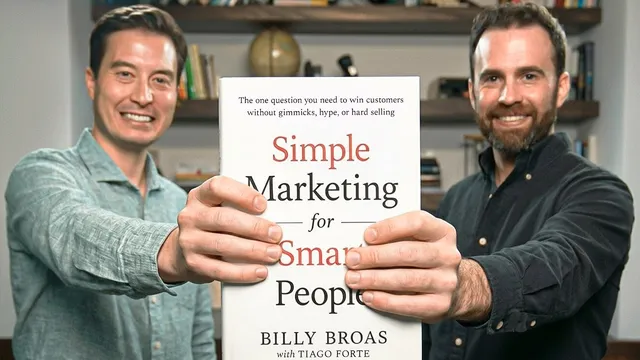
Why Smart People Struggle With Marketing - And How To Fix It
Based on Tiago Forte's video on YouTube. If you like this content, support the original creators by watching, liking and subscribing to their content.
Marketing becomes easier when it’s treated as education that builds beliefs before sales begins.
Briefing
Smart experts don’t struggle with marketing because they lack skill—they struggle because they try to communicate from inside the weeds, while buyers are upstream with different beliefs and limited context. The fix is to treat marketing as belief-building and education: meet prospects where they are, distill the message to what they need to believe to take the next step, and only then move toward sales. Done this way, marketing stops feeling like deception or manipulation and becomes a more ethical, more effective path to customers who are a better fit.
The conversation frames marketing as “icky” largely because people associate it with hype, gimmicks, and hard-sell tactics. That mindset forces entrepreneurs, freelancers, and creators into a false choice: either avoid marketing and lose income, or “sell their soul.” The alternative offered is straightforward: marketing is educating people so they can fully value what’s being offered. That means writing and messaging that treat readers as intelligent—using clear arguments, proof, and even selective honesty such as admitting when someone isn’t the right fit. A key principle is the “golden rule of marketing”: people can tell when they’re being treated like they’re dumb, and they respond better when they’re treated like they’re capable of understanding.
A central blind spot for “smart people” is that their expertise creates a double-edged problem. They notice advanced distinctions and want to teach them immediately, but prospects aren’t there yet. If the marketing message dives into technical details too early, it loses people who aren’t down in the weeds. The remedy is distillation—simplifying without dumbing down—so the message rises to the prospect’s level and only goes deeper when the buyer is ready.
To operationalize this, the book centers on a single question: what does the customer need to believe in order to buy? Belief-building is mapped onto a buyer journey split into two phases: marketing (about 25%) and sales (about 75%). Marketing’s job is to make selling unnecessary or far easier, echoing Peter Drucker’s idea that marketing aims to remove the need for hard selling. The journey starts with awareness of unease, moves through solution-seeking once the problem is articulated, and then advances toward valuing the specific approach only after the prospect understands the options and the reasoning behind the offer.
The transcript also emphasizes why this matters more online than in one-shot offline selling. Instead of “hitting the hole in one,” creators can use multiple touchpoints—emails, posts, videos, and other follow-ups—to move people gradually down the fairway toward purchase.
Belief-building has two stages. First, identify current beliefs by listening for “bad questions” (too advanced or misdirected), surfacing myths (common misconceptions like assuming better gear automatically improves results), and observing behaviors that reveal what people value (for example, obsessively organizing tools instead of taking action). Second, change beliefs by making an argument backed with proof. Aristotle’s rhetoric—ethos (credibility), pathos (emotion/story), and logos (logic/evidence)—is offered as a practical toolkit for persuading readers across any format. The approach is platform-agnostic: the core message should be correct before chasing tactics on TikTok, Instagram, or other channels.
Finally, the guidance draws a line between ethical, long-term marketing and “bro marketer” churn-and-burn behavior that prioritizes revenue over customer outcomes. The recommended path is classier and more sustainable: focus on education, build trust through proof, and design marketing so the right customers self-select into the offer.
Cornell Notes
The core claim is that smart experts struggle with marketing because they communicate from inside their technical “weeds,” while buyers start upstream with different beliefs and limited context. Marketing should be treated as education and belief-building, not deception: prospects must be led to what they need to believe before sales becomes appropriate. The book’s guiding question is, “What does my customer need to believe in order to buy?” Beliefs are identified by spotting bad questions, myths, and behaviors that reveal what people value. Beliefs are changed by making an argument supported by proof using Aristotle’s ethos, pathos, and logos—delivered through any channel, since the message comes first and tactics come later.
Why do “smart people” often miss the mark when marketing their expertise?
How does the belief-building framework map onto the buyer journey?
What are practical ways to identify a prospect’s current beliefs?
How does marketing actually change beliefs instead of just listing information?
Why does the approach insist on being platform-agnostic?
What’s the ethical line drawn around marketing behavior?
Review Questions
- What does the book’s “what does my customer need to believe in order to buy?” question force you to do differently from teaching technical details first?
- How would you diagnose a prospect’s current beliefs using bad questions, myths, and behaviors—without asking them directly what they believe?
- Which of Aristotle’s ethos, pathos, and logos would you prioritize for your own offer, and what specific proof would you use for each?
Key Points
- 1
Marketing becomes easier when it’s treated as education that builds beliefs before sales begins.
- 2
Smart experts often fail by communicating from inside the weeds; distillation is the skill that bridges the gap.
- 3
A single guiding question—what the customer needs to believe to buy—helps turn assumptions into actionable messaging.
- 4
Beliefs can be identified by listening for bad questions, uncovering myths, and observing behaviors that reveal what people value.
- 5
Beliefs are changed by making an argument supported with proof, using ethos, pathos, and logos.
- 6
Upstream message quality matters more than downstream tactics; the same core argument can be delivered across channels.
- 7
Long-term, ethical marketing prioritizes customer fit and outcomes rather than churn-and-burn revenue tactics.