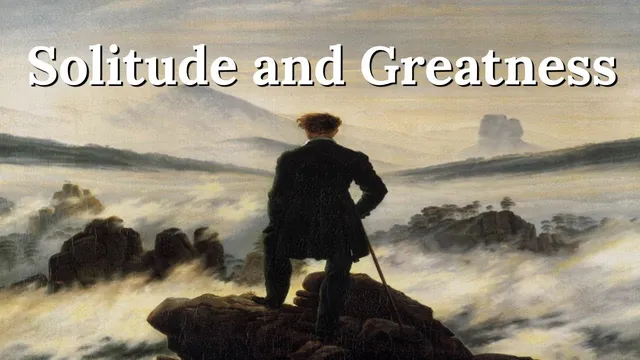
Why Solitude Promotes Greatness - The Benefits of Being Alone
Based on Academy of Ideas's video on YouTube. If you like this content, support the original creators by watching, liking and subscribing to their content.
Chronic loneliness is linked to major health risks, but solitude can be psychologically beneficial when it lacks loneliness’s distress.
Briefing
Chronic loneliness is linked to serious health harms, but solitude—time spent alone without the emotional sting of loneliness—can be a powerful engine for mental healing and personal growth. A 2010 study in PLOS Medicine is cited to quantify loneliness’s risks as roughly equivalent to smoking 15 cigarettes a day. The key distinction is that not all time alone is lonely: solitude can reduce the pressures of social life while creating space for reflection, emotional processing, and self-definition.
Philosophers and writers have long treated solitude as a training ground for character. Henry David Thoreau described extended isolation at Walden Pond as never lonely, calling solitude “companionable.” Philip Koch, in Solitude: A Philosophical Encounter, defines solitude as an experiential stretch where other people are absent from perception, thought, emotion, and action—enough to create a stable inner world across different solitudes. That framework helps explain why figures such as Jesus, Lao Tzu, Buddha, Moses, and later thinkers like Marcus Aurelius and Friedrich Nietzsche sought long stretches of isolation to reach moral and philosophical clarity. Nietzsche’s own account is blunt: when among crowds he “lives as the many do” and stops thinking as he truly thinks, so he “requires the desert” to “grow good again.”
The transcript argues that solitude’s benefits come from freedom from social constraint. In relationships, friends, family, and partners bring “structures of demands,” including expectations about attention, care, and responsiveness. Even strangers can intrude on inner freedom: Jean-Paul Sartre’s “Hell is other people” captures how the mere presence of another person turns the self into an object under someone else’s gaze. William James similarly describes the self-conscious shift a solitary hiker feels when another approaches. Solitude removes these disruptions, allowing people to enjoy surroundings without monitoring how they appear, to think and feel without censorship, and to follow passions without worrying about meeting others’ expectations.
That freedom is portrayed as both valuable in itself and instrumental for growth. Koch’s concept of “attunement to self” describes a “free flow” of thoughts, desires, and emotions, plus access “backwards” toward their origins—an unfiltered contact with inner life that social masks can bury. May Sarton’s Journal of a Solitude is used to show how prolonged isolation can restore a “deep self” after a relationship has battered it. Thomas Merton adds that everyone needs enough silence to hear the “deep inner voice,” warning that constant exile from inner solitude makes life “miserable and exhausting.”
Solitude can also surface painful material—trauma, fear, anxiety, rages, jealousy, dependencies—yet the transcript frames this as an opportunity to confront and process it safely. Albert Camus is quoted on learning to remain alone with suffering without fleeing. The healing claim is reinforced with Shoma Morita’s Zen-influenced psychotherapy, described as forcing patients into a solitude-based environment where they must accept their illness until it becomes one with them. Historical and cross-cultural examples—from Tarahumara practices of solitary living to ritual wilderness quests marking passage into manhood—are offered to argue that societies once treated solitude as formative rather than something to escape. The transcript closes by blaming modern avoidance of solitude for a rise in mental illness, echoing Blaise Pascal’s line that humanity’s problems stem from an inability to sit quietly alone.
Cornell Notes
Solitude is presented as the antidote to loneliness: time alone can be psychologically restorative when it lacks the distress and social threat that define loneliness. The transcript distinguishes solitude from social constraint—demands from others, emotional contagion, and the self-conscious awareness of being judged. Without those pressures, solitude enables “attunement to self,” described as a free-flowing access to thoughts, emotions, and their origins, helping people remove social masks and reconnect with a deeper self. While solitude can bring up painful memories and anxieties, that surfacing is framed as a route to processing and healing, supported by references to Camus and Morita’s Zen-based psychotherapy. Historically, many cultures used solitary periods for moral and life transitions, suggesting solitude is a human developmental tool rather than a defect.
What’s the crucial difference between loneliness and solitude, and why does it matter for health?
How does social life constrain inner experience, according to the transcript’s examples?
What is “attunement to self,” and how is it supposed to support self-development?
Why can solitude be uncomfortable, and how does the transcript connect discomfort to healing?
What evidence is offered that solitude can function like therapy?
How do historical and cultural practices support the claim that solitude can be formative?
Review Questions
- How do the transcript’s definitions of solitude and loneliness change the way you would interpret “time alone” as either risk or benefit?
- Which mechanisms—freedom from judgment, removal of emotional contagion, or “attunement to self”—seem most important in the transcript’s explanation of personal growth?
- What are the potential downsides of solitude described here, and what coping or processing mechanism is proposed to turn those downsides into healing?
Key Points
- 1
Chronic loneliness is linked to major health risks, but solitude can be psychologically beneficial when it lacks loneliness’s distress.
- 2
Solitude is defined as an experiential state where other people are absent from perception, thought, emotion, and action.
- 3
Social life creates constraints through demands, emotional dependence, and self-conscious awareness of being judged.
- 4
Removing those constraints can enable “attunement to self,” described as a free flow of inner thoughts and emotions without censorship.
- 5
Solitude may surface trauma and anxiety; the transcript frames this as an opportunity to process and release distress rather than avoid it.
- 6
Zen-influenced Morita therapy uses enforced solitude and minimal stimulation to help patients confront suffering directly.
- 7
Many cultures historically treated solitary periods as developmental—through spiritual retreats, moral visions, or rites of passage—rather than as something to evade.