Why Some Rainbows Turn White
Based on minutephysics's video on YouTube. If you like this content, support the original creators by watching, liking and subscribing to their content.
Fog bows are rainbows whose colors blur together because the droplets are far smaller than typical raindrops, strengthening diffraction.
Briefing
Some rainbows turn white because the water droplets that create them are so tiny that diffraction smears the rainbow’s separated colors back together. In ordinary rainbows, raindrops are large enough that light reflects inside each drop at a color-dependent angle (brightest near about 140°), producing distinct red and blue components that form crisp rings. Fog bows—often seen in misty conditions—arise from the same basic geometry as rainbows, but the droplets are roughly 10 to 100 (or more) times smaller, so wave effects become dominant and the colors lose their sharp separation.
The color separation starts with how sunlight interacts with a single droplet. Blue light bends more than red as it enters and exits the water, so different wavelengths reflect back at slightly different angles. Looking upward at a specific angle relative to the sun, observers see redder light from drops at one viewing geometry and bluer light from another, building the familiar rainbow spectrum. But that “ray” picture breaks down once the droplet size becomes comparable to the wavelength scale, because light behaves as a wave and can interfere with itself.
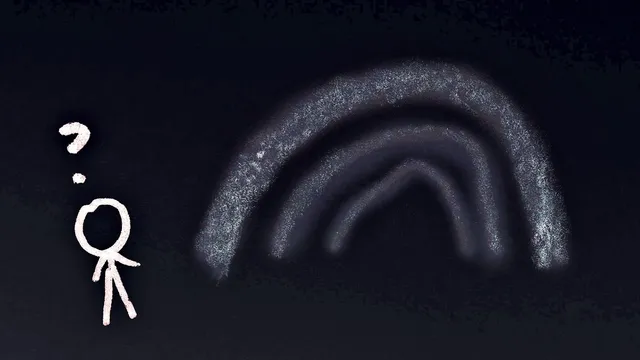
Diffraction and interference turn each droplet’s reflection into a pattern rather than a single bright angle. The situation is likened to shining light through a slit: waves passing different parts of an opening add and cancel, creating bright and dark regions. For a droplet, reflections from different parts of the droplet play the role of waves from different parts of a slit. Instead of one strong reflection near 140°, smaller droplets generate additional bright reflections at more extreme angles, which shows up as extra concentric rings inside the main rainbow.
Whether those rings remain visible depends on droplet size. For raindrops around a millimeter or larger, the diffraction pattern is so narrow that it’s effectively invisible, leaving the high-contrast rainbow people expect. When droplets shrink below about a millimeter, diffraction broadens the color-specific rings enough to create repeating inner arcs known as supernumerary bows. With even smaller droplets—down to a few hundredths of a millimeter, typical of fog—the rings broaden so much that different colors overlap heavily. Instead of distinct red, green, and blue components arriving at separate angles, they blur together and recombine into white light, the same way out-of-focus red, green, and blue images can merge into white.
A fog bow is therefore not a different phenomenon so much as a rainbow whose colors have been blurred out by diffraction from extremely small droplets. The result is a pale, ghostly arc that looks like a rainbow with its chromatic detail drained away.
Cornell Notes
Fog bows form when water droplets are extremely small, making diffraction strong enough to blur a rainbow’s separated colors. Ordinary rainbows rely on wavelength-dependent reflection angles inside larger raindrops, producing crisp rings. As droplet size decreases, interference turns each color’s reflection into a diffraction pattern with extra concentric rings (supernumerary bows). With droplets typical of fog (a few hundredths of a millimeter), those rings broaden and overlap across colors, so red, green, and blue effectively recombine into white light. The same physics explains why defocused RGB images can merge into white: wave blur erases the angular color separation.
What physical mechanism separates colors in a normal rainbow?
Why does diffraction become important for fog bows?
How do supernumerary bows relate to droplet size?
Why do fog bows look white rather than colored?
What slit-and-diffraction analogy helps explain the pattern?
Review Questions
- At what approximate viewing-angle relationship to the sun does redder versus bluer light appear in the rainbow geometry described?
- How does the diffraction pattern change as droplet size decreases from millimeter-scale raindrops to fog droplets?
- Why do supernumerary bows appear before the rainbow fully turns white?
Key Points
- 1
Fog bows are rainbows whose colors blur together because the droplets are far smaller than typical raindrops, strengthening diffraction.
- 2
Ordinary rainbows form from wavelength-dependent reflection angles inside droplets, with strongest reflection near about 140° and blue bending more than red.
- 3
Wave interference turns a droplet’s reflection into a diffraction pattern, producing extra bright reflections at more extreme angles.
- 4
For millimeter-scale raindrops, diffraction is so narrow that it’s essentially absent, yielding crisp, high-contrast rainbows.
- 5
For sub-millimeter droplets, diffraction creates visible concentric inner arcs called supernumerary bows.
- 6
For fog-scale droplets (a few hundredths of a millimeter), diffraction broadens each color’s contribution until different colors overlap and recombine into white light.