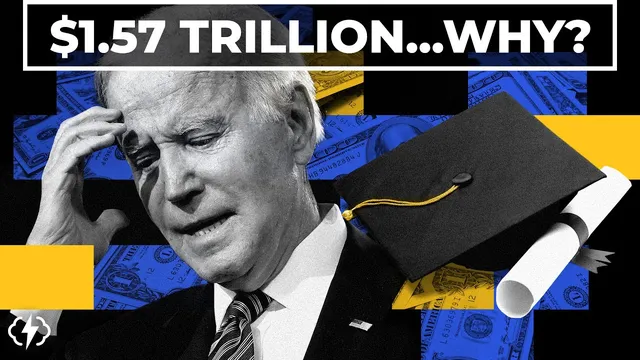
Why Student Debt Is So Hard to Forgive
Based on Second Thought's video on YouTube. If you like this content, support the original creators by watching, liking and subscribing to their content.
Student debt is framed as part of a broader debt-and-control system, not merely a result of rising tuition costs.
Briefing
Student debt is so hard to forgive because it isn’t just a financial problem—it’s built into a broader system where debt helps legitimize coercion and sustain control. The argument ties modern lending to a long-running relationship between money, domination, and violence, suggesting that forgiving student loans would threaten the economic and political machinery that keeps debt functioning.
The discussion starts with a familiar explanation—college costs rising faster than inflation and a growing student population pushing more borrowers into the system—but quickly widens the lens. Debt, it argues, has a much older role than tuition policy. Drawing on anthropologist David Graeber’s work, the transcript frames early economic relationships as often rooted in debt rather than barter, with money emerging when trust-based IOUs weren’t enough—especially in contexts tied to war. In that view, coinage and state-backed currency develop alongside military needs: states borrow, pay soldiers, and expand through conquest, using debt to bind conquered populations through taxation, forced labor, and slavery-like arrangements. The key takeaway is that debt scales up only when violence can back it, and the side capable of force benefits.
The transcript then connects that historical logic to the present. National debt, it notes, is intertwined with past wars and ongoing military spending, while “debt traps” in parts of Africa and Latin America are portrayed as mechanisms that channel resources and production toward wealthy countries and domestic elites. The same pattern is said to echo in student lending: when repayment becomes structurally difficult—because tuition keeps rising or graduates’ wages don’t keep pace—pressure intensifies rather than disappears.
Sociologist Maurizio Lazzarato’s contribution is used to describe how debt spreads beyond trade and war into everyday life. Mortgages, car loans, credit cards, rent arrangements, and student loans all become milestones gated behind contracts. The result is “predatory inclusion”: people can participate in normal life, but only by accepting a continuing obligation to pay. If borrowers fall behind, the transcript emphasizes that enforcement can involve police, threats of destitution, and the moral framing that treats nonpayment as personal failure.
That moral framing is presented as politically useful. Governments, the argument goes, can pin coercion on debt and on borrowers’ presumed wrongdoing, making it easier to maintain pressure than to wield force openly. In this structure, student debt is “too good to give up” because it provides legitimacy for the violence required to keep the system running.
The closing challenge is practical and confrontational: if large numbers of indebted Americans refused repayment, would the state really arrest and imprison millions? The transcript answers by pointing to the fact that debt cancellation is legally and administratively possible—at least in principle—yet remains politically blocked. The core claim is that the system’s design, not borrowers’ individual choices or financial literacy, is what makes student debt so resistant to forgiveness.
Cornell Notes
The transcript argues that student debt is difficult to forgive because debt functions as a tool of domination backed by state power and, ultimately, violence. Using David Graeber’s account of how money and debt grew alongside war, it links the scaling of debt to coercive capacity rather than to purely voluntary exchange. It then draws on Maurizio Lazzarato to show how debt spreads into everyday life—mortgages, credit cards, rent, and student loans—creating “predatory inclusion” where people can access normal opportunities only by accepting ongoing repayment pressure. When repayment becomes unmanageable, enforcement and moral blame intensify, making cancellation politically hard. The implication is that reform must confront the structural role of debt, not just individual borrower behavior.
Why does the transcript treat student debt as more than a tuition-cost problem?
How does David Graeber’s “military coinage slavery complex” relate to modern lending?
What does the transcript mean by “predatory inclusion”?
Why does the transcript say debt cancellation is politically difficult?
What role does violence play in the transcript’s explanation of debt?
What is the transcript’s proposed test of the system’s power?
Review Questions
- How does the transcript connect the emergence of money to war, and why does that matter for understanding student debt today?
- What mechanisms does the transcript use to explain why borrowers face both moral blame and coercive enforcement?
- According to the transcript, what changes if student debt is treated as a structural system rather than an individual financial decision?
Key Points
- 1
Student debt is framed as part of a broader debt-and-control system, not merely a result of rising tuition costs.
- 2
Debt is portrayed as historically linked to war and conquest, with money and state power emerging to manage large-scale obligations.
- 3
Large-scale debt growth is said to require coercive capacity; repayment enforcement is treated as structurally backed by violence.
- 4
Debt is described as spreading into everyday life through mortgages, credit cards, and loans, creating “predatory inclusion.”
- 5
When repayment becomes unmanageable, enforcement and moral blame intensify rather than the system loosening.
- 6
The transcript argues governments find it easier to justify coercion through contract morality and debt narratives than through direct force.
- 7
The transcript claims debt cancellation is administratively possible, but political incentives keep the system intact.