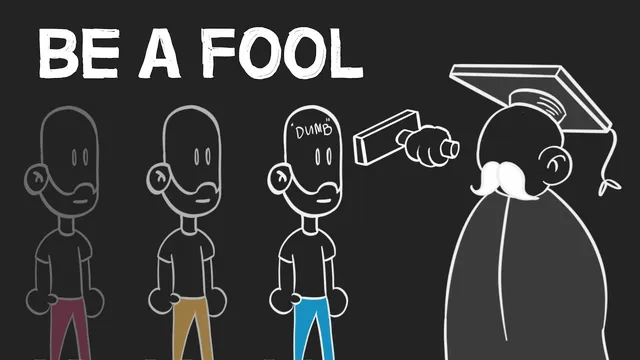
Why Stupidity is Power | Priceless Benefits of Being Stupid
Based on Einzelgänger's video on YouTube. If you like this content, support the original creators by watching, liking and subscribing to their content.
Underestimation can create leverage: people may overshare and treat someone as non-threatening when they assume low competence.
Briefing
Being seen as “stupid” can be a strategic advantage—because it lowers other people’s expectations, reduces the pressure to perform, and can even unlock better thinking. The core claim is that the social fear of looking dumb often distracts people from what actually helps them, while a willingness to be underestimated can create room to learn, maneuver, and avoid unnecessary burdens.
A central thread runs through the argument: people obsess over how others judge them, and that vanity can distort priorities. Schopenhauer’s warning—people chase approval even though other people’s opinions aren’t essential to happiness—frames the idea that the “fool” role can be liberating. When others don’t rate someone as competent, they tend to guard less, overshare, and treat the person as non-threatening. The transcript uses Sun Tzu’s logic from The Art of War—appearing weaker than you are to gain advantage—to suggest that acting dumb can function similarly, as long as it doesn’t cross into harmful manipulation.
Examples sharpen the point. Yoda in Star Wars is presented as a case of deliberate “fool” behavior: an apparently primitive, curious figure living in obscurity whose performance helps reveal Luke Skywalker’s character and morals. The same underestimation dynamic is extended to social norms. In Japan, strict etiquette and conformity create anxiety about standing out; during COVID, many people continued wearing masks even after they were no longer required to avoid disapproval. Yet foreigners are often forgiven for not conforming because they’re assumed to be unaware of local conventions. By analogy, the fool “gets a pass” more easily than the smart person—often because the perceived mistake is interpreted as ignorance rather than intent.
A second major benefit is cognitive. Expertise can narrow perspective, making experienced people unable to anticipate novice errors or imagine solutions from a beginner’s standpoint. The transcript cites Psychology Today and senior scientist Gary Klein, who describes an experienced petrochemical employee who couldn’t picture the kinds of mistakes novices would make—despite being responsible for training them. Klein’s takeaway is that dialing back knowledge to see the world through a beginner’s eyes takes special skill, but it can prevent errors and generate better training and design.
That beginner perspective also supports simplification. The argument links “complexity bias”—a tendency to prefer complicated explanations—to the idea that being “stupid” in the sense of stripping away non-essential details can make problems clearer. Looking at smartphone use for elderly generations is offered as a practical example: helping requires temporarily letting go of technical assumptions.
Finally, the transcript argues that being considered useless can reduce stress. If others underestimate someone, they may assign fewer responsibilities and obligations, sparing the person from burnout. A Taoist story about Zhuangzi’s crooked tree illustrates how “uselessness” can preserve life: woodcutters ignore the crooked tree because it doesn’t fit their needs, allowing it to survive and grow.
The most provocative turn comes with Matthijs van Boxsel, a Dutch historian who frames stupidity as a driver of intelligence and civilization. Human irrationality—ideologies, pride, and even nuclear brinkmanship—creates existential threats that force societies to develop smarter ways to manage risk, including efforts to ban weapons of mass destruction. In that view, stupidity isn’t just a personal liability; it becomes the pressure that pushes humanity toward progress.
Cornell Notes
The transcript argues that being perceived as stupid can deliver real advantages: people underestimate you, lower their guard, and may overshare, which can create strategic opportunities. Acting or thinking from a “beginner” perspective can also improve problem-solving, training, and simplification—especially when expertise narrows what someone can imagine. Being treated as useless can reduce responsibility and stress, echoing Taoist ideas that “crooked” or “unproductive” things survive because they’re ignored. At the societal level, Matthijs van Boxsel claims human stupidity is paradoxically tied to the development of intelligence and civilization, since irrational threats force better thinking and risk management.
How can appearing “weak” or “foolish” become a strategic advantage in social settings?
Why does the transcript say expertise can be a trap for learning and safety?
What role does “complexity bias” play in the benefits of being “stupid”?
How does the idea of being considered useless reduce stress, according to the transcript?
What is the transcript’s most paradoxical claim about stupidity and civilization?
Review Questions
- Where does underestimation help most: information gathering, reduced competition, or reduced responsibility—and what evidence is given for each?
- What does Gary Klein’s petrochemical example suggest about the relationship between expertise and the ability to train novices?
- How do the crooked tree story and Schopenhauer’s quote support the claim that social approval is not essential for happiness?
Key Points
- 1
Underestimation can create leverage: people may overshare and treat someone as non-threatening when they assume low competence.
- 2
Acting “foolish” can reveal character traits, but it can also become unethical if used to harm others.
- 3
Expertise can narrow perspective, making it harder to anticipate novice mistakes and design effective training.
- 4
Adopting a beginner’s viewpoint can generate better solutions and help simplify problems by removing non-essential complexity.
- 5
Being treated as “useless” can reduce stress by lowering expectations and responsibility assignments.
- 6
Taoist and Schopenhauer themes converge on the idea that other people’s opinions matter less for well-being than social pressure suggests.
- 7
At a societal scale, human irrationality may force the development of intelligence and risk-management strategies, including efforts to prevent catastrophic weapons use.