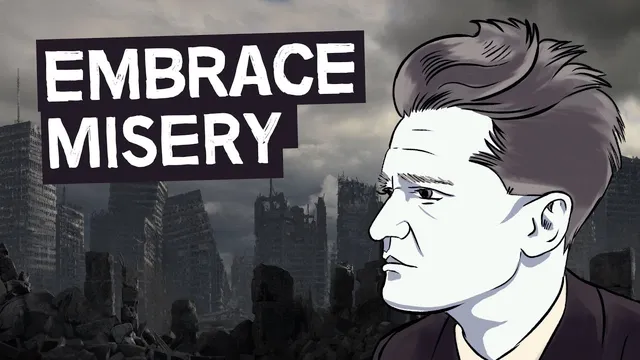
Why Suffering is Beautiful | Emil Cioran’s Dark Philosophy
Based on Einzelgänger's video on YouTube. If you like this content, support the original creators by watching, liking and subscribing to their content.
Cioran treats suffering as a central truth of human existence rather than something to conceal behind institutions or daily denial.
Briefing
Emil Cioran’s dark philosophy treats suffering not as a problem to hide, but as the most honest route to understanding life. In a world that builds thick walls around illness and erases death from everyday conversation, Cioran insists that misery, pain, and despair belong at the center of thought. His writings make despair feel less like a detour from existence and more like a core feature of being human—so confronting it becomes a form of clarity rather than a failure of character.
Cioran’s starting point is a suspicion of “superficial intellectual games” and of the systems people use to keep existential dread at arm’s length. He portrays writing as a kind of temporary salvation—“Creativity is a temporary salvation from the claws of death”—and even credits his early book, On the Heights of Despair, with saving his life. The paradox of his public cheerfulness only sharpens the claim: taking despair seriously can coexist with a fierce appreciation for life, because the refusal to look away is what makes experience feel real.
That refusal also reshapes the pursuit of happiness. Cioran argues that happiness is fleeting and therefore superficial, acting like a thin veil over the uglier truths people won’t face. To chase happiness—through accomplishments, entertainment, shopping, vacations—is to run on a hamster wheel, constantly distracting oneself from the inescapable darker aspects of existence. More broadly, he criticizes the large coping structures humans build to soften suffering: religion, moral and ethical systems, and even philosophy. These frameworks often claim that pain has meaning (“God has meant it to be this way,” “Everything happens for a reason”) or try to regulate emotion so people can “live at life’s normal temperature.”
Cioran’s most radical target is the idea that life contains intrinsic meaning. Life, he says, is an “irreversible question mark,” and the universe’s silence is the only truth. Meaning-seeking becomes futile because any answers are likely human fabrication—an attempt to fill a gap where the cosmos offers none. This worldview aligns with Absurdism associated with Albert Camus: humans hunger for meaning even though life appears useless. Yet Cioran’s conclusion is not suicide; it is a reason to live—“the only one”—by embracing the absurd without consolation.
In that embrace, despair becomes profound rather than merely depressing. Cioran does not offer a system to escape it; he treats agony as revealing, something that teaches people about themselves and, by extension, about others. His writing lingers on the idea that if suffering were fully visible—if a face could adequately express inner agony—communication itself would become impossible, because the truth would be too overwhelming to look at. The result is a philosophy that doesn’t romanticize pain as pleasure, but does insist that daring to see suffering clearly may be the closest thing to honesty about what it means to be alive.
Cornell Notes
Emil Cioran argues that suffering is not an obstacle to be managed with comforting stories, but a central truth about human existence. He criticizes the pursuit of happiness as a distraction and attacks the structures people use to avoid despair—religion, ethics, and even philosophy—because they often assign meaning to pain or try to regulate emotion. Cioran also rejects intrinsic meaning in life, treating the universe’s silence as the only truth and calling meaning-seeking futile. Despite the nihilistic implications, he frames despair as profoundly instructive and even life-saving, with writing serving as a “temporary salvation” from death. The practical takeaway is that confronting suffering directly can produce clarity rather than collapse.
Why does Cioran treat happiness as a dead-end rather than a goal?
What coping structures does Cioran reject, and what do they have in common?
How does Cioran connect despair to creativity and survival?
What does Cioran mean by life being an “irreversible question mark”?
How does Cioran’s nihilism differ from despair that leads to wanting to die?
What is the significance of Cioran’s image of suffering on the face?
Review Questions
- Which elements of Cioran’s critique target happiness-seeking behavior, and which target meaning-seeking behavior?
- How do Cioran’s objections to religion, ethics, and philosophy relate to his view of the universe’s silence?
- Why does Cioran treat despair as “profound” rather than merely harmful or pathological?
Key Points
- 1
Cioran treats suffering as a central truth of human existence rather than something to conceal behind institutions or daily denial.
- 2
The pursuit of happiness functions mainly as distraction because happiness is fleeting and repeatedly forces people back onto a cycle of avoidance.
- 3
Religion, moral systems, and philosophy are criticized for assigning meaning to pain or regulating emotion to keep life at a manageable “normal temperature.”
- 4
Cioran rejects intrinsic meaning in life, framing existence as an “irreversible question mark” answered only by the universe’s silence.
- 5
Absurdism overlaps with Cioran’s view that humans seek meaning despite life’s apparent uselessness, but Cioran emphasizes living with that silence rather than escaping it.
- 6
Despair is portrayed as profoundly instructive: confronting it teaches people about themselves and others, even without a system for relief.
- 7
Writing is presented as a cathartic and life-saving practice—“Creativity is a temporary salvation from the claws of death.”